
Ch 36: Diffraction
Young & Freedman Calc - University Physics 14th Edition
Young & Freedman Calc14th EditionUniversity PhysicsISBN: 9780321973610Non è quello che usi tu?Cambia libro di testo
Capitolo 36, Problema 30

A laser beam of wavelength λ = 632.8 nm shines at normal incidence on the reflective side of a compact disc. (a) The tracks of tiny pits in which information is coded onto the CD are 1.60 μm apart. For what angles of reflection (measured from the normal) will the intensity of light be maximum? (b) On a DVD, the tracks are only 0.740 μm apart. Repeat the calculation of part (a) for the DVD.

Guida verificata passo dopo passo
1
Step 1: Recognize that this problem involves diffraction and interference of light. The condition for maximum intensity (constructive interference) is given by the diffraction grating equation: d⁢sin⁢θ=m⁢λ, where d is the spacing between the tracks, θ is the angle of reflection, m is the order of the maximum (an integer), and λ is the wavelength of the light.
Step 2: For part (a), substitute the given values for the CD: d=1.60⁢mm=1.60⁢10⁢-3m and λ=632.8⁢nm=632.8⁢10⁢-9m. Rearrange the diffraction equation to solve for θ: sin⁢θ=md⁢λ. Calculate θ for different integer values of m (starting from m=1) until sin⁢θ exceeds 1, which is physically impossible.
Step 3: For part (b), repeat the same process for the DVD. Substitute the given values: d=0.740⁢μm=0.740⁢10⁢-6m and λ=632.8⁢nm=632.8⁢10⁢-9m. Use the same diffraction equation to calculate θ for different values of m.
Step 4: For both parts (a) and (b), ensure that the calculated angles θ are measured from the normal (perpendicular to the surface). Note that the maximum order m is limited by the condition sin⁢θ≤1.
Step 5: Summarize the results by listing the angles of reflection θ for each order m for both the CD and DVD. These angles correspond to the directions where the intensity of the reflected light is maximum due to constructive interference.

Risposta video verificata per un problema simile:

Questa soluzione video è stata consigliata dai nostri tutor come utile per risolvere questo problema.
Durata del video:
11m

Concetti chiave

Ecco i concetti essenziali che devi comprendere per rispondere correttamente alla domanda.

Interference of Light

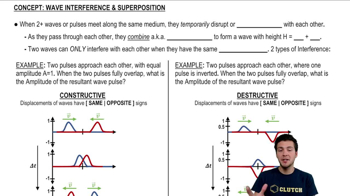
Interference occurs when two or more light waves overlap, resulting in a new wave pattern. Constructive interference happens when the waves are in phase, leading to increased intensity, while destructive interference occurs when they are out of phase, reducing intensity. This principle is crucial for understanding how light behaves when reflecting off surfaces with periodic structures, such as the pits on a CD or DVD.
Video consigliato:
Percorso guidato
03:47
Wave Interference & Superposition

Bragg's Law

Bragg's Law relates the angle of incidence and the wavelength of light to the spacing of the tracks on a reflective surface. It is expressed as nλ = 2d sin(θ), where n is an integer (order of reflection), λ is the wavelength, d is the distance between tracks, and θ is the angle of reflection. This law helps determine the angles at which constructive interference occurs, leading to maximum intensity.
Video consigliato:

Wavelength and Frequency

The wavelength of light is the distance between successive peaks of a wave, and it is inversely related to frequency. In the context of the problem, the wavelength of the laser light (632.8 nm) is essential for calculating the angles of reflection using Bragg's Law. Understanding the relationship between wavelength and frequency is vital for analyzing how light interacts with the periodic structures on CDs and DVDs.
Video consigliato:
Percorso guidato
05:08
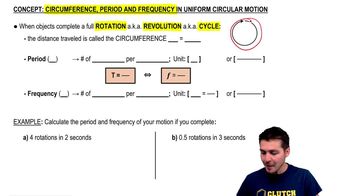
Circumference, Period, and Frequency in UCM
Pratica correlata
Domanda del libro di testo

The wavelength range of the visible spectrum is approximately 380–750 nm. White light falls at normal incidence on a diffraction grating that has 350 slits/mm. Find the angular width of the visible spectrum in the first order.

318
views
Domanda del libro di testo

If the planes of a crystal are 3.50 Å (1 Å = 10-10 m = 1 Ångstrom unit) apart, what wavelength of electromagnetic waves is needed so that the first strong interference maximum in the Bragg reflection occurs when the waves strike the planes at an angle of 22.0°, and in what part of the electromagnetic spectrum do these waves lie?

1729
views
Domanda del libro di testo

Two satellites at an altitude of 1200 km are separated by 28 km. If they broadcast 3.6 cm microwaves, what minimum receiving-dish diameter is needed to resolve (by Rayleigh’s criterion) the two transmissions?

1507
views
Domanda del libro di testo

If a diffraction grating produces a third-order bright spot for red light (of wavelength 700 nm) at 65.0° from the central maximum, at what angle will the second-order bright spot be for violet light (of wavelength 400 nm)?

328
views
Domanda del libro di testo

If you can read the bottom row of your doctor’s eye chart, your eye has a resolving power of 1 arcminute, equal to 1/60 degree. If this resolving power is diffraction-limited, to what effective diameter of your eye’s optical system does this correspond? Use Rayleigh’s criterion and assume λ = 550 nm.

59
views
Domanda del libro di testo

(a) What is the wavelength of light that is deviated in the first order through an angle of 13.5° by a transmission grating having 5000 slits/cm? (b) What is the second-order deviation of this wavelength? Assume normal incidence.

287
views