
Ch 35: Interference
Young & Freedman Calc - University Physics 14th Edition
Young & Freedman Calc14th EditionUniversity PhysicsISBN: 9780321973610Non è quello che usi tu?Cambia libro di testo
Capitolo 35, Problema 4b

Two radio antennas A and B radiate in phase. Antenna B is 120 m to the right of antenna A. Consider point Q along the extension of the line connecting the antennas, a horizontal distance of 40 m to the right of antenna B. The frequency, and hence the wavelength, of the emitted waves can be varied. What is the longest wavelength for which there will be constructive interference at point Q?

Guida verificata passo dopo passo
1
Determine the condition for constructive interference: Constructive interference occurs when the path difference between the waves from the two antennas is an integer multiple of the wavelength, i.e., \( \Delta d = m \lambda \), where \( m \) is an integer (0, 1, 2, ...).
Calculate the path difference \( \Delta d \): The distance from antenna A to point Q is \( 120 + 40 = 160 \ \text{m} \), and the distance from antenna B to point Q is \( 40 \ \text{m} \). Thus, the path difference is \( \Delta d = 160 - 40 = 120 \ \text{m} \).
Set the path difference equal to an integer multiple of the wavelength: For constructive interference, \( \Delta d = m \lambda \). Substituting \( \Delta d = 120 \ \text{m} \), we get \( 120 = m \lambda \).
Find the longest wavelength: The longest wavelength corresponds to the smallest integer value of \( m \), which is \( m = 1 \). Substituting \( m = 1 \) into \( 120 = m \lambda \), we find \( \lambda = 120 \ \text{m} \).
Conclude the result: The longest wavelength for which there will be constructive interference at point Q is \( \lambda = 120 \ \text{m} \).

Risposta video verificata per un problema simile:

Questa soluzione video è stata consigliata dai nostri tutor come utile per risolvere questo problema.
Durata del video:
8m

Concetti chiave

Ecco i concetti essenziali che devi comprendere per rispondere correttamente alla domanda.

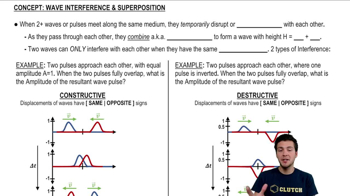
Constructive Interference

Constructive interference occurs when two or more waves meet in phase, meaning their peaks and troughs align. This alignment results in a wave of greater amplitude, enhancing the overall signal. For constructive interference to happen, the path difference between the waves arriving at a point must be an integer multiple of the wavelength.
Video consigliato:
Percorso guidato
03:47
Wave Interference & Superposition

Path Difference

Path difference refers to the difference in distance traveled by two waves from their sources to a specific point. In the context of interference, it is crucial to determine whether this difference leads to constructive or destructive interference. For constructive interference, the path difference must equal nλ, where n is an integer and λ is the wavelength.
Video consigliato:

Wavelength

Wavelength is the distance between successive peaks (or troughs) of a wave, typically denoted by the symbol λ. It is inversely related to frequency; as frequency increases, wavelength decreases. In the context of radio waves, varying the wavelength affects the conditions for interference, including the longest wavelength that allows for constructive interference at a given point.
Video consigliato:
Percorso guidato
05:42
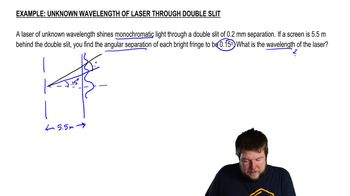
Unknown Wavelength of Laser through Double Slit
Pratica correlata
Domanda del libro di testo

Two speakers that are 15.0 m apart produce in-phase sound waves of frequency 250.0 Hz in a room where the speed of sound is 340.0 m/s. A woman starts out at the midpoint between the two speakers. The room's walls and ceiling are covered with absorbers to eliminate reflections, and she listens with only one ear for best precision. What does she hear: constructive or destructive interference? Why?

2078
views
Domanda del libro di testo

Two slits spaced 0.450 mm apart are placed 75.0 cm from a screen. What is the distance between the second and third dark lines of the interference pattern on the screen when the slits are illuminated with coherent light with a wavelength of 500 nm?

1669
views
Domanda del libro di testo

Two speakers, emitting identical sound waves of wavelength 2.0 m in phase with each other, and an observer are located as shown in Fig. E35.5. At the observer's location, what is the path difference for waves from the two speakers?

4449
views
1
rank
Domanda del libro di testo

Coherent light with wavelength 450 nm falls on a pair of slits. On a screen 1.80 m away, the distance between dark fringes is 3.90 mm. What is the slit separation?

2223
views
Domanda del libro di testo

Two speakers that are 15.0 m apart produce in-phase sound waves of frequency 250.0 Hz in a room where the speed of sound is 340.0 m/s. A woman starts out at the midpoint between the two speakers. The room's walls and ceiling are covered with absorbers to eliminate reflections, and she listens with only one ear for best precision. How far from the center must she walk before she first hears the sound maximally enhanced?

1784
views
Domanda del libro di testo

Two radio antennas A and B radiate in phase. Antenna B is 120 m to the right of antenna A. Consider point Q along the extension of the line connecting the antennas, a horizontal distance of 40 m to the right of antenna B. The frequency, and hence the wavelength, of the emitted waves can be varied. What is the longest wavelength for which there will be destructive interference at point Q?

2401
views
1
rank