
Ch 37: Special Relativity
Young & Freedman Calc - University Physics 14th Edition
Young & Freedman Calc14th EditionUniversity PhysicsISBN: 9780321973610Non è quello che usi tu?Cambia libro di testo
Capitolo 37, Problema 39a

Compute the kinetic energy of a proton (mass 1.67×10−271.67\(\times\)10^{-27} kg) using both the nonrelativistic and relativistic expressions, and compute the ratio of the two results (relativistic divided by nonrelativistic) for speeds of (a) 8.00×1078.00\(\times\)10^7 m/s and (b) 2.85×1082.85\(\times\)10^8 m/s.

Guida verificata passo dopo passo
1
Step 1: Understand the concept of kinetic energy. Kinetic energy is the energy that an object possesses due to its motion. The nonrelativistic kinetic energy (KE) is given by the formula: KE=12mv2, where m is the mass and v is the velocity.
Step 2: Calculate the nonrelativistic kinetic energy for the proton at speed (a) 8.00 * 10^7 m/s. Use the formula: KE=12mv2. Substitute m=1.67×10⁻²⁷ kg and v=8.00×10⁷ m/s.
Step 3: Calculate the relativistic kinetic energy using the formula: KE=mc(2)(1-v2c2-1), where c is the speed of light (3.00×10⁸ m/s). Substitute the values for m and v as in Step 2.
Step 4: Repeat Steps 2 and 3 for speed (b) 2.85 * 10^8 m/s. Substitute v=2.85×10⁸ m/s into both the nonrelativistic and relativistic kinetic energy formulas.
Step 5: Compute the ratio of the relativistic kinetic energy to the nonrelativistic kinetic energy for both speeds (a) and (b). This involves dividing the relativistic result by the nonrelativistic result for each speed.

Risposta video verificata per un problema simile:

Questa soluzione video è stata consigliata dai nostri tutor come utile per risolvere questo problema.
Durata del video:
9m

Concetti chiave

Ecco i concetti essenziali che devi comprendere per rispondere correttamente alla domanda.

Kinetic Energy

Kinetic energy is the energy possessed by an object due to its motion, calculated using the formula KE = 0.5 * m * v^2 for nonrelativistic speeds. It is a measure of the work needed to accelerate an object from rest to its current velocity, and is dependent on both mass and velocity.
Video consigliato:
Percorso guidato
06:07
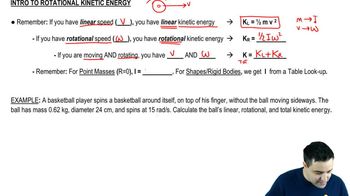
Intro to Rotational Kinetic Energy

Relativistic Kinetic Energy

Relativistic kinetic energy accounts for the effects of special relativity at high speeds, close to the speed of light. It is calculated using the formula KE = (γ - 1) * m * c^2, where γ is the Lorentz factor, m is mass, and c is the speed of light. This formula reflects how energy increases significantly as an object's speed approaches the speed of light.
Video consigliato:
Percorso guidato
06:07
Intro to Rotational Kinetic Energy

Lorentz Factor

The Lorentz factor, denoted as γ, is a crucial component in relativistic physics, defined as γ = 1 / sqrt(1 - v^2/c^2). It quantifies the amount of time dilation, length contraction, and relativistic mass increase experienced by an object moving at velocity v relative to the speed of light c. It becomes significant when v approaches c, affecting calculations of relativistic kinetic energy.
Video consigliato:
Percorso guidato
14:16
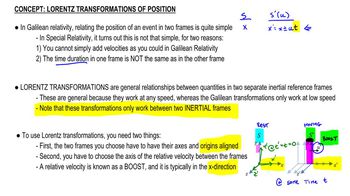
Lorentz Transformations of Position