Ch 38: Photons: Light Waves Behaving as Particles
Young & Freedman Calc - University Physics 14th Edition
Young & Freedman Calc14th EditionUniversity PhysicsISBN: 9780321973610Non è quello che usi tu?Cambia libro di testo
Capitolo 38, Problema 22a

An electron and a positron are moving toward each other and each has speed 0.500c0.500c in the lab frame. What is the kinetic energy of each particle?

Guida verificata passo dopo passo
1
Step 1: Recall the formula for relativistic kinetic energy, which is given by \( KE = (\gamma - 1)m c^2 \), where \( \gamma \) is the Lorentz factor, \( m \) is the rest mass of the particle, and \( c \) is the speed of light.
Step 2: Calculate the Lorentz factor \( \gamma \) using the formula \( \gamma = \frac{1}{\sqrt{1 - v^2/c^2}} \), where \( v = 0.500c \). Substitute \( v \) into the equation to find \( \gamma \).
Step 3: Use the rest mass of the electron (or positron), which is \( m = 9.11 \times 10^{-31} \; \text{kg} \), and the speed of light \( c = 3.00 \times 10^8 \; \text{m/s} \). Substitute these values into the kinetic energy formula along with the calculated \( \gamma \).
Step 4: Simplify the expression \( KE = (\gamma - 1)m c^2 \) by substituting the numerical values for \( \gamma \), \( m \), and \( c \). This will give the kinetic energy of one particle.
Step 5: Since the problem asks for the kinetic energy of each particle, note that the calculation is the same for both the electron and the positron because they have the same mass and speed. The result from Step 4 applies to both particles.

Risposta video verificata per un problema simile:

Questa soluzione video è stata consigliata dai nostri tutor come utile per risolvere questo problema.
Durata del video:
7m

Concetti chiave

Ecco i concetti essenziali che devi comprendere per rispondere correttamente alla domanda.

Relativistic Kinetic Energy

In relativistic physics, the kinetic energy of an object moving at a significant fraction of the speed of light (c) is given by the formula KE = (γ - 1)mc², where γ (gamma) is the Lorentz factor. The Lorentz factor accounts for time dilation and length contraction effects at high speeds, defined as γ = 1 / √(1 - v²/c²). This concept is crucial for accurately calculating the kinetic energy of particles like electrons and positrons moving at relativistic speeds.
Video consigliato:
Percorso guidato
06:07
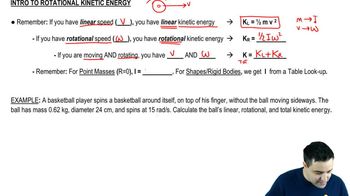
Intro to Rotational Kinetic Energy

Lorentz Factor

The Lorentz factor (γ) is a key component in the theory of special relativity, representing how much time, length, and relativistic mass increase as an object approaches the speed of light. It is calculated using the formula γ = 1 / √(1 - v²/c²), where v is the object's velocity and c is the speed of light. Understanding the Lorentz factor is essential for determining the relativistic effects on the kinetic energy of particles moving at high speeds.
Video consigliato:
Percorso guidato
14:16
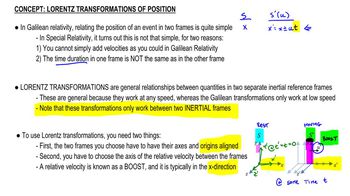
Lorentz Transformations of Position

Conservation of Energy

The principle of conservation of energy states that the total energy in a closed system remains constant over time. In the context of particle physics, this means that the kinetic energy of particles, such as electrons and positrons, must be accounted for when analyzing their interactions. This principle is fundamental when calculating the energies involved in particle collisions and transformations, ensuring that all forms of energy, including kinetic and rest mass energy, are considered.
Video consigliato:
Percorso guidato
06:24
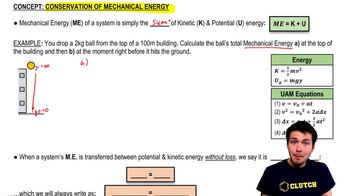
Conservation Of Mechanical Energy
Pratica correlata
Domanda del libro di testo

X rays with an initial wavelength of 0.900×10−100.900\(\times\)10^{-10} m undergo Compton scattering. For what scattering angle is the wavelength of the scattered x rays greater by 1.0%1.0\% than that of the incident x rays?

1236
views

Domanda del libro di testo

A photon scatters in the backward direction (ϕ=180\(\phi\)=180°) from a free proton that is initially at rest. What must the wavelength of the incident photon be if it is to undergo a 10.0%10.0\% change in wavelength as a result of the scattering?

1262
views
Domanda del libro di testo

A horizontal beam of laser light of wavelength 585585 nm passes through a narrow slit that has width 0.06200.0620 mm. The intensity of the light is measured on a vertical screen that is 2.002.00 m from the slit.

(a) What is the minimum uncertainty in the vertical component of the momentum of each photon in the beam after the photon has passed through the slit?

(b) Use the result of part (a) to estimate the width of the central diffraction maximum that is observed on the screen.

2888
views
2
rank
Domanda del libro di testo

X rays with initial wavelength 0.06650.0665 nm undergo Compton scattering. What is the longest wavelength found in the scattered x rays? At which scattering angle is this wavelength observed?

1704
views
Domanda del libro di testo

An ultrashort pulse has a duration of 9.009.00 fs and produces light at a wavelength of 556556 nm. What are the momentum and momentum uncertainty of a single photon in the pulse?

2294
views