Ch 40: Quantum Mechanics I: Wave Functions
Young & Freedman Calc - University Physics 14th Edition
Young & Freedman Calc14th EditionUniversity PhysicsISBN: 9780321973610Non è quello che usi tu?Cambia libro di testo
Capitolo 40, Problema 27

(a) An electron with initial kinetic energy 3232 eV encoun­ters a square barrier with height 4141 eV and width 0.250.25 nm. What is the probability that the electron will tunnel through the barrier?
(b) A proton with the same kinetic energy encounters the same barrier. What is the probability that the proton will tunnel through the barrier?

Guida verificata passo dopo passo
1
Step 1: Begin by understanding the concept of quantum tunneling. Quantum tunneling occurs when a particle passes through a potential barrier that it classically does not have enough energy to overcome. The probability of tunneling is determined using the Schrödinger equation and depends on the particle's mass, energy, and the barrier's properties.
Step 2: For part (a), calculate the wave number inside the barrier for the electron using the formula: k=2m(V-E)ħ², where m is the mass of the electron, V is the barrier height, E is the particle's energy, and ħ is the reduced Planck constant.
Step 3: Use the tunneling probability formula: P=e-(2ka), where a is the width of the barrier and k is the wave number calculated in Step 2. Substitute the values for the electron's mass, energy, barrier height, and width to find the tunneling probability.
Step 4: For part (b), repeat the process for the proton. Since the proton has a much larger mass than the electron, its wave number k will be different. Use the same formula for k and substitute the proton's mass instead of the electron's mass.
Step 5: Calculate the tunneling probability for the proton using the same formula: P=e-(2ka). Compare the probabilities for the electron and proton to understand the effect of mass on tunneling probability.

Risposta video verificata per un problema simile:

Questa soluzione video è stata consigliata dai nostri tutor come utile per risolvere questo problema.

Concetti chiave

Ecco i concetti essenziali che devi comprendere per rispondere correttamente alla domanda.

Quantum Tunneling

Quantum tunneling is a phenomenon in quantum mechanics where a particle has a probability of passing through a potential energy barrier, even if its energy is less than the height of the barrier. This occurs because particles exhibit wave-like properties, allowing them to exist in a superposition of states, which can lead to a non-zero probability of being found on the other side of the barrier.

Barrier Penetration Probability

The probability of a particle tunneling through a barrier can be calculated using the transmission coefficient, which depends on the height and width of the barrier as well as the energy of the particle. For a rectangular barrier, this probability decreases exponentially with increasing barrier height and width, making it less likely for particles with lower energy to tunnel through.
Video consigliato:
Percorso guidato
04:03
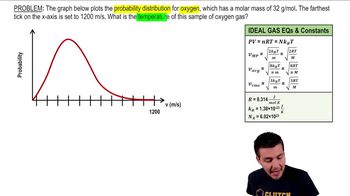
Probability Distribution Graph

Mass and Energy Relationship

In quantum mechanics, the mass of a particle affects its wave function and, consequently, its tunneling probability. Heavier particles, like protons, have a shorter wavelength compared to lighter particles, like electrons, which influences their ability to tunnel through barriers. This means that for the same kinetic energy, a proton will generally have a lower tunneling probability than an electron when encountering the same barrier.
Video consigliato:
Percorso guidato
03:43
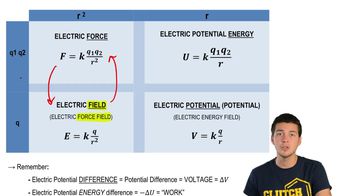
Relationships Between Force, Field, Energy, Potential
Pratica correlata
Domanda del libro di testo

An electron with initial kinetic energy 6.06.0 eV encounters a barrier with height 11.011.0 eV. What is the probability of tunneling if the width of the barrier is (a) 0.800.80 nm and (b) 0.40 0.40 nm?

45
views
Domanda del libro di testo

Recall that (∣ψ∣2)dx(|ψ|^2)dx is the probability of finding the par­ticle that has normalized wave function ψ(x)ψ(x) in the interval xx to x+dxx+dx. Consider a particle in a box with rigid walls at x=0x = 0 and x=Lx = L. Let the particle be in the ground level and use ψnψ_n as given in Eq. (40.3540.35) ψn(x)=2Lsin[(nπxL)]\(\psi\)_{n}(x)=\(\sqrt{\frac{2}{L}\)}sin[(\(\frac{n\pi x}{L}\))] where n=1,2,3,…n=1,2,3,\(\ldots\).

(a) For which values of xx, if any, in the range from 00 to LL is the probability of finding the particle zero?

(b) For which values of xx is the probability highest?

(c) In parts (a) and (b) are your answers consistent with Fig. 40.1240.12? Explain.

67
views
Domanda del libro di testo

(a) Find the excitation energy from the ground level to the third excited level for an electron confined to a box of width 0.3600.360 nm.

(b) The electron makes a transition from the n=1n = 1 to n=4n = 4 level by absorbing a photon. Calculate the wave­length of this photon.

80
views
Domanda del libro di testo

An electron is in a box of width 3.0×10−103.0\(\times\)10^{-10} m. What are the de Broglie wavelength and the magnitude of the momentum of the electron if it is in (a) the n=1n = 1 level; (b) the n=2n = 2 level; (c) the n=3n = 3 level? In each case how does the wavelength compare to the width of the box?

42
views
Domanda del libro di testo

An electron with initial kinetic energy 5.05.0 eV encoun­ters a barrier with height U0U_0 and width 0.600.60 nm. What is the transmission coefficient if (a) U0=7.0U_0 = 7.0 eV; (b) U0=9.0U_0 = 9.0 eV; (c) U0=13.0U_0 = 13.0 eV?

49
views
Domanda del libro di testo

While undergoing a transition from the n=1n = 1 to the n=2n = 2 energy level, a harmonic oscillator absorbs a photon of wavelength 6.506.50 μμm. What is the wavelength of the absorbed photon when this oscillator undergoes a transition (a) from the n=2n = 2 to the n=3n = 3 energy level and (b) from the n=1n = 1 to the n=3n =3 energy level?

(c) What is the value of (k′/m)\(\sqrt{(k^{\prime}\)/m)}, the angular oscillation frequency of the corresponding Newtonian oscillator?

55
views