
Ch 40: Quantum Mechanics I: Wave Functions
Young & Freedman Calc - University Physics 14th Edition
Young & Freedman Calc14th EditionUniversity PhysicsISBN: 9780321973610Non è quello che usi tu?Cambia libro di testo
Capitolo 40, Problema 4

A particle is described by a wave function ψ(x)=Ae−αx2\(\psi\)(x)=Ae^{-\(\alpha\) x^2}, where AA and αα are real, positive constants. If the value of αα is increased, what effect does this have on (a) the particle’s uncer­tainty in position and (b) the particle’s uncertainty in momentum? Explain your answers.

Guida verificata passo dopo passo
1
Step 1: Begin by understanding the wave function ψ(x) = A e^(-αx^2). This is a Gaussian wave function, which is commonly used in quantum mechanics to describe the probability amplitude of a particle's position. The parameter α determines the width of the Gaussian curve, and hence it is related to the spread of the particle's position.
Step 2: Recall the uncertainty principle, ΔxΔp ≥ ℏ/2, which states that the product of the uncertainties in position (Δx) and momentum (Δp) must be greater than or equal to ℏ/2. This principle will guide our analysis of how changes in α affect Δx and Δp.
Step 3: Analyze the effect of increasing α on the uncertainty in position (Δx). A larger α makes the Gaussian wave function narrower in position space, meaning the particle's position is more localized. Therefore, the uncertainty in position, Δx, decreases as α increases.
Step 4: Consider the relationship between position and momentum space. A narrower wave function in position space corresponds to a broader wave function in momentum space due to the Fourier transform relationship between the two. Thus, as α increases and Δx decreases, the uncertainty in momentum, Δp, increases.
Step 5: Conclude that increasing α decreases the uncertainty in position (Δx) while increasing the uncertainty in momentum (Δp). This behavior is consistent with the uncertainty principle, ΔxΔp ≥ ℏ/2, which remains satisfied throughout.

Risposta video verificata per un problema simile:

Questa soluzione video è stata consigliata dai nostri tutor come utile per risolvere questo problema.

Concetti chiave

Ecco i concetti essenziali che devi comprendere per rispondere correttamente alla domanda.

Wave Function and Probability Density

In quantum mechanics, a wave function, denoted as ψ(x), describes the quantum state of a particle. The square of the absolute value of the wave function, |ψ(x)|², gives the probability density of finding the particle at position x. This concept is fundamental for understanding how the behavior of particles is probabilistic rather than deterministic.
Video consigliato:
Percorso guidato
08:30
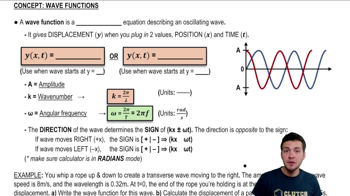
Intro to Wave Functions

Uncertainty Principle

The Heisenberg Uncertainty Principle states that there is a fundamental limit to the precision with which certain pairs of physical properties, such as position and momentum, can be known simultaneously. Specifically, increasing the certainty in position (decreasing uncertainty in position) leads to an increase in uncertainty in momentum, and vice versa. This principle is crucial for analyzing the effects of changes in the wave function.
Video consigliato:
Percorso guidato
14:47
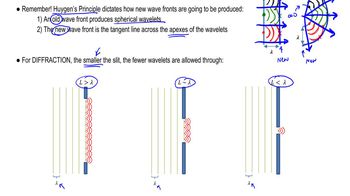
Diffraction with Huygen's Principle

Gaussian Wave Packets

The given wave function ψ(x) = Ae^(-αx^2) represents a Gaussian wave packet, which is characterized by its bell-shaped curve. The parameter α controls the width of the wave packet; increasing α results in a narrower wave function, which implies a more localized particle position. This localization leads to a corresponding increase in the uncertainty of momentum, illustrating the trade-off described by the Uncertainty Principle.
Video consigliato:
Percorso guidato
07:19
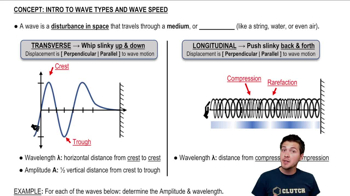
Intro to Waves and Wave Speed
Pratica correlata
Domanda del libro di testo

An electron is moving as a free particle in the −x-x-direction with momentum that has magnitude 4.50×10−244.50\(\times\)10^{-24} kg*m/s. Let k2=3k1=3kk_2 = 3k_1 = 3k. At t=0 t = 0, the probability distribution func­tion ∣Ψ(x,t)∣2|Ψ(x, t)|^2 has a maximum at x=0x = 0.

(a) What is the smallest positive value of xx for which the probability distribution function has a maximum at time t=2πωt=\(\frac{2\pi}{\omega}\), where ω=hk2/2mω = hk^2/2m?

(b) From your result in part (a), what is the average speed with which the probability distribution is moving in the +x+x­-direction?

44
views
Domanda del libro di testo

Let ψ1ψ_1 and ψ2ψ_2 be two solutions of Eq. (40.2340.23) [−h22md2ψ(x)dx2+U(x)ψ(x)=Eψ(x)-\(\frac{h^2}{2m}\)\(\frac{d^2\psi(x)}{dx^2}\)+U\(\left\)(x\(\right\))\(\psi\[\left\)(x\(\right\))=E\(\psi\]\left\)(x\(\right\))] with energies E1E_1 and E2E_2 respectively, where E1≠E2E_1≠E_2. Is ψ=Aψ1+Bψ2ψ = Aψ_1 + Bψ_2, where AA and BB are nonzero constants, a solution to Eq. (40.2340.23)? Explain your answer.

63
views
Domanda del libro di testo

An electron is moving as a free particle in the −x-x-direction with momentum that has magnitude 4.50×10−244.50\(\times\)10^{-24} kg-m/s. What is the one-­dimensional time-­dependent wave function of the electron?

399
views
Domanda del libro di testo

(a) Find the lowest energy level for a particle in a box if the particle is a billiard ball (m=0.20m = 0.20 kg) and the box has a width of 1.31.3 m, the size of a billiard table. (Assume that the billiard ball slides without friction rather than rolls; that is, ignore the rotational kinetic energy.)

(b) Since the energy in part (a) is all kinetic, to what speed does this correspond? How much time would it take at this speed for the ball to move from one side of the table to the other?

44
views
Domanda del libro di testo

Consider a wave function given by ψ(x)=Asinkxψ(x) = A sinkx, where k=2π/λ k = 2π/λ and AA is a real constant.

(a) For what values of xx is there the highest probability of finding the particle described by this wave function? Explain.

(b) For which values of xx is the probability zero? Explain.

36
views
Domanda del libro di testo

A free particle moving in one dimension has wave function ψ(x,t)=A[ei(kx−ωt)−ei(2kx−4ωt)]\(\psi\)(x,t)=A[e^{i\(\left\)(kx-\(\omega\) t\(\right\))}-e^{i(2kx-4\(\omega\) t)}] where kk and vv are positive real constants.

(a) At t=0 t = 0, what are the two smallest positive values of xx for which the probability function ∣ψ(x,t)∣2 |ψ(x,t)|^2 is a maximum?

(b) Repeat part (a) for time t=2πωt=\(\frac{2\pi}{\omega}\).

78
views