Domanda del libro di testo
How many times does a human heart beat during a person's lifetime? How many gallons of blood does it pump?
1521
views

 Young & Freedman Calc 15th EditionCh 01: Units, Physical Quantities & VectorsProblema 22a
 Guida verificata passo dopo passo
 07:30
07:30
 03:59
03:59 04:54
04:54How many times does a human heart beat during a person's lifetime? How many gallons of blood does it pump?
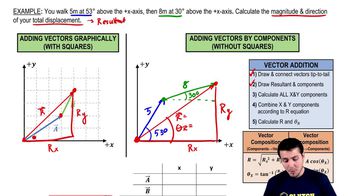
For the vectors A and B in Fig. E1.24, use a scale drawing to find the magnitude and direction of the vector difference A − B.
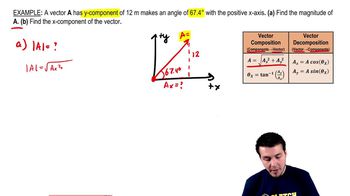
Let θ be the angle that the vector A makes with the +x-axis, measured counterclockwise from that axis. Find angle θ for a vector that has these components: Ax = 2.00m, Ay = −1.00 m
You are using water to dilute small amounts of chemicals in the laboratory, drop by drop. How many drops of water are in a 1.0-L bottle?
A spelunker is surveying a cave. She follows a passage 180 m straight west, then 210 m in a direction 45° east of south, and then 280 m at 30° east of north. After a fourth displacement, she finds herself back where she started. Use a scale drawing to determine the magnitude and direction of the fourth displacement.
Four astronauts are in a spherical space station. If, as is typical, each of them breathes about 500 cm3 of air with each breath, approximately what volume of air (in cubic meters) do these astronauts breathe in a year?