Ch 02: Motion Along a Straight Line
Young & Freedman Calc - University Physics 15th Edition
Young & Freedman Calc15th EditionUniversity PhysicsISBN: 9780135159552Non è quello che usi tu?Cambia libro di testo
Capitolo 2, Problema 38b

A brick is dropped (zero initial speed) from the roof of a building. The brick strikes the ground in 1.901.90 s. You may ignore air resistance, so the brick is in free fall. What is the magnitude of the brick's velocity just before it reaches the ground?

Guida verificata passo dopo passo
1
Identify the known values: The initial velocity \( v_0 \) is 0 m/s, the time \( t \) is 1.90 s, and the acceleration due to gravity \( g \) is approximately 9.81 m/s².
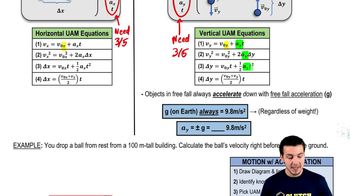
Use the kinematic equation for velocity in free fall: \( v = v_0 + gt \). Since the initial velocity \( v_0 \) is zero, the equation simplifies to \( v = gt \).
Substitute the known values into the equation: \( v = 9.81 \text{ m/s}^2 \times 1.90 \text{ s} \).
Calculate the product of the acceleration due to gravity and the time to find the magnitude of the velocity just before the brick hits the ground.
The result from the calculation will give you the magnitude of the brick's velocity just before impact, which is the final answer.

Risposta video verificata per un problema simile:

Questa soluzione video è stata consigliata dai nostri tutor come utile per risolvere questo problema.
Durata del video:
2m

Concetti chiave

Ecco i concetti essenziali che devi comprendere per rispondere correttamente alla domanda.

Free Fall

Free fall refers to the motion of an object under the influence of gravitational force only, with no other forces acting on it, such as air resistance. In this scenario, the brick is in free fall, meaning it accelerates downward at a constant rate due to gravity, which is approximately 9.81 m/s² on Earth.
Video consigliato:
Percorso guidato
08:36
Vertical Motion & Free Fall

Acceleration Due to Gravity

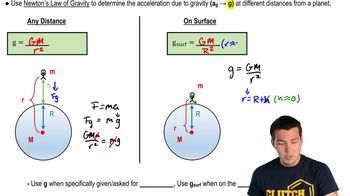
Acceleration due to gravity is the rate at which an object speeds up as it falls freely towards the Earth. It is denoted by 'g' and has a standard value of 9.81 m/s². This constant acceleration is crucial for calculating the velocity and displacement of objects in free fall, such as the brick in this problem.
Video consigliato:
Percorso guidato
05:20
Acceleration Due to Gravity

Kinematic Equations

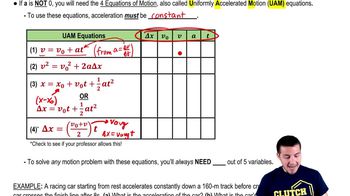
Kinematic equations describe the motion of objects under constant acceleration. For this problem, the equation v = u + gt can be used, where v is the final velocity, u is the initial velocity (zero in this case), g is the acceleration due to gravity, and t is the time. This equation helps determine the brick's velocity just before it hits the ground.
Video consigliato:
Percorso guidato
08:25
Kinematics Equations
Pratica correlata
Domanda del libro di testo

A brick is dropped (zero initial speed) from the roof of a building. The brick strikes the ground in 1.901.90 s. You may ignore air resistance, so the brick is in free fall. How tall, in meters, is the building?

1888
views
Domanda del libro di testo

A tennis ball on Mars, where the acceleration due to gravity is 0.379g0.379g and air resistance is negligible, is hit directly upward and returns to the same level 8.58.5 s later. How high above its original point did the ball go?

4512
views
Domanda del libro di testo

A 75007500-kg rocket blasts off vertically from the launch pad with a constant upward acceleration of 2.252.25 m/s2 and feels no appreciable air resistance. When it has reached a height of 525525 m, its engines suddenly fail; the only force acting on it is now gravity. What is the maximum height this rocket will reach above the launch pad?

1832
views
Domanda del libro di testo

A 75007500-kg rocket blasts off vertically from the launch pad with a constant upward acceleration of 2.252.25 m/s2 and feels no appreciable air resistance. When it has reached a height of 525525 m, its engines suddenly fail; the only force acting on it is now gravity. How much time will elapse after engine failure before the rocket comes crashing down to the launch pad, and how fast will it be moving just before it crashes?

3129
views
Domanda del libro di testo

A lunar lander is making its descent to Moon Base I (Fig. E2.402.40). The lander descends slowly under the retro-thrust of its descent engine. The engine is cut off when the lander is 5.05.0 m above the surface and has a downward speed of 0.80.8 m/s. With the engine off, the lander is in free fall. What is the speed of the lander just before it touches the surface? The acceleration due to gravity on the moon is 1.61.6 m/s.

2606
views
Domanda del libro di testo

A tennis ball on Mars, where the acceleration due to gravity is 0.379g0.379g and air resistance is negligible, is hit directly upward and returns to the same level 8.58.5 s later. How fast was it moving just after it was hit?

2211
views