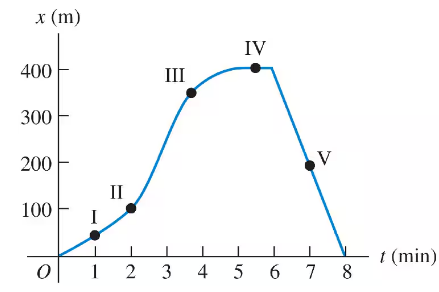
A physics professor leaves her house and walks along the sidewalk toward campus. After min, it starts to rain, and she returns home. Her distance from her house as a function of time is shown in Fig. E. At which of the labeled points is her velocity constant and positive?
Young & Freedman Calc 15th Edition
Ch 02: Motion Along a Straight Line
Problema 10eA physics professor leaves her house and walks along the sidewalk toward campus. After min, it starts to rain, and she returns home. Her distance from her house as a function of time is shown in Fig. E. At which of the labeled points is her velocity decreasing in magnitude?

Guida verificata passo dopo passo
Risposta video verificata per un problema simile:
Concetti chiave
Velocity
Slope of a Graph
Acceleration
A physics professor leaves her house and walks along the sidewalk toward campus. After min, it starts to rain, and she returns home. Her distance from her house as a function of time is shown in Fig. E. At which of the labeled points is her velocity zero?
A physics professor leaves her house and walks along the sidewalk toward campus. After min, it starts to rain, and she returns home. Her distance from her house as a function of time is shown in Fig. E. At which of the labeled points is her velocity constant and negative?
A turtle crawls along a straight line, which we will call the -axis with the positive direction to the right. The equation for the turtle's position as a function of time is cm + ( cm/s) − ( cm/s2). At what time is the velocity of the turtle zero?
A turtle crawls along a straight line, which we will call the -axis with the positive direction to the right. The equation for the turtle's position as a function of time is cm + ( cm/s) − ( cm/s2). Sketch graphs of versus , versus , and versus , for the time interval to s.
A turtle crawls along a straight line, which we will call the -axis with the positive direction to the right. The equation for the turtle's position as a function of time is cm + ( cm/s) − ( cm/s2). Find the turtle's initial velocity, initial position, and initial acceleration.