Starting from the front door of a ranch house, you walk m due east to a windmill, turn around, and then slowly walk m west to a bench, where you sit and watch the sunrise. It takes you s to walk from the house to the windmill and then s to walk from the windmill to the bench. For the entire trip from the front door to the bench, what are your (a) average velocity? (b) average speed?
Ch 02: Motion Along a Straight Line
Young & Freedman Calc15th EditionUniversity PhysicsISBN: 9780135159552Non è quello che usi tu?Cambia libro di testo
Tutti i libri di testo
Young & Freedman Calc 15th Edition
Ch 02: Motion Along a Straight Line
Problema 2a
Young & Freedman Calc 15th Edition
Ch 02: Motion Along a Straight Line
Problema 2aCapitolo 2, Problema 2a
In an experiment, a shearwater (a seabird) was taken from its nest, flown km away, and released. The bird found its way back to its nest days after release. If we place the origin at the nest and extend the –axis to the release point, what was the bird's average velocity in m/s for the return flight?
Guida verificata passo dopo passo1
Understand the concept of average velocity, which is defined as the total displacement divided by the total time taken. In this case, the displacement is the distance from the release point back to the nest, which is 5150 km.
Convert the displacement from kilometers to meters to ensure consistency in units. Since 1 km = 1000 m, multiply 5150 km by 1000 to get the displacement in meters.
Convert the time taken for the bird to return to its nest from days to seconds. Since 1 day = 24 hours, 1 hour = 60 minutes, and 1 minute = 60 seconds, multiply 13.5 days by 24, then by 60, and then by 60 again to get the time in seconds.
Use the formula for average velocity: \( v_{avg} = \frac{\Delta x}{\Delta t} \), where \( \Delta x \) is the displacement in meters and \( \Delta t \) is the time in seconds.
Substitute the values obtained for displacement and time into the average velocity formula to find the bird's average velocity in meters per second.

Risposta video verificata per un problema simile:
Questa soluzione video è stata consigliata dai nostri tutor come utile per risolvere questo problema.
Durata del video:
2mConcetti chiave
Ecco i concetti essenziali che devi comprendere per rispondere correttamente alla domanda.
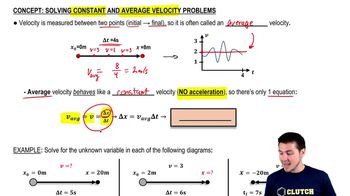
Average Velocity
Average velocity is defined as the total displacement divided by the total time taken for that displacement. It is a vector quantity, meaning it has both magnitude and direction. In this context, the displacement is the straight-line distance from the release point back to the nest, and the time is the duration of the bird's return journey.
Video consigliato:
Percorso guidato
Solving Constant and Average Velocity Problems
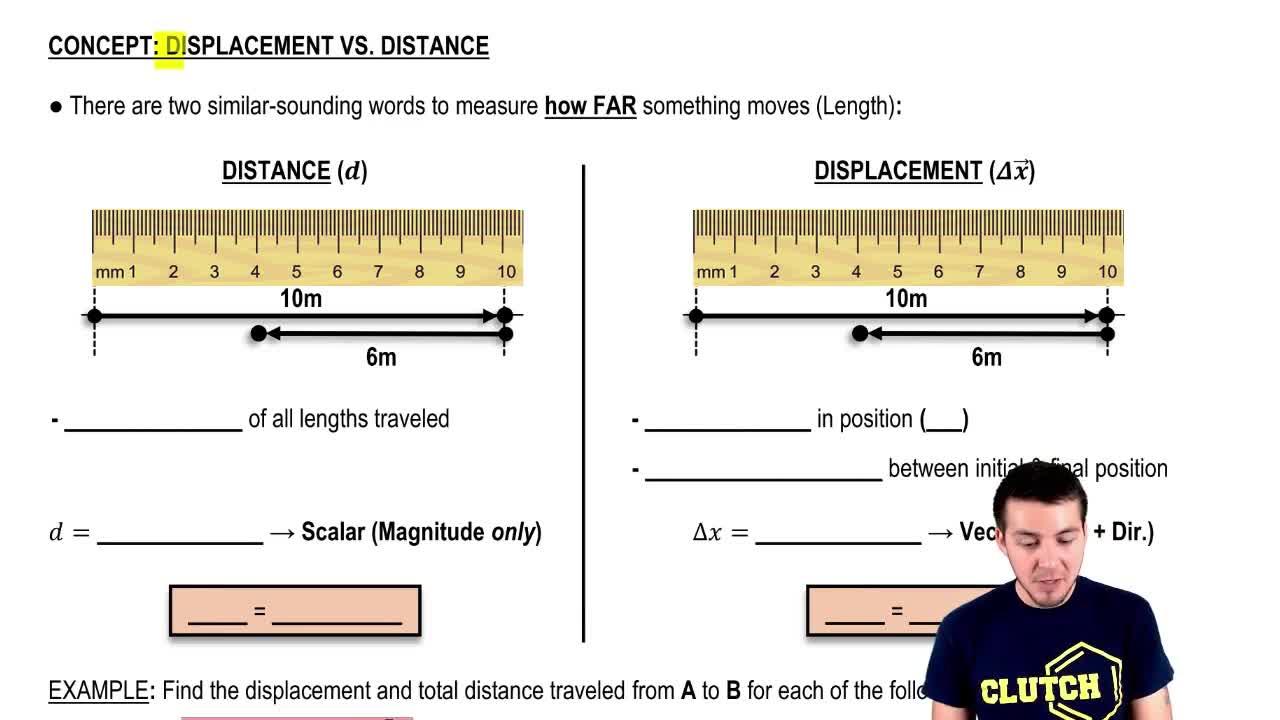
Displacement
Displacement refers to the change in position of an object and is a vector quantity. It is the shortest distance from the initial to the final position of the object, along with the direction. For the shearwater, the displacement is the direct distance from the release point back to its nest, which is 5150 km.
Video consigliato:
Percorso guidato
Displacement vs. Distance
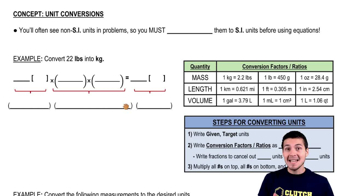
Unit Conversion
Unit conversion is the process of converting a measure from one unit to another. In this problem, the distance is given in kilometers and time in days, but the average velocity needs to be calculated in meters per second. This requires converting kilometers to meters and days to seconds to ensure consistent units for velocity calculation.
Video consigliato:
Percorso guidato
Unit Conversions
Pratica correlata
Domanda del libro di testo
364
views
Domanda del libro di testo
You normally drive on the freeway between San Diego and Los Angeles at an average speed of km/h ( mi/h), and the trip takes h and min. On a Friday afternoon, however, heavy traffic slows you down and you drive the same distance at an average speed of only km/h ( mi/h). How much longer does the trip take?
4008
views
Domanda del libro di testo
A car is stopped at a traffic light. It then travels along a straight road such that its distance from the light is given by , where m/s2 and m/s3. Calculate the average velocity of the car for the time interval to s.
3486
views
1
rank