Ch 03: Motion in Two or Three Dimensions
Young & Freedman Calc - University Physics 15th Edition
Young & Freedman Calc15th EditionUniversity PhysicsISBN: 9780135159552Non è quello che usi tu?Cambia libro di testo
Capitolo 3, Problema 36a

A railroad flatcar is traveling to the right at a speed of 13.0 m/s relative to an observer standing on the ground. Someone is riding a motor scooter on the flatcar (Fig. E3.30). What is the velocity (magnitude and direction) of the scooter relative to the flatcar if the scooter's velocity relative to the observer on the ground is 18.0 m/s to the right?

Guida verificata passo dopo passo
1
Identify the given velocities: The velocity of the flatcar relative to the ground is 13.0 m/s to the right, and the velocity of the scooter relative to the ground is 18.0 m/s to the right.
Understand the concept of relative velocity: The velocity of the scooter relative to the flatcar is the difference between the velocity of the scooter relative to the ground and the velocity of the flatcar relative to the ground.
Set up the equation for relative velocity: Let v_s/f be the velocity of the scooter relative to the flatcar. Then, v_s/f = v_s/g - v_f/g, where v_s/g is the velocity of the scooter relative to the ground, and v_f/g is the velocity of the flatcar relative to the ground.
Substitute the given values into the equation: v_s/f = 18.0 m/s - 13.0 m/s.
Solve the equation to find the velocity of the scooter relative to the flatcar. The result will give you both the magnitude and direction of the scooter's velocity relative to the flatcar.

Risposta video verificata per un problema simile:

Questa soluzione video è stata consigliata dai nostri tutor come utile per risolvere questo problema.
Durata del video:
2m

Concetti chiave

Ecco i concetti essenziali che devi comprendere per rispondere correttamente alla domanda.

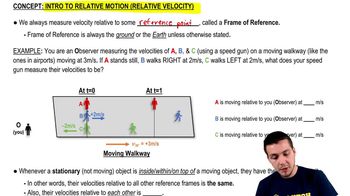
Relative Velocity

Relative velocity is the velocity of an object as observed from a particular reference frame. It is calculated by subtracting the velocity of the observer from the velocity of the object. In this problem, the velocity of the scooter relative to the flatcar is found by subtracting the flatcar's velocity from the scooter's velocity as observed from the ground.
Video consigliato:
Percorso guidato
04:27
Intro to Relative Motion (Relative Velocity)

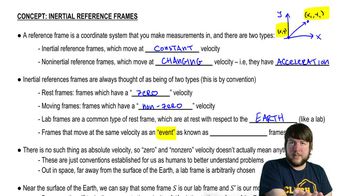
Reference Frames

A reference frame is a perspective from which motion is observed and measured. In this scenario, there are two reference frames: one is the ground observer's frame, and the other is the flatcar's frame. Understanding how velocities transform between these frames is crucial for solving the problem.
Video consigliato:
Percorso guidato
14:10
Inertial Reference Frames

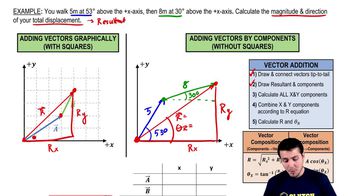
Vector Addition

Vector addition is a method used to combine vectors, which have both magnitude and direction. In this context, the velocities are vectors, and the relative velocity is determined by vector subtraction, which is a form of vector addition where one vector is added in the opposite direction. This helps in finding the scooter's velocity relative to the flatcar.
Video consigliato:
Percorso guidato
07:30
Vector Addition By Components
Pratica correlata
Domanda del libro di testo

Two piers, A and B, are located on a river; B is 1500 m downstream from A (Fig. E3.32). Two friends must make round trips from pier A to pier B and return. One rows a boat at a constant speed of 4.00 km/h relative to the water; the other walks on the shore at a constant speed of 4.00 km/h. The velocity of the river is 2.80 km/h in the direction from A to B. How much time does it take each person to make the round trip?


3887
views
Domanda del libro di testo

At its Ames Research Center, NASA uses its large '20-G' centrifuge to test the effects of very large accelerations ('hypergravity') on test pilots and astronauts. In this device, an arm 8.84 m long rotates about one end in a horizontal plane, and an astronaut is strapped in at the other end. Suppose that he is aligned along the centrifuge's arm with his head at the outermost end. The maximum sustained acceleration to which humans are subjected in this device is typically 12.5g. How fast in rpm (rev/min) is the arm turning to produce the maximum sustained acceleration?

2272
views
Domanda del libro di testo

A 'moving sidewalk' in an airport terminal moves at 1.0 m/s and is 35.0 m long. If a woman steps on at one end and walks at 1.5 m/s relative to the moving sidewalk, how much time does it take her to reach the opposite end if she walks In the opposite direction?

2585
views
Domanda del libro di testo

A canoe has a velocity of 0.40 m/s southeast relative to the earth. The canoe is on a river that is flowing 0.50 m/s east relative to the earth. Find the velocity (magnitude and direction) of the canoe relative to the river.

3896
views
Domanda del libro di testo

The nose of an ultralight plane is pointed due south, and its airspeed indicator shows 35 m/s35\(\text{ m/s}\). The plane is in a 10 m/s10\(\text{ m/s}\) wind blowing toward the southwest relative to the earth. In a vector-addition diagram, show the relationship of v→P/E\(\overrightarrow{v}\)_{P/E} (the velocity of the plane relative to the earth) to the two given vectors.

2699
views
Domanda del libro di testo

A 'moving sidewalk' in an airport terminal moves at 1.0 m/s and is 35.0 m long. If a woman steps on at one end and walks at 1.5 m/s relative to the moving sidewalk, how much time does it take her to reach the opposite end if she walks in the same direction the sidewalk is moving?

2204
views