Ch 03: Motion in Two or Three Dimensions
Young & Freedman Calc - University Physics 15th Edition
Young & Freedman Calc15th EditionUniversity PhysicsISBN: 9780135159552Non è quello che usi tu?Cambia libro di testo
Capitolo 3, Problema 12a

A rookie quarterback throws a football with an initial upward velocity component of 12.0 m/s and a horizontal velocity component of 20.0 m/s. Ignore air resistance. How much time is required for the football to reach the highest point of the trajectory?

Guida verificata passo dopo passo
1
Identify the vertical motion of the football. The initial upward velocity component is given as 12.0 m/s. The acceleration due to gravity, which acts downward, is approximately 9.8 m/s².
Understand that at the highest point of the trajectory, the vertical velocity of the football will be 0 m/s. This is because gravity will decelerate the upward motion until it stops momentarily before descending.
Use the kinematic equation for vertical motion to find the time to reach the highest point: \( v = u + at \), where \( v \) is the final vertical velocity (0 m/s at the highest point), \( u \) is the initial vertical velocity (12.0 m/s), \( a \) is the acceleration due to gravity (-9.8 m/s², negative because it opposes the upward motion), and \( t \) is the time.
Rearrange the equation to solve for time \( t \): \( t = \frac{v - u}{a} \). Substitute the known values into the equation: \( t = \frac{0 - 12.0}{-9.8} \).
Calculate the time \( t \) using the values substituted into the equation. This will give you the time required for the football to reach the highest point of its trajectory.

Risposta video verificata per un problema simile:

Questa soluzione video è stata consigliata dai nostri tutor come utile per risolvere questo problema.

Concetti chiave

Ecco i concetti essenziali che devi comprendere per rispondere correttamente alla domanda.

Projectile Motion

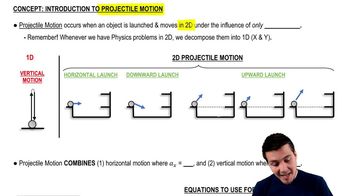
Projectile motion involves the movement of an object thrown into the air, subject to only the acceleration due to gravity. It can be analyzed by separating the motion into horizontal and vertical components, which are independent of each other. Understanding these components is crucial for solving problems related to the trajectory of projectiles.
Video consigliato:
Percorso guidato
04:44
Introduction to Projectile Motion

Vertical Motion Under Gravity

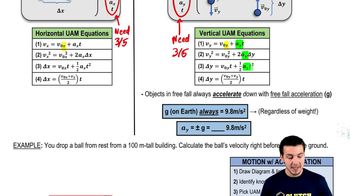
Vertical motion under gravity refers to the motion of an object moving upwards or downwards under the influence of gravity. The upward velocity decreases until it reaches zero at the highest point, where the object momentarily stops before descending. The time to reach this point can be calculated using the initial vertical velocity and the acceleration due to gravity.
Video consigliato:
Percorso guidato
08:36
Vertical Motion & Free Fall

Kinematic Equations

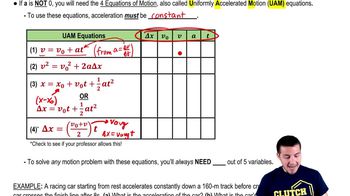
Kinematic equations describe the motion of objects under constant acceleration, such as gravity. These equations relate initial velocity, final velocity, acceleration, time, and displacement. For the vertical component of projectile motion, the equation v = u + at can be used to find the time taken to reach the highest point, where the final velocity is zero.
Video consigliato:
Percorso guidato
08:25
Kinematics Equations
Pratica correlata
Domanda del libro di testo

A rookie quarterback throws a football with an initial upward velocity component of 12.0 m/s and a horizontal velocity component of 20.0 m/s. Ignore air resistance. How much time (after it is thrown) is required for the football to return to its original level? How does this compare with the time calculated in part (a)?

2697
views
Domanda del libro di testo

A daring 510 N swimmer dives off a cliff with a running horizontal leap, as shown in Fig. E3.10. What must her minimum speed be just as she leaves the top of the cliff so that she will miss the ledge at the bottom, which is 1.75 m wide and 9.00 m below the top of the cliff?

7099
views
Domanda del libro di testo

A rookie quarterback throws a football with an initial upward velocity component of 12.0 m/s and a horizontal velocity component of 20.0 m/s. Ignore air resistance. How high is this point?

3587
views
1
rank
Domanda del libro di testo

A rookie quarterback throws a football with an initial upward velocity component of 12.0 m/s and a horizontal velocity component of 20.0 m/s. Ignore air resistance. How far has the football traveled horizontally during this time?

2309
views
Domanda del libro di testo

Crickets Chirpy and Milada jump from the top of a vertical cliff. Chirpy drops downward and reaches the ground in 2.70 s, while Milada jumps horizontally with an initial speed of 95.0 cm/s. How far from the base of the cliff will Milada hit the ground? Ignore air resistance.

3876
views
Domanda del libro di testo

A physics book slides off a horizontal tabletop with a speed of 1.10 m/s. It strikes the floor in 0.480 s. Ignore air resistance. Find the height of the tabletop above the floor.

5112
views
7
rank