Ch 03: Motion in Two or Three Dimensions
Young & Freedman Calc - University Physics 15th Edition
Young & Freedman Calc15th EditionUniversity PhysicsISBN: 9780135159552Non è quello che usi tu?Cambia libro di testo
Capitolo 3, Problema 7b

The coordinates of a bird flying in the xy-plane are given by x(t) = αt and y(t) = 3.0 m − βt2, where α = 2.4 m/s and β = 1.2 m/s2. Calculate the velocity and acceleration vectors of the bird as functions of time.

Guida verificata passo dopo passo
1
Start by understanding the given position functions: x(t) = αt and y(t) = 3.0 m − βt². These functions describe the bird's position in the xy-plane at any time t.
To find the velocity vector, differentiate the position functions with respect to time. The velocity vector v(t) is composed of the derivatives of x(t) and y(t).
Calculate the derivative of x(t) = αt with respect to time t. This gives the x-component of the velocity: v_x(t) = d(x)/dt = α.
Calculate the derivative of y(t) = 3.0 m − βt² with respect to time t. This gives the y-component of the velocity: v_y(t) = d(y)/dt = -2βt.
To find the acceleration vector, differentiate the velocity components with respect to time. The acceleration vector a(t) is composed of the derivatives of v_x(t) and v_y(t). Since v_x(t) = α is constant, its derivative is zero. For v_y(t) = -2βt, the derivative with respect to time is a_y(t) = -2β.

Risposta video verificata per un problema simile:

Questa soluzione video è stata consigliata dai nostri tutor come utile per risolvere questo problema.
Durata del video:
2m

Concetti chiave

Ecco i concetti essenziali che devi comprendere per rispondere correttamente alla domanda.

Velocity Vector

The velocity vector represents the rate of change of position with respect to time. It is derived by differentiating the position functions x(t) and y(t) with respect to time. For the bird, the velocity vector is v(t) = (dx/dt, dy/dt), which involves calculating the derivatives of x(t) = αt and y(t) = 3.0 m − βt².
Video consigliato:
Percorso guidato
06:44
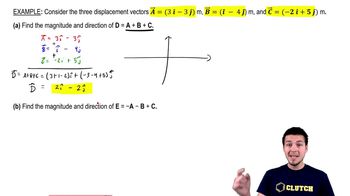
Adding 3 Vectors in Unit Vector Notation

Acceleration Vector

The acceleration vector indicates the rate of change of velocity with respect to time. It is obtained by differentiating the velocity vector components. For the bird, the acceleration vector is a(t) = (d²x/dt², d²y/dt²), which requires calculating the second derivatives of the position functions x(t) and y(t).
Video consigliato:
Percorso guidato
06:44
Adding 3 Vectors in Unit Vector Notation

Differentiation

Differentiation is a mathematical process used to find the rate at which a quantity changes. In physics, it is essential for determining velocity and acceleration from position functions. For this problem, differentiate x(t) = αt and y(t) = 3.0 m − βt² to find the velocity, and differentiate again to find the acceleration.
Video consigliato:
Percorso guidato
13:04
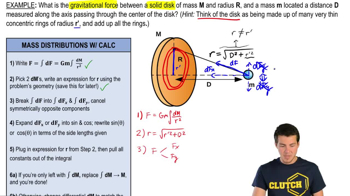
Gravitational Force from a Solid Disk
Pratica correlata
Domanda del libro di testo

A remote-controlled car is moving in a vacant parking lot. The velocity of the car as a function of time is given by v⃗=[5.00 m/s−(0.0180 m/s3)t2]i^+[2.00 m/s+(0.550 m/s2)t]j^\(\vec{v}\) = \(\left\)[ 5.00~\(\mathrm{m/s}\) - (0.0180~\(\mathrm{m/s^3}\))t^2 \(\right\)] \(\hat{i}\) + \(\left\)[ 2.00~\(\mathrm{m/s}\) + (0.550~\(\mathrm{m/s^2}\))t \(\right\)] \(\hat{j}\) . What are the magnitude and direction of the car's velocity at t=8.00 st=8.00\(\text{ }\)s? (b) What are the magnitude and direction of the car's acceleration at t=8.00 st=8.00\(\text{ }\)s?

3510
views
Domanda del libro di testo

The position of a squirrel running in a park is given by r⃗=[(0.280 m/s)t+(0.0360 m/s2)t2]i^+(0.0190 m/s3)t3j^\(\vec{r}\) = \(\left\)[ (0.280~\(\mathrm{m/s}\))t + (0.0360~\(\mathrm{m/s^2}\))t^2 \(\right\)] \(\hat{i}\) + (0.0190~\(\mathrm{m/s^3}\))t^3 \(\hat{j}\) . At t=5.00st = 5.00 s, how far is the squirrel from its initial position?

3952
views
Domanda del libro di testo

The coordinates of a bird flying in the xy-plane are given by x(t) = αt and y(t) = 3.0 m − βt2, where α = 2.4 m/s and β = 1.2 m/s2. Calculate the magnitude and direction of the bird's velocity and acceleration at t = 2.0 s.

5168
views
2
rank
Domanda del libro di testo

The coordinates of a bird flying in the xy-plane are given by x(t) = αt and y(t) = 3.0 m − βt2, where α = 2.4 m/s and β = 1.2 m/s2. (a) Sketch the path of the bird between t = 0 and t = 2.0 s.

2523
views
Domanda del libro di testo

A remote-controlled car is moving in a vacant parking lot. The velocity of the car as a function of time is given by v⃗=[5.00 m/s−(0.0180 m/s3)t2]i^+[2.00 m/s+(0.550 m/s2)t]j^\(\vec{v}\) = \(\left\)[ 5.00~\(\mathrm{m/s}\) - (0.0180~\(\mathrm{m/s^3}\))t^2 \(\right\)] \(\hat{i}\) + \(\left\)[ 2.00~\(\mathrm{m/s}\) + (0.550~\(\mathrm{m/s^2}\))t \(\right\)] \(\hat{j}\) . What are ax(t)a_{x}(t) and ay(t)a_{y}(t), the xx- and yy- components of the car's velocity as functions of time?

564
views
Domanda del libro di testo

A dog running in an open field has components of velocity vx = 2.6 m/s and vy = −1.8 m/s at t1 = 10.0 s. For the time interval from t1 = 10.0 s to t2 = 20.0 s, the average acceleration of the dog has magnitude 0.45 m/s2 and direction 31.0° measured from the +x–axis toward the +y–axis. At t2 = 20.0 s, what are the x- and y-components of the dog's velocity?

4165
views