
Ch 05: Applying Newton's Laws
Young & Freedman Calc - University Physics 15th Edition
Young & Freedman Calc15th EditionUniversity PhysicsISBN: 9780135159552Non è quello che usi tu?Cambia libro di testo
Capitolo 5, Problema 44b

A 5252-kg ice skater spins about a vertical axis through her body with her arms horizontally outstretched; she makes 2.02.0 turns each second. The distance from one hand to the other is 1.501.50 m. Biometric measurements indicate that each hand typically makes up about 1.25%1.25\% of body weight. What horizontal force must her wrist exert on her hand?

Guida verificata passo dopo passo
1
Determine the mass of one hand by calculating 1.25% of the skater's total body mass. Use the formula: \( m_{hand} = 0.0125 \times m_{body} \), where \( m_{body} = 52 \, \text{kg} \).
Calculate the radius of the circular motion for one hand. Since the distance between the two hands is 1.50 m, the radius for one hand is half of this distance: \( r = \frac{1.50}{2} \).
Determine the angular velocity \( \omega \) of the skater. The skater makes 2.0 turns per second, so \( \omega = 2 \times 2\pi \) radians per second (since one turn equals \( 2\pi \) radians).
Calculate the centripetal force required to keep one hand in circular motion using the formula: \( F_c = m_{hand} \cdot r \cdot \omega^2 \). Substitute the values for \( m_{hand} \), \( r \), and \( \omega \) into this equation.
The horizontal force exerted by the wrist on the hand is equal to the centripetal force calculated in the previous step. This force is directed toward the center of the circular motion.

Risposta video verificata per un problema simile:

Questa soluzione video è stata consigliata dai nostri tutor come utile per risolvere questo problema.
Durata del video:
6m

Concetti chiave

Ecco i concetti essenziali che devi comprendere per rispondere correttamente alla domanda.

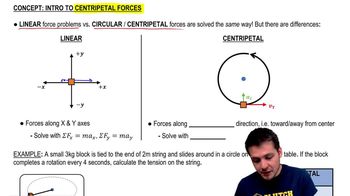
Centripetal Force

Centripetal force is the net force required to keep an object moving in a circular path, directed towards the center of the circle. In the case of the ice skater, this force is necessary to maintain her circular motion as she spins. It can be calculated using the formula F_c = m * v^2 / r, where m is mass, v is tangential velocity, and r is the radius of the circular path.
Video consigliato:
Percorso guidato
06:48
Intro to Centripetal Forces

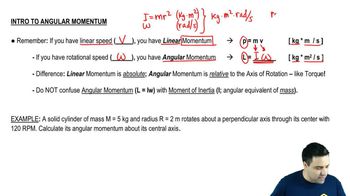
Angular Velocity

Angular velocity is a measure of how quickly an object rotates around an axis, expressed in radians per second. For the skater, making 2.0 turns per second translates to an angular velocity of 4π radians per second. This concept is crucial for determining the tangential speed of her hands and the forces acting on them during the spin.
Video consigliato:
Percorso guidato
06:18
Intro to Angular Momentum

Torque

Torque is the rotational equivalent of linear force, representing the tendency of a force to cause rotation about an axis. In this scenario, the wrist exerts a torque to counteract the centrifugal effects experienced by the outstretched hands during the spin. The torque can be calculated by multiplying the force exerted by the wrist by the distance from the wrist to the hand.
Video consigliato:
Percorso guidato
08:55
Net Torque & Sign of Torque
Pratica correlata
Domanda del libro di testo

Two crates connected by a rope lie on a horizontal surface (Fig. E5.375.37). Crate A has mass mAm_A, and crate B has mass mBm_B. The coefficient of kinetic friction between each crate and the surface is μkμ_k. The crates are pulled to the right at constant velocity by a horizontal force FF. Draw one or more free-body diagrams to calculate the following in terms of mAm_A, mBm_B, and μkμ_k: the tension in the rope connecting the blocks.

1562
views
Domanda del libro di testo

You throw a baseball straight upward. The drag force is proportional to v2v^2. In terms of gg, what is the y y-component of the ball's acceleration when the ball's speed is half its terminal speed and it is moving back down?

2760
views
Domanda del libro di testo

A small remote-controlled car with mass 1.601.60 kg moves at a constant speed of v=12.0v = 12.0 m/s in a track formed by a vertical circle inside a hollow metal cylinder that has a radius of 5.005.00 m (Fig. E5.455.45). What is the magnitude of the normal force exerted on the car by the walls of the cylinder at point AA (bottom of the track)?

2178
views
Domanda del libro di testo

A small remote-controlled car with mass 1.601.60 kg moves at a constant speed of v=12.0v = 12.0 m/s in a track formed by a vertical circle inside a hollow metal cylinder that has a radius of 5.005.00 m (Fig. E5.455.45). What is the magnitude of the normal force exerted on the car by the walls of the cylinder at point BB (top of the track)?

4559
views
1
rank
Domanda del libro di testo

You throw a baseball straight upward. The drag force is proportional to v2v^2. In terms of gg, what is the y y-component of the ball's acceleration when the ball's speed is half its terminal speed and it is moving up?

1681
views
Domanda del libro di testo

A small car with mass 0.8000.800 kg travels at constant speed on the inside of a track that is a vertical circle with radius 5.005.00 m (Fig. E5.455.45). If the normal force exerted by the track on the car when it is at the top of the track (point BB) is 6.006.00 N, what is the normal force on the car when it is at the bottom of the track (point AA)?

4169
views
1
comments