Ch 07: Potential Energy & Conservation
Young & Freedman Calc - University Physics 15th Edition
Young & Freedman Calc15th EditionUniversity PhysicsISBN: 9780135159552Non è quello che usi tu?Cambia libro di testo
Capitolo 7, Problema 19a

A spring of negligible mass has force constant k=800k = 800 N/m. How far must the spring be compressed for 1.201.20 J of potential energy to be stored in it?

Guida verificata passo dopo passo
1
Step 1: Recall the formula for the potential energy stored in a spring, which is given by \( U = \frac{1}{2} k x^2 \), where \( U \) is the potential energy, \( k \) is the spring constant, and \( x \) is the compression distance.
Step 2: Rearrange the formula to solve for \( x \). Start by multiplying both sides of the equation by 2 to eliminate the fraction: \( 2U = kx^2 \). Then divide both sides by \( k \): \( x^2 = \frac{2U}{k} \).
Step 3: Take the square root of both sides to isolate \( x \): \( x = \sqrt{\frac{2U}{k}} \).
Step 4: Substitute the given values into the equation. The potential energy \( U \) is 1.20 J, and the spring constant \( k \) is 800 N/m. The equation becomes \( x = \sqrt{\frac{2 \times 1.20}{800}} \).
Step 5: Simplify the expression under the square root to find the compression distance \( x \). This will give the final answer for how far the spring must be compressed.

Risposta video verificata per un problema simile:

Questa soluzione video è stata consigliata dai nostri tutor come utile per risolvere questo problema.
Durata del video:
2m

Concetti chiave

Ecco i concetti essenziali che devi comprendere per rispondere correttamente alla domanda.

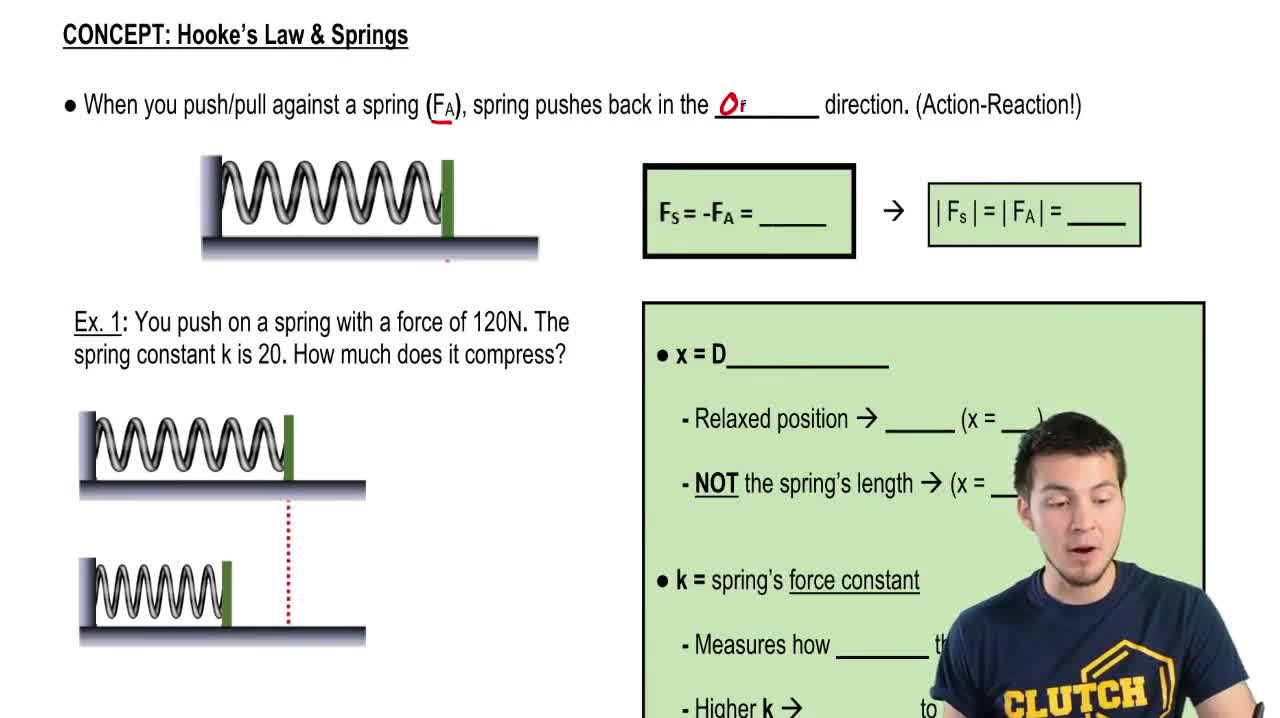
Hooke's Law

Hooke's Law states that the force exerted by a spring is directly proportional to its displacement from the equilibrium position, expressed as F = -kx, where F is the force, k is the spring constant, and x is the displacement. This principle is fundamental in understanding how springs behave under compression or extension.
Video consigliato:
Percorso guidato
05:27
Spring Force (Hooke's Law)

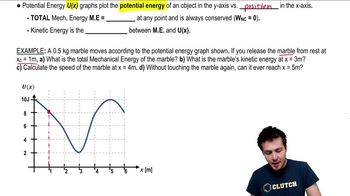
Elastic Potential Energy

Elastic potential energy is the energy stored in a spring when it is compressed or stretched. It can be calculated using the formula U = 1/2 kx², where U is the potential energy, k is the spring constant, and x is the displacement. This concept is crucial for determining how much energy is stored in the spring based on its compression.
Video consigliato:
Percorso guidato
07:24
Potential Energy Graphs

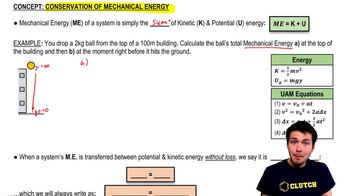
Energy Conservation

The principle of energy conservation states that energy cannot be created or destroyed, only transformed from one form to another. In the context of springs, the work done to compress the spring is converted into elastic potential energy, which can later be released as kinetic energy when the spring returns to its equilibrium position.
Video consigliato:
Percorso guidato
06:24
Conservation Of Mechanical Energy
Pratica correlata
Domanda del libro di testo

A spring of negligible mass has force constant k=1600k = 1600 N/m. How far must the spring be compressed for 3.203.20 J of potential energy to be stored in it?

1620
views

Domanda del libro di testo

A spring of negligible mass has force constant k=1600k = 1600 N/m. You place the spring vertically with one end on the floor. You then drop a 1.201.20-kg book onto it from a height of 0.8000.800 m above the top of the spring. Find the maximum distance the spring will be compressed.

3571
views
Domanda del libro di testo

In one day, a 7575-kg mountain climber ascends from the 15001500-m level on a vertical cliff to the top at 24002400 m. The next day, she descends from the top to the base of the cliff, which is at an elevation of 13501350 m. What is her change in gravitational potential energy on the first day?

1389
views
Domanda del libro di testo

Tarzan, in one tree, sights Jane in another tree. He grabs the end of a vine with length 2020 m that makes an angle of 45°45° with the vertical, steps off his tree limb, and swings down and then up to Jane's open arms. When he arrives, his vine makes an angle of 30°30° with the vertical. Determine whether he gives her a tender embrace or knocks her off her limb by calculating Tarzan's speed just before he reaches Jane. Ignore air resistance and the mass of the vine.

3006
views
3
rank
Domanda del libro di testo

The maximum height a typical human can jump from a crouched start is about 6060 cm. By how much does the gravitational potential energy increase for a 7272-kg person in such a jump? Where does this energy come from?

3943
views
1
rank