Ch 08: Momentum, Impulse, and Collisions
Young & Freedman Calc - University Physics 15th Edition
Young & Freedman Calc15th EditionUniversity PhysicsISBN: 9780135159552Non è quello che usi tu?Cambia libro di testo
Capitolo 8, Problema 40b

To protect their young in the nest, peregrine falcons will fly into birds of prey (such as ravens) at high speed. In one such episode, a 600-g falcon flying at 20.0 m/s hit a 1.50-kg raven flying at 9.0 m/s. The falcon hit the raven at right angles to its original path and bounced back at 5.0 m/s. (These figures were estimated by the author as he watched this attack occur in northern New Mexico.) What was the raven's speed right after the collision?

Guida verificata passo dopo passo
1
Step 1: Identify the type of collision. This is an inelastic collision in two dimensions, as the falcon and raven interact and change their velocities. Momentum is conserved in both the x and y directions.
Step 2: Define the coordinate system. Let the falcon's initial motion be along the x-axis and the raven's initial motion be along the y-axis. Assign positive directions to the initial velocities of both birds.
Step 3: Write the conservation of momentum equations for the x and y directions. For the x-direction: \( m_f v_{f,ix} + m_r v_{r,ix} = m_f v_{f,fx} + m_r v_{r,fx} \). For the y-direction: \( m_f v_{f,iy} + m_r v_{r,iy} = m_f v_{f,fy} + m_r v_{r,fy} \). Here, \( m_f \) and \( m_r \) are the masses of the falcon and raven, respectively, and \( v_{f,i} \), \( v_{r,i} \), \( v_{f,f} \), and \( v_{r,f} \) are their initial and final velocities in the x and y directions.
Step 4: Substitute the known values into the equations. For the x-direction: \( (0.600 \text{ kg})(20.0 \text{ m/s}) + (1.50 \text{ kg})(0 \text{ m/s}) = (0.600 \text{ kg})(-5.0 \text{ m/s}) + (1.50 \text{ kg})(v_{r,fx}) \). For the y-direction: \( (0.600 \text{ kg})(0 \text{ m/s}) + (1.50 \text{ kg})(9.0 \text{ m/s}) = (0.600 \text{ kg})(0 \text{ m/s}) + (1.50 \text{ kg})(v_{r,fy}) \).
Step 5: Solve for the components of the raven's final velocity. From the x-direction equation, isolate \( v_{r,fx} \). From the y-direction equation, isolate \( v_{r,fy} \). Then, use the Pythagorean theorem to find the magnitude of the raven's final velocity: \( v_r = \sqrt{v_{r,fx}^2 + v_{r,fy}^2} \).

Risposta video verificata per un problema simile:

Questa soluzione video è stata consigliata dai nostri tutor come utile per risolvere questo problema.
Durata del video:
12m

Concetti chiave

Ecco i concetti essenziali che devi comprendere per rispondere correttamente alla domanda.

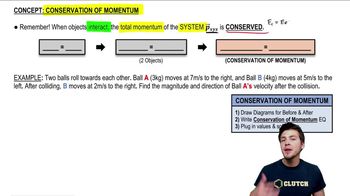
Conservation of Momentum

The conservation of momentum states that in a closed system, the total momentum before an event (like a collision) is equal to the total momentum after the event. This principle is crucial for analyzing collisions, as it allows us to calculate the velocities of objects post-collision by equating the momentum of the system before and after the interaction.
Video consigliato:
Percorso guidato
05:58
Conservation Of Momentum

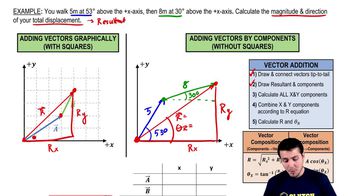
Vector Components

In physics, motion is often analyzed using vector components, which break down a vector quantity (like velocity) into its horizontal and vertical parts. This is particularly important in collisions where objects may move in different directions, allowing for a clearer understanding of their interactions and resulting velocities in a two-dimensional space.
Video consigliato:
Percorso guidato
07:30
Vector Addition By Components

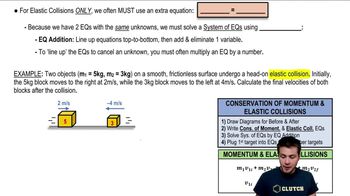
Elastic vs. Inelastic Collisions

Collisions can be classified as elastic or inelastic based on whether kinetic energy is conserved. In elastic collisions, both momentum and kinetic energy are conserved, while in inelastic collisions, momentum is conserved but kinetic energy is not. Understanding this distinction helps in determining the final velocities of colliding objects, as it influences the calculations involved.
Video consigliato:
Percorso guidato
08:56
Intro To Elastic Collisions