Ch 10: Dynamics of Rotational Motion
Young & Freedman Calc - University Physics 15th Edition
Young & Freedman Calc15th EditionUniversity PhysicsISBN: 9780135159552Non è quello che usi tu?Cambia libro di testo
Capitolo 10, Problema 52a

A uniform, 4.5-kg, square, solid wooden gate 1.5 m on each side hangs vertically from a frictionless pivot at the center of its upper edge. A 1.1-kg raven flying horizontally at 5.0 m/s flies into this door at its center and bounces back at 2.0 m/s in the opposite direction. What is the angular speed of the gate just after it is struck by the unfortunate raven?

Guida verificata passo dopo passo
1
First, identify the conservation of angular momentum principle. The angular momentum before the collision must equal the angular momentum after the collision, as no external torques are acting on the system.
Calculate the initial angular momentum of the raven. Use the formula for linear momentum, \( p = mv \), where \( m \) is the mass of the raven and \( v \) is its velocity. The raven's initial angular momentum relative to the pivot is \( L_{initial} = m_{raven} \cdot v_{raven} \cdot r \), where \( r \) is the distance from the pivot to the point of impact (0.75 m, half the side of the gate).
Calculate the final angular momentum of the raven after it bounces back. Use the same formula, but with the final velocity of the raven. The direction of the velocity is opposite, so the angular momentum will be negative: \( L_{final} = m_{raven} \cdot v_{final} \cdot r \).
Determine the change in angular momentum of the raven, \( \Delta L = L_{initial} - L_{final} \). This change in angular momentum is transferred to the gate.
Use the formula for the moment of inertia of a square gate about the pivot point, \( I = \frac{1}{3} m_{gate} \cdot L^2 \), where \( m_{gate} \) is the mass of the gate and \( L \) is the length of the side of the gate. Then, use the relationship \( \Delta L = I \cdot \omega \) to solve for the angular speed \( \omega \) of the gate: \( \omega = \frac{\Delta L}{I} \).

Risposta video verificata per un problema simile:

Questa soluzione video è stata consigliata dai nostri tutor come utile per risolvere questo problema.
Durata del video:
14m

Concetti chiave

Ecco i concetti essenziali che devi comprendere per rispondere correttamente alla domanda.

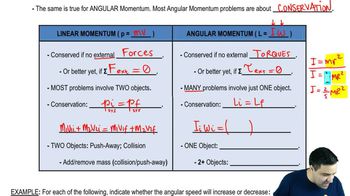
Conservation of Angular Momentum

The conservation of angular momentum states that if no external torque acts on a system, the total angular momentum remains constant. In this scenario, the raven's impact on the gate is an internal interaction, so the angular momentum before and after the collision must be equal, allowing us to calculate the gate's angular speed post-collision.
Video consigliato:
Percorso guidato
12:12
Conservation of Angular Momentum

Moment of Inertia

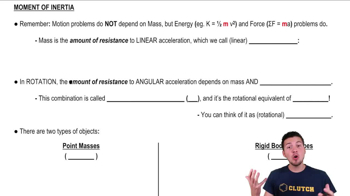
Moment of inertia is a measure of an object's resistance to changes in its rotation. For a square gate pivoted at its upper edge, the moment of inertia can be calculated using the formula for a solid square plate. This value is crucial for determining the gate's angular speed after the collision, as it relates angular momentum to angular velocity.
Video consigliato:
Percorso guidato
11:47
Intro to Moment of Inertia

Elastic Collision

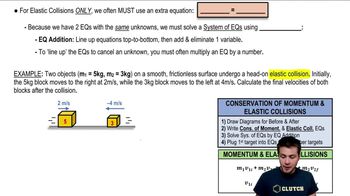
An elastic collision is one where kinetic energy is conserved. In this problem, the raven bounces back after hitting the gate, indicating an elastic collision. Understanding this concept helps in analyzing the energy transfer during the collision, which affects the gate's motion and allows us to apply conservation laws effectively.
Video consigliato:
Percorso guidato
08:56
Intro To Elastic Collisions
Pratica correlata
Domanda del libro di testo

A uniform, 4.5-kg, square, solid wooden gate 1.5 m on each side hangs vertically from a frictionless pivot at the center of its upper edge. A 1.1-kg raven flying horizontally at 5.0 m/s flies into this door at its center and bounces back at 2.0 m/s in the opposite direction. During the collision, why is the angular momentum conserved but not the linear momentum?

1541
views
Domanda del libro di testo

A thin uniform rod has a length of 0.500 m0.500\(\text{ m}\) and is rotating in a circle on a frictionless table. The axis of rotation is perpendicular to the length of the rod at one end and is stationary. The rod has an angular velocity of 0.400 rad/s0.400\(\text{ rad/s}\) and a moment of inertia about the axis of 3.00×10⁻³kg/m23.00\(\times\)10^{-3}\(\text{kg/m}\)^2. A bug initially standing on the rod at the axis of rotation decides to crawl out to the other end of the rod. When the bug has reached the end of the rod and sits there, its tangential speed is 0.160 m/s0.160\(\text{ m/s}\). The bug can be treated as a point mass. What is the mass of the rod.

3866
views
1
comments
Domanda del libro di testo

A certain gyroscope precesses at a rate of 0.50 rad/s when used on earth. If it were taken to a lunar base, where the acceleration due to gravity is 0.165g, what would be its precession rate?

1571
views
Domanda del libro di testo

A small 10.0-g bug stands at one end of a thin uniform bar that is initially at rest on a smooth horizontal table. The other end of the bar pivots about a nail driven into the table and can rotate freely, without friction. The bar has mass 50.0 g and is 100 cm in length. The bug jumps off in the horizontal direction, perpendicular to the bar, with a speed of 20.0 cm/s relative to the table. What is the angular speed of the bar just after the frisky insect leaps?

1715
views
Domanda del libro di testo

Suppose that an asteroid traveling straight toward the center of the earth were to collide with our planet at the equator and bury itself just below the surface. What would have to be the mass of this asteroid, in terms of the earth's mass M, for the day to become 25.0% longer than it presently is as a result of the collision? Assume that the asteroid is very small compared to the earth and that the earth is uniform throughout.

3898
views