Ch 12: Fluid Mechanics
Young & Freedman Calc - University Physics 15th Edition
Young & Freedman Calc15th EditionUniversity PhysicsISBN: 9780135159552Non è quello che usi tu?Cambia libro di testo
Capitolo 12, Problema 14

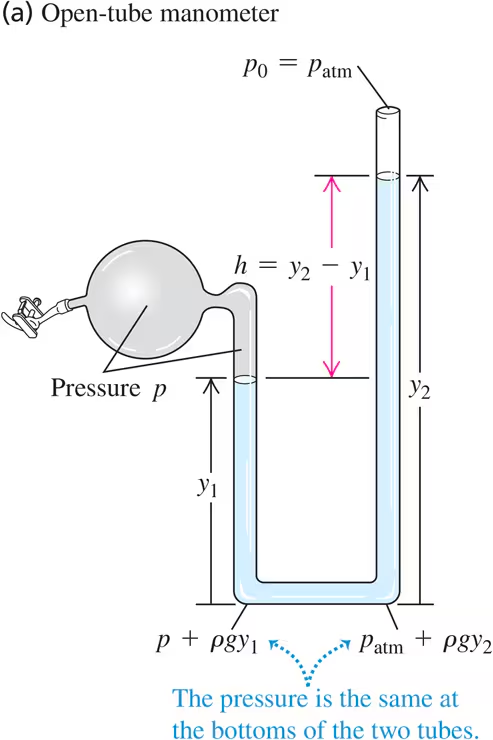
The liquid in the open-tube manometer in Fig. 12.8a is mercury, y1=3.00 cm,and y2=7.00 cm. Atmospheric pressure is 980 millibars. What is (a) the absolute pressure at the bottom of the U-shaped tube; (b) the absolute pressure in the open tube at a depth of 4.00 cm below the free surface; (c) the absolute pressure of the gas in the container; (d) the gauge pressure of the gas in pascals?

Guida verificata passo dopo passo
1
To find the absolute pressure at the bottom of the U-shaped tube, we need to consider the atmospheric pressure and the pressure due to the mercury column. The pressure at the bottom is the sum of the atmospheric pressure and the pressure due to the height difference in mercury levels. Use the formula: P_bottom = P_atm + ρgh, where ρ is the density of mercury, g is the acceleration due to gravity, and h is the height difference (y_2 - y_1).
To find the absolute pressure in the open tube at a depth of 4.00 cm below the free surface, calculate the pressure due to the mercury column above this point and add it to the atmospheric pressure. Use the formula: P_depth = P_atm + ρg(4.00 cm).
To find the absolute pressure of the gas in the container, consider the pressure difference between the gas and the open end of the tube. The pressure of the gas is equal to the atmospheric pressure plus the pressure due to the mercury column height difference (y_2 - y_1). Use the formula: P_gas = P_atm + ρg(y_2 - y_1).
To find the gauge pressure of the gas in pascals, subtract the atmospheric pressure from the absolute pressure of the gas. Gauge pressure is given by: P_gauge = P_gas - P_atm.
Convert the atmospheric pressure from millibars to pascals for calculations. Use the conversion: 1 millibar = 100 pascals. Therefore, P_atm = 980 millibars * 100 pascals/millibar.

Risposta video verificata per un problema simile:

Questa soluzione video è stata consigliata dai nostri tutor come utile per risolvere questo problema.
Durata del video:
12m

Concetti chiave

Ecco i concetti essenziali che devi comprendere per rispondere correttamente alla domanda.

Pressure Measurement

Pressure is the force exerted per unit area. In a manometer, the pressure difference between two points is determined by the height difference of the liquid column. The absolute pressure is the sum of the atmospheric pressure and the pressure due to the liquid column, while gauge pressure is the difference between the absolute pressure and atmospheric pressure.
Video consigliato:
Percorso guidato
17:04
Pressure and Atmospheric Pressure

Hydrostatic Pressure

Hydrostatic pressure is the pressure exerted by a fluid at equilibrium due to the force of gravity. It increases with depth and is calculated using the formula P = ρgh, where ρ is the fluid density, g is the acceleration due to gravity, and h is the height of the fluid column. This concept is crucial for determining pressure at various depths in the manometer.
Video consigliato:
Percorso guidato
17:04
Pressure and Atmospheric Pressure

Manometer Functionality

A manometer is a device used to measure the pressure of a gas or liquid. It typically consists of a U-shaped tube filled with a liquid like mercury. The difference in liquid levels in the two arms of the tube indicates the pressure difference between the gas in the container and the atmospheric pressure, allowing for calculations of absolute and gauge pressures.
Video consigliato:
Percorso guidato
10:40
Pressure Gauges: Manometer
Pratica correlata
Domanda del libro di testo

You are designing a diving bell to withstand the pressure of seawater at a depth of 250 m. (a) What is the gauge pressure at this depth? (You can ignore changes in the density of the water with depth.)

1958
views

Domanda del libro di testo

BIO. The lower end of a long plastic straw is immersed below the surface of the water in a plastic cup. An average person sucking on the upper end of the straw can pull water into the straw to a vertical height of 1.1 m above the surface of the water in the cup. (a) What is the lowest gauge pressure that the average person can achieve inside his lungs? (b) Explain why your answer in part (a) is negative.

3037
views
Domanda del libro di testo

You are designing a diving bell to withstand the pressure of seawater at a depth of 250 m. What is the gauge pressure at this depth? (You can ignore changes in the density of the water with depth.) At this depth, what is the net force due to the water outside and the air inside the bell on a circular glass window 30.0 cm in diameter if the pressure inside the diving bell equals the pressure at the surface of the water? (Ignore the small variation of pressure over the surface of the window.)

1163
views
Domanda del libro di testo

BIO. There is a maximum depth at which a diver can breathe through a snorkel tube (Fig. E12.17) because as the depth increases, so does the pressure difference, which tends to collapse the diver's lungs. Since the snorkel connects the air in the lungs to the atmosphere at the surface, the pressure inside the lungs is atmospheric pressure. What is the external– internal pressure difference when the diver's lungs are at a depth of 6.1 m (about 20 ft)? Assume that the diver is in fresh-water. (A scuba diver breathing from compressed air tanks can operate at greater depths than can a snorkeler, since the pressure of the air inside the scuba diver's lungs increases to match the external pressure of the water.)


3511
views
Domanda del libro di testo

Hydraulic Lift II.The piston of a hydraulic automobile lift is 0.30 m in diameter. What gauge pressure, in pascals, is required to lift a car with a mass of 1200 kg? Also express this pressure in atmospheres.

2108
views
1
rank
Domanda del libro di testo

Ear Damage from Diving. If the force on the tympanic membrane (eardrum) increases by about 1.5 N above the force from atmospheric pressure, the membrane can be damaged. When you go scuba diving in the ocean, below what depth could damage to your eardrum start to occur? The eardrum is typically 8.2 mm in diameter. (Consult Table 12.1.)

3104
views
2
rank