Ch 14: Periodic Motion
Young & Freedman Calc - University Physics 15th Edition
Young & Freedman Calc15th EditionUniversity PhysicsISBN: 9780135159552Non è quello che usi tu?Cambia libro di testo
Capitolo 14, Problema 20bc

A 0.500kg0.500\(\operatorname{kg}\) mass on a spring has velocity as a function of time given by vx(t)=−(3.60cm/s)sin[(4.7 rad/s)t−(π/2)]v_{x}(t)=-(3.60\(\operatorname{cm}\)/s)\(\sin\)[(4.7\(\text{ }\)rad/s)t-(\(\pi\)/2)]. What are the amplitude and the maximum acceleration of the mass?

Guida verificata passo dopo passo
1
To find the period (T) of the motion, use the angular frequency (ω) from the velocity function vx(t) = -(3.60 cm/s) sin[(4.71 rad/s)t - (π/2)]. The period is given by T = 2π/ω. Substitute ω = 4.71 rad/s into the formula to find T.
The amplitude (A) of the motion can be determined from the maximum velocity given in the function vx(t). The maximum velocity occurs when the sine function equals ±1, so the amplitude of the velocity is 3.60 cm/s. Use the relationship between maximum velocity and amplitude: vmax = ωA, where ω = 4.71 rad/s. Solve for A.
To find the maximum acceleration (amax), use the relationship amax = ω²A. You have already found ω and A in previous steps. Substitute these values into the formula to find amax.
The force constant (k) of the spring can be found using Hooke's Law and the relationship between angular frequency and mass: ω = √(k/m). Rearrange this formula to solve for k: k = mω². Use m = 0.500 kg and ω = 4.71 rad/s to find k.
Review the units and ensure consistency across all calculations. Convert units where necessary, such as converting cm/s to m/s for velocity, to maintain SI units throughout the problem.

Risposta video verificata per un problema simile:

Questa soluzione video è stata consigliata dai nostri tutor come utile per risolvere questo problema.
Durata del video:
5m

Concetti chiave

Ecco i concetti essenziali che devi comprendere per rispondere correttamente alla domanda.

Simple Harmonic Motion

Simple Harmonic Motion (SHM) describes the oscillatory motion of systems like masses on springs, where the restoring force is proportional to displacement. The velocity function given indicates SHM, characterized by sinusoidal functions for displacement, velocity, and acceleration. Understanding SHM is crucial for determining the period, amplitude, and other properties of the system.
Video consigliato:
Percorso guidato
07:52
Simple Harmonic Motion of Pendulums

Period of Oscillation

The period of oscillation is the time taken for one complete cycle of motion in SHM. It is inversely related to the angular frequency, ω, given in the velocity function. The period, T, can be calculated using T = 2π/ω, which helps in understanding the timing of the oscillatory motion and is essential for solving part (a) of the question.
Video consigliato:
Percorso guidato
06:28
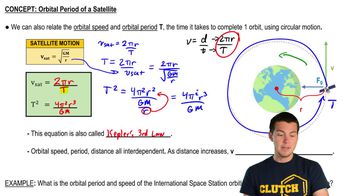
Satellite Period

Hooke's Law and Spring Constant

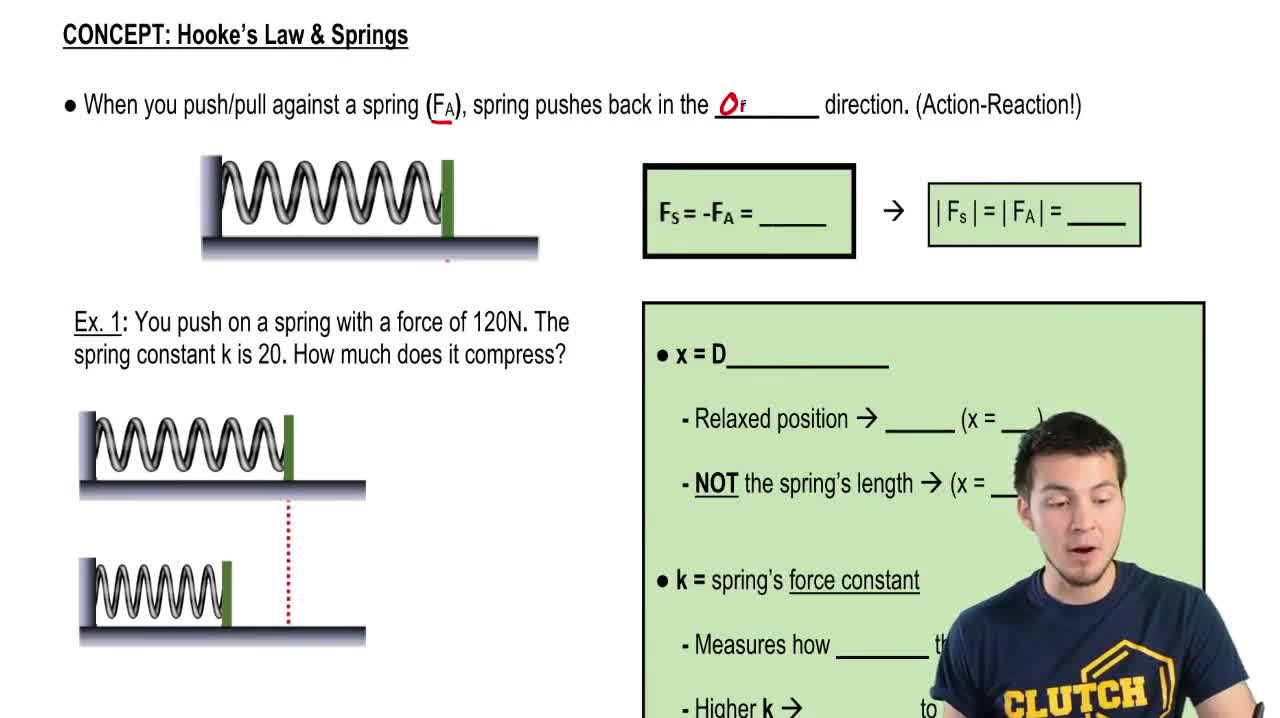
Hooke's Law states that the force exerted by a spring is proportional to its displacement, F = -kx, where k is the spring constant. The spring constant is crucial for determining the force characteristics of the spring system. It can be derived from the mass and angular frequency using k = mω², which is necessary for solving part (d) of the question.
Video consigliato:
Percorso guidato
05:27
Spring Force (Hooke's Law)