Ch 14: Periodic Motion
Young & Freedman Calc - University Physics 15th Edition
Young & Freedman Calc15th EditionUniversity PhysicsISBN: 9780135159552Non è quello che usi tu?Cambia libro di testo
Capitolo 14, Problema 46

A certain simple pendulum has a period on the earth of 1.60 s. What is its period on the surface of Mars, where g = 3.71 m/s2?

Guida verificata passo dopo passo
1
Understand the formula for the period of a simple pendulum: T=2π√lg, where T is the period, l is the length of the pendulum, and g is the acceleration due to gravity.
Recognize that the period of the pendulum depends on the gravitational acceleration. On Earth, g=9.81 m/s^2.
Since the period on Earth is given as 1.60 s, use the formula to express the length of the pendulum in terms of the period and Earth's gravity: l=g(T2π)^2.
Substitute the known values into the formula to find the length of the pendulum: l=9.81(1.602π)^2.
Use the length of the pendulum and the gravitational acceleration on Mars to find the new period: T=2π√l3.71. Substitute the value of l from the previous step to calculate the period on Mars.

Risposta video verificata per un problema simile:

Questa soluzione video è stata consigliata dai nostri tutor come utile per risolvere questo problema.
Durata del video:
4m

Concetti chiave

Ecco i concetti essenziali che devi comprendere per rispondere correttamente alla domanda.

Simple Pendulum

A simple pendulum consists of a mass (called the bob) attached to a string or rod of fixed length, which swings back and forth under the influence of gravity. The period of a simple pendulum is the time it takes to complete one full oscillation, and it depends on the length of the pendulum and the acceleration due to gravity.
Video consigliato:
Percorso guidato
07:52
Simple Harmonic Motion of Pendulums

Period of a Pendulum

The period of a simple pendulum is given by the formula T = 2π√(L/g), where T is the period, L is the length of the pendulum, and g is the acceleration due to gravity. This formula shows that the period is directly proportional to the square root of the length and inversely proportional to the square root of the gravitational acceleration.
Video consigliato:
Percorso guidato
06:28
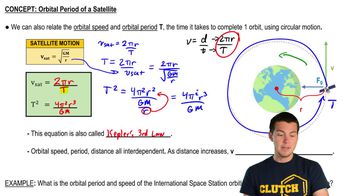
Satellite Period

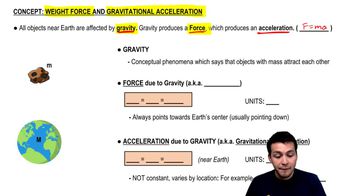
Gravitational Acceleration

Gravitational acceleration (g) is the acceleration of an object due to the force of gravity acting on it. On Earth, g is approximately 9.81 m/s², but it varies on other planets. For example, on Mars, g is about 3.71 m/s². This difference in gravitational acceleration affects the period of a pendulum, as seen in the pendulum period formula.
Video consigliato:
Percorso guidato
07:32
Weight Force & Gravitational Acceleration