Ch 15: Mechanical Waves
Young & Freedman Calc - University Physics 15th Edition
Young & Freedman Calc15th EditionUniversity PhysicsISBN: 9780135159552Non è quello che usi tu?Cambia libro di testo
Capitolo 15, Problema 39a

CALC. A thin, taut string tied at both ends and oscillating in its third harmonic has its shape described by the equation y(x,t)=(5.60 cm)sin[(0.0340 rad/cm)x]sin[(50.0 rad/s)t]y(x,t)=(5.60\(\text{ cm}\))\(\sin\)[(0.0340\(\text{ rad/cm}\))x]\(\sin\)[(50.0\(\text{ rad/s}\))t], where the origin is at the left end of the string, the xx-axis is along the string, and the yy-axis is perpendicular to the string. Draw a sketch that shows the standing-wave pattern.

Guida verificata passo dopo passo
1
Understand the given wave equation: y(x, t) = (5.60 cm) sin[(0.0340 rad/cm)x] sin[(50.0 rad/s)t]. This represents a standing wave on a string.
Identify the harmonic: The equation describes the third harmonic. In a standing wave, the number of antinodes corresponds to the harmonic number. Therefore, there will be three antinodes.
Determine the wavelength: The wave number k is given as 0.0340 rad/cm. The wavelength λ is related to the wave number by the equation k = 2π/λ. Solve for λ to find the wavelength of the wave.
Sketch the wave: For the third harmonic, the string will have three antinodes and two nodes (excluding the endpoints). The nodes are points of zero displacement, and the antinodes are points of maximum displacement.
Label the sketch: Clearly mark the nodes and antinodes on the sketch. The nodes are at the fixed ends and at points along the string where the displacement is always zero. The antinodes are the points of maximum amplitude.

Risposta video verificata per un problema simile:

Questa soluzione video è stata consigliata dai nostri tutor come utile per risolvere questo problema.
Durata del video:
6m

Concetti chiave

Ecco i concetti essenziali che devi comprendere per rispondere correttamente alla domanda.

Standing Waves

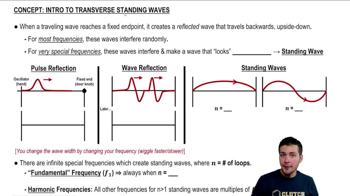
Standing waves are formed when two waves of the same frequency and amplitude travel in opposite directions and interfere with each other. This results in a wave pattern that appears to be stationary, characterized by nodes (points of no displacement) and antinodes (points of maximum displacement). In the context of a string, standing waves occur at specific frequencies known as harmonics.
Video consigliato:
Percorso guidato
07:58
Intro to Transverse Standing Waves

Harmonics

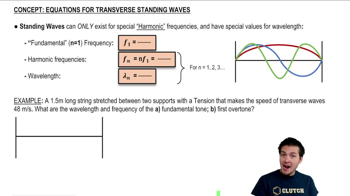
Harmonics are the resonant frequencies at which standing waves are established on a string fixed at both ends. The fundamental frequency, or first harmonic, has one antinode and two nodes at the ends. The third harmonic, as in this problem, has three antinodes and four nodes, indicating that the string vibrates in a more complex pattern with higher frequency.
Video consigliato:
Percorso guidato
07:52
Simple Harmonic Motion of Pendulums

Wave Equation

The wave equation y(x, t) = (5.60 cm) sin[(0.0340 rad/cm)x] sin[(50.0 rad/s)t] describes the displacement of points on the string over time. The spatial component, sin[(0.0340 rad/cm)x], determines the wave's shape along the string, while the temporal component, sin[(50.0 rad/s)t], dictates the oscillation over time. This equation is crucial for visualizing and sketching the standing wave pattern.
Video consigliato:
Percorso guidato
06:28
Equations for Transverse Standing Waves
Pratica correlata
Domanda del libro di testo

The wave function of a standing wave is y(x,t)=4.44 mmsin[(32.5 rad/m)x]sin[(754rad/s)t]y(x,t)=4.44\(\text{ mm}\)\(\sin\)[(32.5\(\text{ rad/m}\))x]\(\sin\)[(754\(\text{rad/s}\))t]. For the two traveling waves that make up this standing wave, find the frequency.

1495
views

Domanda del libro di testo

A wire with mass 40.0 g is stretched so that its ends are tied down at points 80.0 cm apart. The wire vibrates in its fundamental mode with frequency 60.0 Hz and with an amplitude at the antinodes of 0.300 cm. What is the speed of propagation of transverse waves in the wire?

1726
views
Domanda del libro di testo

The wave function of a standing wave is y(x,t)=4.44 mmsin[(32.5 rad/m)x]sin[(754rad/s)t]y(x,t)=4.44\(\text{ mm}\)\(\sin\)[(32.5\(\text{ rad/m}\))x]\(\sin\)[(754\(\text{rad/s}\))t]. For the two traveling waves that make up this standing wave, find the wavelength.

2060
views
Domanda del libro di testo

The wave function of a standing wave is y(x,t)=4.44 mmsin[(32.5 rad/m)x]sin[(754rad/s)t]y(x,t)=4.44\(\text{ mm}\)\(\sin\)[(32.5\(\text{ rad/m}\))x]\(\sin\)[(754\(\text{rad/s}\))t]. For the two traveling waves that make up this standing wave, find the amplitude.

2106
views
Domanda del libro di testo

A piano tuner stretches a steel piano wire with a tension of 800 N. The steel wire is 0.400 m long and has a mass of 3.00 g. What is the frequency of its fundamental mode of vibration?

1899
views
Domanda del libro di testo

A 1.50-m-long rope is stretched between two supports with a tension that makes the speed of transverse waves 62.0 m/s.What are the wavelength and frequency of the fourth harmonic?

1589
views