Ch 15: Mechanical Waves
Young & Freedman Calc - University Physics 15th Edition
Young & Freedman Calc15th EditionUniversity PhysicsISBN: 9780135159552Non è quello che usi tu?Cambia libro di testo
Capitolo 15, Problema 27b

Energy Output. By measurement you determine that sound waves are spreading out equally in all directions from a point source and that the intensity is 0.026 W/m2 at a distance of 4.3 m from the source. How much sound energy does the source emit in one hour if its power output remains constant?

Guida verificata passo dopo passo
1
First, understand that the intensity of a sound wave is defined as the power per unit area. The formula for intensity \( I \) is \( I = \frac{P}{A} \), where \( P \) is the power and \( A \) is the area over which the power is distributed.
Since the sound waves are spreading out equally in all directions, they form a sphere around the point source. The area \( A \) of a sphere is given by \( A = 4\pi r^2 \), where \( r \) is the radius of the sphere.
Substitute the given values into the intensity formula to find the power \( P \). Use \( I = 0.026 \text{ W/m}^2 \) and \( r = 4.3 \text{ m} \) to calculate \( P = I \times A = 0.026 \times 4\pi (4.3)^2 \).
Once you have the power \( P \), calculate the total energy emitted in one hour. Energy \( E \) is the product of power and time, \( E = P \times t \). Convert one hour into seconds (3600 seconds) and use \( E = P \times 3600 \).
Ensure all units are consistent and check your calculations for any errors. The final expression for energy will give you the total sound energy emitted by the source in one hour.

Risposta video verificata per un problema simile:

Questa soluzione video è stata consigliata dai nostri tutor come utile per risolvere questo problema.
Durata del video:
3m

Concetti chiave

Ecco i concetti essenziali che devi comprendere per rispondere correttamente alla domanda.

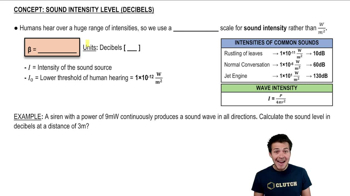
Sound Intensity

Sound intensity is the power per unit area carried by a sound wave, measured in watts per square meter (W/m^2). It describes how much energy passes through a given area and is crucial for determining the energy output of a sound source. In this problem, the intensity at a specific distance helps calculate the total energy emitted.
Video consigliato:
Percorso guidato
04:25
Sound Intensity Level and the Decibel Scale

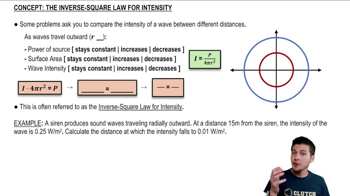
Inverse Square Law

The inverse square law states that the intensity of a wave, such as sound, decreases with the square of the distance from the source. This principle is essential for understanding how sound spreads out in space, affecting the calculation of total energy emitted by the source over a given area.
Video consigliato:
Percorso guidato
05:26
The Inverse-Square Law for Intensity

Power and Energy Relationship

Power is the rate at which energy is emitted or transferred, measured in watts (W). Energy is the total amount of work done or heat transferred, measured in joules (J). The relationship between power and energy is given by the formula: Energy = Power × Time. This concept is key to calculating the total sound energy emitted over a specified time period.
Video consigliato:
Percorso guidato
03:43
Relationships Between Force, Field, Energy, Potential
Pratica correlata
Domanda del libro di testo

A fellow student with a mathematical bent tells you that the wave function of a traveling wave on a thin rope is y(x,t)=(2.30mm)cos[(16.98 rad/m)x+(742 rad/s)t]y(x,t)=\(\left\)(2.30\(\operatorname{mm)}\)\(\cos\)[\(\left\)(16.98\(\text{ }\)rad/m\(\right\))x+(742\(\text{ }\)rad/s\(\right\))t]. Being more practical, you measure the rope to have a length of 1.35 m1.35\(\text{ m}\) and a mass of 0.00338kg0.00338\(\operatorname{kg}\). You are then asked to determine the following: (f) tension in the rope; (g) average power transmitted by the wave.

1591
views
Domanda del libro di testo

A fellow student with a mathematical bent tells you that the wave function of a traveling wave on a thin rope is y(x,t)=(2.30mm)cos[(16.98 rad/m)x+(742 rad/s)t]y(x,t)=\(\left\)(2.30\(\operatorname{mm)}\)\(\cos\)[\(\left\)(16.98\(\text{ }\)rad/m\(\right\))x+(742\(\text{ }\)rad/s\(\right\))t]. Being more practical, you measure the rope to have a length of 1.35 m1.35\(\text{ m}\) and a mass of 0.00338kg0.00338\(\operatorname{kg}\). You are then asked to determine the following: (d) wave speed; (e) direction the wave is traveling;

1586
views
Domanda del libro di testo

A 1.50-m-long rope is stretched between two supports with a tension that makes the speed of transverse waves 62.0 m/s.What are the wavelength and frequency of the second overtone?

1703
views
Domanda del libro di testo

A 1.50-m-long rope is stretched between two supports with a tension that makes the speed of transverse waves 62.0 m/s.What are the wavelength and frequency of the fundamental?

1863
views
Domanda del libro di testo

A 1.50-m-long rope is stretched between two supports with a tension that makes the speed of transverse waves 62.0 m/s.What are the wavelength and frequency of the fourth harmonic?

1589
views
Domanda del libro di testo

Energy Output. By measurement you determine that sound waves are spreading out equally in all directions from a point source and that the intensity is 0.026 W/m2 at a distance of 4.3 m from the source. What is the intensity at a distance of 3.1 m from the source?

1533
views