Ch 16: Sound & Hearing
Young & Freedman Calc - University Physics 15th Edition
Young & Freedman Calc15th EditionUniversity PhysicsISBN: 9780135159552Non è quello che usi tu?Cambia libro di testo
Capitolo 16, Problema 23b

Standing sound waves are produced in a pipe that is 1.20 m long. For the fundamental and first two overtones, determine the locations along the pipe (measured from the left end) of the displacement nodes and the pressure nodes if the pipe is closed at the left end and open at the right end.

Guida verificata passo dopo passo
1
Understand the concept of standing waves in a pipe closed at one end: In such a pipe, the closed end is a displacement node (where the air doesn't move) and a pressure antinode (where the pressure variation is maximum), while the open end is a displacement antinode and a pressure node.
Identify the pattern of nodes and antinodes for the fundamental frequency: For the fundamental frequency (first harmonic), the pipe length is one-quarter of the wavelength (λ/4). Therefore, the displacement node is at the closed end, and the displacement antinode is at the open end.
Calculate the wavelength for the fundamental frequency: Use the relationship between the speed of sound (v), frequency (f), and wavelength (λ): v = f * λ. For the fundamental frequency, the pipe length L = λ/4, so λ = 4L.
Determine the locations of nodes and antinodes for the first overtone: The first overtone (second harmonic) has a pattern where the pipe length is three-quarters of the wavelength (3λ/4). This means there will be one additional displacement node and antinode within the pipe.
Determine the locations of nodes and antinodes for the second overtone: The second overtone (third harmonic) has a pattern where the pipe length is five-quarters of the wavelength (5λ/4). This results in two additional displacement nodes and antinodes within the pipe.

Risposta video verificata per un problema simile:

Questa soluzione video è stata consigliata dai nostri tutor come utile per risolvere questo problema.
Durata del video:
9m

Concetti chiave

Ecco i concetti essenziali che devi comprendere per rispondere correttamente alla domanda.

Standing Waves

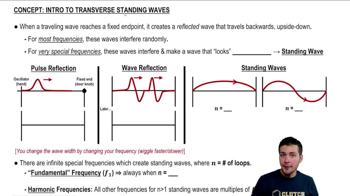
Standing waves are formed by the interference of two waves traveling in opposite directions, resulting in a wave that appears to be stationary. In a pipe, these waves create nodes (points of no displacement) and antinodes (points of maximum displacement), crucial for understanding sound wave patterns in closed and open pipes.
Video consigliato:
Percorso guidato
07:58
Intro to Transverse Standing Waves

Boundary Conditions in Pipes

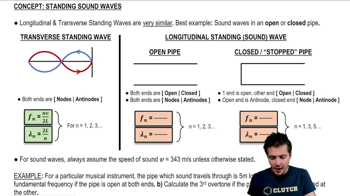
Boundary conditions refer to the constraints at the ends of a pipe that affect wave behavior. In a pipe closed at one end and open at the other, the closed end is a displacement node (pressure antinode), while the open end is a displacement antinode (pressure node). These conditions determine the wave patterns and node locations.
Video consigliato:
Percorso guidato
05:17
Standing Sound Waves

Harmonics and Overtones

Harmonics are integral multiples of the fundamental frequency, and overtones are the frequencies above the fundamental. In a closed-open pipe, the fundamental frequency has one-quarter wavelength, while overtones have additional quarter wavelengths. Understanding harmonics helps locate nodes and antinodes for different frequencies.
Video consigliato:
Percorso guidato
07:52
Simple Harmonic Motion of Pendulums