Ch 16: Sound & Hearing
Young & Freedman Calc - University Physics 15th Edition
Young & Freedman Calc15th EditionUniversity PhysicsISBN: 9780135159552Non è quello che usi tu?Cambia libro di testo
Capitolo 16, Problema 50a

The siren of a fire engine that is driving northward at 30.0 m/s emits a sound of frequency 2000 Hz. A truck in front of this fire engine is moving northward at 20.0 m/s. (a) What is the frequency of the siren's sound that the fire engine's driver hears reflected from the back of the truck?

Guida verificata passo dopo passo
1
Identify the problem as a Doppler effect scenario involving two moving objects: the fire engine and the truck.
Determine the speed of sound in air, which is typically around 343 m/s at room temperature. This will be used as the speed of the medium.
Calculate the frequency of the sound as heard by the truck using the Doppler effect formula for a moving source and a stationary observer: \( f' = f \frac{v + v_o}{v + v_s} \), where \( f \) is the original frequency, \( v \) is the speed of sound, \( v_o \) is the speed of the observer (truck), and \( v_s \) is the speed of the source (fire engine).
Substitute the given values into the formula: \( f' = 2000 \text{ Hz} \times \frac{343 \text{ m/s} + 20.0 \text{ m/s}}{343 \text{ m/s} - 30.0 \text{ m/s}} \). Calculate this intermediate frequency \( f' \) that the truck hears.
Now, consider the truck as the source of the reflected sound and the fire engine as the observer. Use the Doppler effect formula again: \( f'' = f' \frac{v + v_s}{v + v_o} \), where \( f' \) is the frequency heard by the truck, \( v_s \) is now the speed of the truck, and \( v_o \) is the speed of the fire engine. Substitute the values to find the frequency \( f'' \) that the fire engine's driver hears.

Risposta video verificata per un problema simile:

Questa soluzione video è stata consigliata dai nostri tutor come utile per risolvere questo problema.
Durata del video:
7m

Concetti chiave

Ecco i concetti essenziali che devi comprendere per rispondere correttamente alla domanda.

Doppler Effect

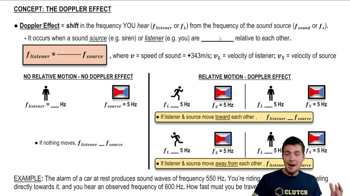
The Doppler Effect describes the change in frequency or wavelength of a wave in relation to an observer moving relative to the wave source. In this scenario, the fire engine and the truck are moving, affecting the frequency of the sound waves perceived by the driver. The relative motion between the source and the observer causes the frequency to increase or decrease depending on their direction.
Video consigliato:
Percorso guidato
07:40
The Doppler Effect

Relative Velocity

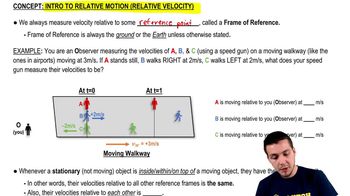
Relative velocity is the velocity of an object as observed from another moving object. It is crucial in this problem to determine the effective speed at which the sound waves are approaching or receding from the truck. The relative velocity between the fire engine and the truck influences the frequency shift experienced due to the Doppler Effect.
Video consigliato:
Percorso guidato
04:27
Intro to Relative Motion (Relative Velocity)

Wave Reflection

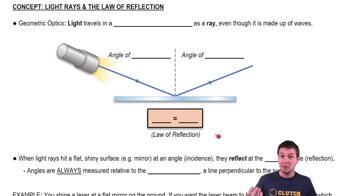
Wave reflection occurs when a wave encounters a surface and bounces back. In this context, the sound waves emitted by the fire engine's siren reflect off the back of the truck. The frequency of the reflected sound waves is affected by the Doppler Effect twice: once when approaching the truck and again when reflecting back towards the fire engine.
Video consigliato:
Percorso guidato
06:25
Law of Reflection