Ch 17: Temperature and Heat
Young & Freedman Calc - University Physics 15th Edition
Young & Freedman Calc15th EditionUniversity PhysicsISBN: 9780135159552Non è quello che usi tu?Cambia libro di testo
Capitolo 17, Problema 17.41

A 6.00-kg piece of solid copper metal at an initial temperature T is placed with 2.00 kg of ice that is initially at -20.0°C. The ice is in an insulated container of negligible mass and no heat is exchanged with the surroundings. After thermal equilibrium is reached, there is 1.20 kg of ice and 0.80 kg of liquid water. What was the initial temperature of the piece of copper?

Guida verificata passo dopo passo
1
Identify the heat transfer processes involved: The copper will lose heat, and the ice will gain heat. The heat gained by the ice will first raise its temperature to 0°C, then melt some of it into water, and finally raise the temperature of the resulting water to the equilibrium temperature.
Use the specific heat capacity formula to calculate the heat lost by the copper: \( Q_{\text{copper}} = m_{\text{copper}} \cdot c_{\text{copper}} \cdot (T_{\text{final}} - T_{\text{initial}}) \), where \( m_{\text{copper}} = 6.00 \text{ kg} \), \( c_{\text{copper}} = 385 \text{ J/kg°C} \), and \( T_{\text{final}} \) is the equilibrium temperature.
Calculate the heat required to raise the temperature of the ice from -20.0°C to 0°C using \( Q_{\text{ice warming}} = m_{\text{ice}} \cdot c_{\text{ice}} \cdot (0 - (-20.0)) \), where \( m_{\text{ice}} = 2.00 \text{ kg} \) and \( c_{\text{ice}} = 2.09 \text{ J/g°C} \).
Calculate the heat required to melt 0.80 kg of ice into water using \( Q_{\text{melting}} = m_{\text{melted ice}} \cdot L_f \), where \( m_{\text{melted ice}} = 0.80 \text{ kg} \) and \( L_f = 334 \text{ kJ/kg} \).
Set up the energy balance equation: The total heat lost by the copper equals the total heat gained by the ice and water. Solve for the initial temperature of the copper using the equation: \( Q_{\text{copper}} = Q_{\text{ice warming}} + Q_{\text{melting}} + Q_{\text{water warming}} \), where \( Q_{\text{water warming}} = m_{\text{water}} \cdot c_{\text{water}} \cdot (T_{\text{final}} - 0) \) and \( c_{\text{water}} = 4.18 \text{ J/g°C} \).

Risposta video verificata per un problema simile:

Questa soluzione video è stata consigliata dai nostri tutor come utile per risolvere questo problema.
Durata del video:
9m

Concetti chiave

Ecco i concetti essenziali che devi comprendere per rispondere correttamente alla domanda.

Heat Transfer

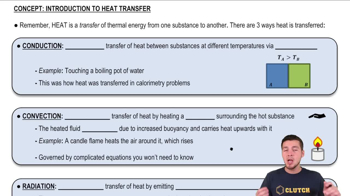
Heat transfer is the process of thermal energy moving from a hotter object to a cooler one until thermal equilibrium is reached. In this scenario, the copper transfers heat to the ice, causing some of it to melt. Understanding the principles of heat transfer, including conduction and the conservation of energy, is crucial for solving this problem.
Video consigliato:
Percorso guidato
05:14
Overview of Heat Transfer

Specific Heat Capacity

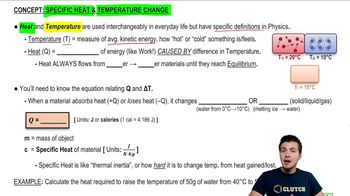
Specific heat capacity is the amount of heat required to change the temperature of a unit mass of a substance by one degree Celsius. For copper, this value is needed to calculate how much heat the copper can release as it cools. This concept helps determine the initial temperature of the copper by equating the heat lost by copper to the heat gained by the ice.
Video consigliato:
Percorso guidato
06:50
Specific Heat & Temperature Changes

Phase Change and Latent Heat

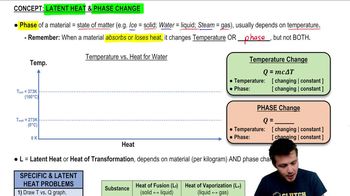
Phase change involves the transformation of a substance from one state of matter to another, such as ice melting into water. Latent heat is the heat absorbed or released during a phase change without a change in temperature. In this problem, the latent heat of fusion for ice is essential to calculate the energy required to melt the ice, which helps in determining the initial temperature of the copper.
Video consigliato:
Percorso guidato
10:40
Latent Heat & Phase Changes
Pratica correlata
Domanda del libro di testo

A steel tank is completely filled with 1.90 m3 of ethanol when both the tank and the ethanol are at 32.0°C. When the tank and its contents have cooled to 18.0°C, what additional volume of ethanol can be put into the tank?

1805
views
Domanda del libro di testo

The pressure of a gas at the triple point of water is 1.351.35 atm. If its volume remains unchanged, what will its pressure be at the temperature at which CO2 solidifies?

2632
views
Domanda del libro di testo

Steel train rails are laid in 12.0-m-long segments placed end to end. The rails are laid on a winter day when their temperature is -9.0°C. How much space must be left between adjacent rails if they are just to touch on a summer day when their temperature is 33.0°C?

1804
views
Domanda del libro di testo

A brass rod is 185 cm long and 1.60 cm in diameter. What force must be applied to each end of the rod to prevent it from contracting when it is cooled from 120.0°C to 10.0°C?

2095
views
Domanda del libro di testo

A geodesic dome constructed with an aluminum framework is a nearly perfect hemisphere; its diameter measures 55.0 m on a winter day at a temperature of -15°C. How much more interior space does the dome have in the summer, when the temperature is 35°C?

1839
views
Domanda del libro di testo

A constant-volume gas thermometer registers an absolute pressure corresponding to 325325 mm of mercury when in contact with water at the triple point. What pressure does it read when in contact with water at the normal boiling point?

2268
views