Ch 17: Temperature and Heat
Young & Freedman Calc - University Physics 15th Edition
Young & Freedman Calc15th EditionUniversity PhysicsISBN: 9780135159552Non è quello che usi tu?Cambia libro di testo
Capitolo 17, Problema 50

A laboratory technician drops a 0.08500.0850-kg sample of unknown solid material, at 100.0100.0°C, into a calorimeter. The calorimeter can, initially at 19.019.0°C, is made of 0.1500.150 kg of copper and contains 0.2000.200 kg of water. The final temperature of the calorimeter can and contents is 26.126.1°C. Compute the specific heat of the sample.

Guida verificata passo dopo passo
1
Identify the principle of conservation of energy, which states that the heat lost by the sample will be equal to the heat gained by the calorimeter and its contents.
Write the equation for heat transfer: \( Q = mc\Delta T \), where \( Q \) is the heat transferred, \( m \) is the mass, \( c \) is the specific heat capacity, and \( \Delta T \) is the change in temperature.
Calculate the heat gained by the copper calorimeter using its specific heat capacity \( c_{\text{Cu}} = 0.385 \text{ J/g°C} \). Use the formula: \( Q_{\text{Cu}} = m_{\text{Cu}} \cdot c_{\text{Cu}} \cdot (T_{\text{final}} - T_{\text{initial, Cu}}) \).
Calculate the heat gained by the water using its specific heat capacity \( c_{\text{water}} = 4.186 \text{ J/g°C} \). Use the formula: \( Q_{\text{water}} = m_{\text{water}} \cdot c_{\text{water}} \cdot (T_{\text{final}} - T_{\text{initial, water}}) \).
Set up the equation for the heat lost by the sample: \( Q_{\text{sample}} = m_{\text{sample}} \cdot c_{\text{sample}} \cdot (T_{\text{initial, sample}} - T_{\text{final}}) \). Solve for \( c_{\text{sample}} \) using the equation: \( Q_{\text{sample}} = Q_{\text{Cu}} + Q_{\text{water}} \).

Risposta video verificata per un problema simile:

Questa soluzione video è stata consigliata dai nostri tutor come utile per risolvere questo problema.
Durata del video:
11m

Concetti chiave

Ecco i concetti essenziali che devi comprendere per rispondere correttamente alla domanda.

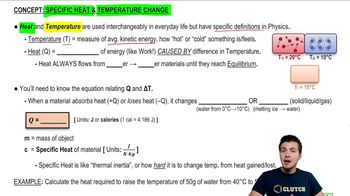
Specific Heat Capacity

Specific heat capacity is the amount of heat required to change the temperature of a unit mass of a substance by one degree Celsius. It is a material-specific property and is crucial in determining how a substance responds to heat energy. In this problem, it helps calculate the heat absorbed or released by the unknown material.
Video consigliato:
Percorso guidato
06:50
Specific Heat & Temperature Changes

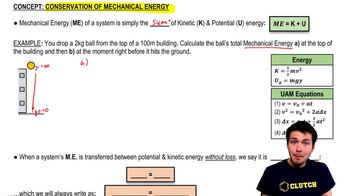
Conservation of Energy

The principle of conservation of energy states that energy cannot be created or destroyed, only transferred or converted from one form to another. In calorimetry, this principle implies that the heat lost by the hot object (the unknown sample) is equal to the heat gained by the cooler objects (the calorimeter and water).
Video consigliato:
Percorso guidato
06:24
Conservation Of Mechanical Energy

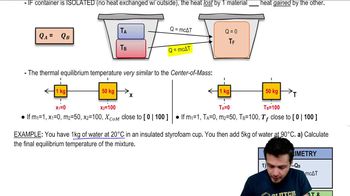
Calorimetry

Calorimetry is the science of measuring the heat of chemical reactions or physical changes. It involves using a calorimeter to measure the heat exchanged between substances. In this scenario, calorimetry is used to determine the specific heat of the unknown sample by analyzing the temperature changes in the calorimeter system.
Video consigliato:
Percorso guidato
06:53
Solving Calorimetry Problems
Pratica correlata
Domanda del libro di testo

An asteroid with a diameter of 10 km and a mass of 2.60 × 10¹⁵ kg impacts the earth at a speed of 32.0 km/s, landing in the Pacific Ocean. If 1.00% of the asteroid's kinetic energy goes to boiling the ocean water (assume an initial water temperature of 10.0°C), what mass of water will be boiled away by the collision? (For comparison, the mass of water contained in Lake Superior is about 2 × 10¹⁵ kg.)

1587
views
Domanda del libro di testo

A 4.004.00-kg silver ingot is taken from a furnace, where its temperature is 750.0750.0°C, and placed on a large block of ice at 0.00.0°C. Assuming that all the heat given up by the silver is used to melt the ice, how much ice is melted?

1323
views
Domanda del libro di testo

A copper pot with a mass of 0.500 kg contains 0.170 kg of water, and both are at 20.0°C. A 0.250-kg block of iron at 85.0°C is dropped into the pot. Find the final temperature of the system, assuming no heat loss to the surroundings.

2283
views
Domanda del libro di testo

Two rods, one made of brass and the other made of copper, are joined end to end. The length of the brass section is 0.300 0.300 m and the length of the copper section is 0.8000.800 m. Each segment has cross-sectional area 0.005000.00500 m2. The free end of the brass segment is in boiling water and the free end of the copper segment is in an ice–water mixture, in both cases under normal atmospheric pressure. The sides of the rods are insulated so there is no heat loss to the surroundings. What mass of ice is melted in 5.005.00 min by the heat conducted by the composite rod?

2891
views
1
rank
Domanda del libro di testo

An ice-cube tray of negligible mass contains 0.290 kg of water at 18.0°C. How much heat must be removed to cool the water to 0.00°C and freeze it? Express your answer in joules, calories, and Btu.

1455
views
Domanda del libro di testo

An insulated beaker with negligible mass contains 0.2500.250 kg of water at 75.075.0°C. How many kilograms of ice at −20.0-20.0°C must be dropped into the water to make the final temperature of the system 40.040.0°C?

2944
views
3
rank