Ch 20: The Second Law of Thermodynamics
Young & Freedman Calc - University Physics 15th Edition
Young & Freedman Calc15th EditionUniversity PhysicsISBN: 9780135159552Non è quello che usi tu?Cambia libro di testo
Capitolo 20, Problema 28a

Two moles of an ideal gas occupy a volume VV. The gas expands isothermally and reversibly to a volume 3V3V. Is the velocity distribution changed by the isothermal expansion? Explain.

Guida verificata passo dopo passo
1
Understand the concept of isothermal expansion: In an isothermal process, the temperature of the system remains constant. For an ideal gas, this means that the internal energy, which depends only on temperature, does not change.
Recall the Maxwell-Boltzmann distribution: The velocity distribution of gas molecules in an ideal gas is described by the Maxwell-Boltzmann distribution, which depends on the temperature of the gas.
Since the process is isothermal, the temperature of the gas remains constant throughout the expansion. Therefore, the parameters that determine the Maxwell-Boltzmann distribution do not change.
Conclude that because the temperature remains constant, the velocity distribution of the gas molecules does not change during the isothermal expansion.
Summarize: In an isothermal expansion of an ideal gas, the velocity distribution remains unchanged because it is solely dependent on the temperature, which is constant in this process.

Risposta video verificata per un problema simile:

Questa soluzione video è stata consigliata dai nostri tutor come utile per risolvere questo problema.
Durata del video:
1m

Concetti chiave

Ecco i concetti essenziali che devi comprendere per rispondere correttamente alla domanda.

Ideal Gas Law

The Ideal Gas Law is a fundamental equation in thermodynamics, expressed as PV = nRT, where P is pressure, V is volume, n is the number of moles, R is the gas constant, and T is temperature. It describes the relationship between these variables for an ideal gas, assuming no interactions between gas molecules and that the volume of the molecules themselves is negligible.
Video consigliato:
Percorso guidato
07:21
Ideal Gases and the Ideal Gas Law

Isothermal Process

An isothermal process is a thermodynamic process in which the temperature of the system remains constant. For an ideal gas undergoing an isothermal expansion, the internal energy remains unchanged, and any work done by the gas is compensated by heat absorbed from the surroundings, maintaining a constant temperature throughout the process.
Video consigliato:
Percorso guidato
06:13
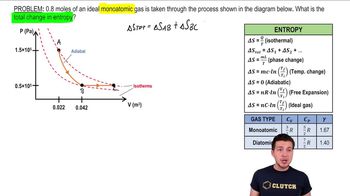
Entropy & Ideal Gas Processes

Maxwell-Boltzmann Distribution

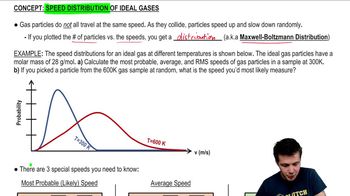
The Maxwell-Boltzmann distribution describes the distribution of speeds among particles in a gas. It is dependent on the temperature and mass of the particles. In an isothermal process, since the temperature remains constant, the velocity distribution of the gas particles does not change, meaning the shape of the distribution curve remains the same.
Video consigliato:
Percorso guidato
07:59
Speed Distribution & Special Speeds of Ideal Gases