
Ch 21: Electric Charge and Electric Field
Young & Freedman Calc - University Physics 15th Edition
Young & Freedman Calc15th EditionUniversity PhysicsISBN: 9780135159552Non è quello che usi tu?Cambia libro di testo
Capitolo 21, Problema 44

A point charge q1=−4.00q_1=-4.00 nC is at the point x=0.600x = 0.600 m, y=0.800y = 0.800 m, and a second point charge q2=+6.00q_2=+6.00 nC is at the point x=0.600x = 0.600 m, y=0y = 0. Calculate the magnitude and direction of the net electric field at the origin due to these two point charges.

Guida verificata passo dopo passo
1
Identify the positions of the charges: q1 = -4.00 nC is at (0.600 m, 0.800 m) and q2 = +6.00 nC is at (0.600 m, 0). The origin is at (0, 0).
Calculate the distance from each charge to the origin using the distance formula: \( r = \sqrt{(x_2 - x_1)^2 + (y_2 - y_1)^2} \). For q1, the distance is \( r_1 = \sqrt{(0.600)^2 + (0.800)^2} \). For q2, the distance is \( r_2 = 0.600 \) m.
Use Coulomb's Law to find the electric field due to each charge at the origin. The electric field \( E \) due to a point charge is given by \( E = \frac{k |q|}{r^2} \), where \( k \) is Coulomb's constant \( 8.99 \times 10^9 \text{ N m}^2/\text{C}^2 \). Calculate \( E_1 \) for q1 and \( E_2 \) for q2.
Determine the direction of each electric field vector. The electric field due to a negative charge points towards the charge, while the field due to a positive charge points away. For q1, the field points towards (0.600 m, 0.800 m), and for q2, it points away from (0.600 m, 0).
Calculate the net electric field at the origin by vector addition of \( E_1 \) and \( E_2 \). Break each electric field into components, sum the components, and use the Pythagorean theorem to find the magnitude of the resultant vector. Use trigonometry to find the direction of the net electric field.

Risposta video verificata per un problema simile:

Questa soluzione video è stata consigliata dai nostri tutor come utile per risolvere questo problema.
Durata del video:
17m

Concetti chiave

Ecco i concetti essenziali che devi comprendere per rispondere correttamente alla domanda.

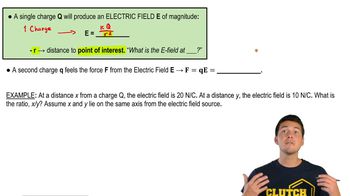
Electric Field Due to a Point Charge

The electric field (E) created by a point charge (q) at a distance (r) is given by Coulomb's law: E = k|q|/r², where k is Coulomb's constant. The direction of the field is radially outward from a positive charge and inward towards a negative charge. This concept helps determine the individual electric fields at the origin due to each charge.
Video consigliato:
Percorso guidato
06:28
Electric Field due to a Point Charge

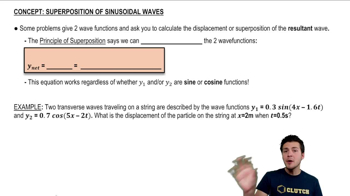
Superposition Principle

The superposition principle states that the net electric field due to multiple charges is the vector sum of the electric fields produced by each charge independently. This principle is crucial for calculating the net electric field at the origin by adding the contributions from both q1 and q2, considering their magnitudes and directions.
Video consigliato:
Percorso guidato
03:32
Superposition of Sinusoidal Wave Functions

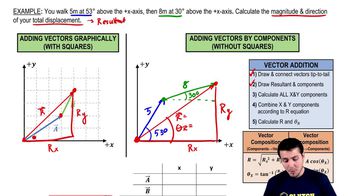
Vector Addition

Vector addition involves combining vectors by adding their corresponding components. For electric fields, this means summing the x and y components separately to find the resultant vector. This concept is essential for determining the magnitude and direction of the net electric field at the origin from the individual fields of q1 and q2.
Video consigliato:
Percorso guidato
07:30
Vector Addition By Components
Pratica correlata
Domanda del libro di testo

A point charge is placed at each corner of a square with side length aa. All charges have magnitude qq. Two of the charges are positive and two are negative (Fig. E21.4221.42). What is the direction of the net electric field at the center of the square due to the four charges, and what is its magnitude in terms of qq and aa?

3269
views
1
rank
Domanda del libro di testo

Point charges q1=−4.5q_1=-4.5 nC and q2=+4.5q_2=+4.5 nC are separated by 3.13.1 mm, forming an electric dipole. The charges are in a uniform electric field whose direction makes an angle of 36.936.9° with the line connecting the charges. What is the magnitude of this field if the torque exerted on the dipole has magnitude 7.2×10−97.2\(\times\)10^{-9} Nm?

2827
views
2
rank
Domanda del libro di testo

An electric dipole with dipole moment p p is in a uniform external electric field EE. Find the orientations of the dipole for which the torque on the dipole is zero.

2980
views
Domanda del libro di testo

A −4.00-4.00-nC point charge is at the origin, and a second −5.00-5.00-nC point charge is on the xx-axis at x=0.800x = 0.800 m. Find the electric field (magnitude and direction) at each of the following points on the xx-axis: (i) x=0.200x = 0.200 m; (ii) x=1.20x = 1.20 m; (iii) x=−0.200x = -0.200 m.

3214
views
Domanda del libro di testo

A very long, straight wire has charge per unit length 3.20×10−103.20\(\times\)10^{-10} C/m. At what distance from the wire is the electric field magnitude equal to 2.502.50 N/C?

3899
views
Domanda del libro di testo

A −4.00-4.00-nC point charge is at the origin, and a second −5.00-5.00-nC point charge is on the xx-axis at x=0.800x = 0.800 m. Find the net electric force that the two charges would exert on an electron placed at each point in part (a). Note: Part (a) asked to find the electric field (magnitude and direction) at each of the following points on the xx-axis: (i) x=0.200x = 0.200 m; (ii) x=1.20x = 1.20 m; (iii) x=−0.200x = -0.200 m.

4118
views