Ch 21: Electric Charge and Electric Field
Young & Freedman Calc - University Physics 15th Edition
Young & Freedman Calc15th EditionUniversity PhysicsISBN: 9780135159552Non è quello che usi tu?Cambia libro di testo
Capitolo 21, Problema 13

Three point charges are arranged on a line. Charge q3=+5.00q_3=+5.00 nC and is at the origin. Charge q2=−3.00q_2=-3.00 nC and is at x=+4.00x = +4.00 cm. Charge q1q_1 is at x=+2.00x = +2.00 cm. What is q1q_1 (magnitude and sign) if the net force on q3q_3 is zero?

Guida verificata passo dopo passo
1
Understand that the net force on q3 is zero, meaning the forces exerted by q1 and q2 on q3 must be equal in magnitude but opposite in direction.
Use Coulomb's Law to express the force between two point charges: F=k⁢q⁢q⁢r⁢rr2, where k is Coulomb's constant, q are the charges, and r is the distance between them.
Calculate the force exerted by q2 on q3 using the formula: F=k⁢3.00⁢5.00⁢10⁢-920.042.
Set up the equation for the force exerted by q1 on q3 to be equal in magnitude to the force exerted by q2 on q3: k⁢q⁢5.00⁢10⁢-920.022=k⁢3.00⁢5.00⁢10⁢-920.042.
Solve for q1, ensuring that the sign of q1 is such that the direction of the force it exerts on q3 is opposite to the force exerted by q2 on q3.

Risposta video verificata per un problema simile:

Questa soluzione video è stata consigliata dai nostri tutor come utile per risolvere questo problema.
Durata del video:
10m

Concetti chiave

Ecco i concetti essenziali che devi comprendere per rispondere correttamente alla domanda.

Coulomb's Law

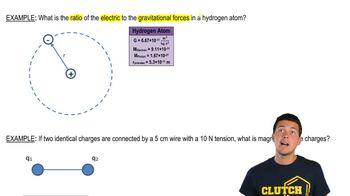
Coulomb's Law describes the electrostatic force between two point charges. The force is directly proportional to the product of the magnitudes of the charges and inversely proportional to the square of the distance between them. The force is attractive if the charges are of opposite signs and repulsive if they are of the same sign.
Video consigliato:

Superposition Principle

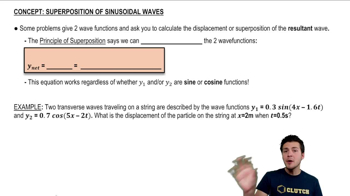
The superposition principle states that the net force on a charge is the vector sum of all individual forces acting on it. In this problem, the net force on charge q3 is the sum of the forces due to q1 and q2. For the net force to be zero, these forces must be equal in magnitude and opposite in direction.
Video consigliato:
Percorso guidato
03:32
Superposition of Sinusoidal Wave Functions

Equilibrium of Forces

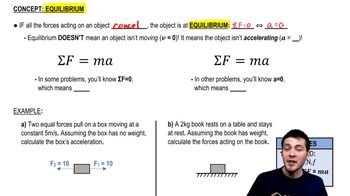
Equilibrium occurs when the net force acting on an object is zero, resulting in no acceleration. In the context of electrostatics, this means that the forces due to surrounding charges must balance each other out. For q3 to be in equilibrium, the forces exerted by q1 and q2 must cancel each other out, allowing us to solve for the unknown charge q1.
Video consigliato:
Pratica correlata
Domanda del libro di testo

Three point charges are arranged along the xx-axis. Charge q1=+3.00q_1=+3.00 μ\(\mu\)C is at the origin, and charge q2=−5.00q_2=-5.00 μ\(\mu\)C is at x=0.200x = 0.200 m. Charge q2=−8.00q_2=-8.00 μ\(\mu\)C. Where is q3q_3 located if the net force on q1q_1 is 7.007.00 N in the −x-x-direction?

3603
views
Domanda del libro di testo

A uniform electric field exists in the region between two oppositely charged plane parallel plates. A proton is released from rest at the surface of the positively charged plate and strikes the surface of the opposite plate, 1.601.60 cm distant from the first, in a time interval of 3.20×10−63.20\(\times\)10^{-6} s. Find the magnitude of the electric field.

3234
views
Domanda del libro di testo

A uniform electric field exists in the region between two oppositely charged plane parallel plates. A proton is released from rest at the surface of the positively charged plate and strikes the surface of the opposite plate, 1.601.60 cm distant from the first, in a time interval of 3.20×10−63.20\(\times\)10^{-6} s. Find the speed of the proton when it strikes the negatively charged plate.

1542
views
Domanda del libro di testo

Two small plastic spheres are given positive electric charges. When they are 15.015.0 cm apart, the repulsive force between them has magnitude 0.2200.220 N. What is the charge on each sphere if the two charges are equal?

2071
views
Domanda del libro di testo

The nuclei of large atoms, such as uranium, with 9292 protons, can be modeled as spherically symmetric spheres of charge. The radius of the uranium nucleus is approximately 7.4×10−157.4\(\times\)10^{-15} m. What magnitude of electric field does it produce at the distance of the electrons, which is about 1.0×10−101.0\(\times\)10^{-10} m?

1932
views
Domanda del libro di testo

Two small plastic spheres are given positive electric charges. When they are 15.015.0 cm apart, the repulsive force between them has magnitude 0.2200.220 N. What is the charge on each sphere if one sphere has four times the charge of the other?

4078
views