
Ch 22: Gauss' Law
Young & Freedman Calc - University Physics 15th Edition
Young & Freedman Calc15th EditionUniversity PhysicsISBN: 9780135159552Non è quello che usi tu?Cambia libro di testo
Capitolo 22, Problema 16c

Some planetary scientists have suggested that the planet Mars has an electric field somewhat similar to that of the earth, producing a net electric flux of −3.63×10¹⁶-3.63\(\times\)10^{16} Nm2/C at the planet's surface. Calculate the charge density on Mars, assuming all the charge is uniformly distributed over the planet's surface.

Guida verificata passo dopo passo
1
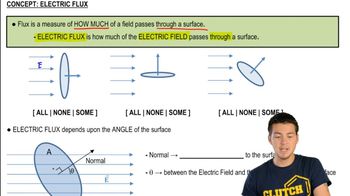
First, understand the concept of electric flux. Electric flux (Φ) is the measure of the electric field passing through a given area. It is given by the formula: Φ=EAcosθ, where E is the electric field, A is the area, and θ is the angle between the field lines and the normal to the surface.
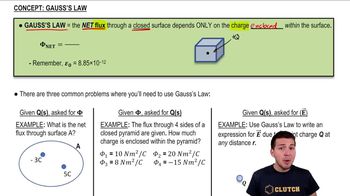
Next, recall Gauss's Law, which relates the electric flux through a closed surface to the charge enclosed by that surface. Gauss's Law is expressed as: Φ=Qε, where Q is the total charge enclosed and ε is the permittivity of free space (ε=8.85×10⁻12C²N⁻1m⁻2).
To find the charge density (σ), use the formula: σ=QA, where A is the surface area of Mars. The surface area of a sphere is given by: A=4πr², with r being the radius of Mars.
Combine Gauss's Law and the formula for charge density to express σ in terms of Φ and ε: σ=Φε×4πr². This equation allows you to calculate the charge density using the given electric flux and known values.
Finally, substitute the given values into the equation. Use the electric flux value of -3.63×10¹⁶ N·m²/C, the permittivity of free space, and the radius of Mars (approximately 3.39×10⁶ m) to find the charge density.

Risposta video verificata per un problema simile:

Questa soluzione video è stata consigliata dai nostri tutor come utile per risolvere questo problema.
Durata del video:
2m

Concetti chiave

Ecco i concetti essenziali che devi comprendere per rispondere correttamente alla domanda.

Electric Flux

Electric flux is a measure of the electric field passing through a given surface. It is calculated as the product of the electric field and the area perpendicular to the field. In this context, it helps quantify the electric field generated by Mars, which is crucial for determining the charge distribution on its surface.
Video consigliato:

Gauss's Law

Gauss's Law relates the electric flux through a closed surface to the charge enclosed by that surface. It states that the total electric flux is equal to the enclosed charge divided by the permittivity of free space. This principle is essential for calculating the charge density on Mars by using the given electric flux value.
Video consigliato:

Charge Density

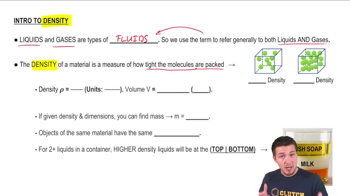
Charge density refers to the amount of electric charge per unit area on a surface. It is calculated by dividing the total charge by the surface area. Understanding charge density is crucial for determining how the electric charge is distributed across Mars's surface, assuming uniform distribution as stated in the problem.
Video consigliato:
Percorso guidato
8:13
Intro to Density
Pratica correlata
Domanda del libro di testo

The nuclei of large atoms, such as uranium, with 9292 protons, can be modeled as spherically symmetric spheres of charge. The radius of the uranium nucleus is approximately 7.4×10−157.4\(\times\)10^{-15} m. The electrons can be modeled as forming a uniform shell of negative charge. What net electric field do they produce at the location of the nucleus?

3138
views
Domanda del libro di testo

A hollow, conducting sphere with an outer radius of 0.2500.250 m and an inner radius of 0.2000.200 m has a uniform surface charge density of +6.37×10⁻⁶+6.37\(\times\)10^{-6} C/m2. A charge of −0.500−0.500 μ\(\mu\)C is now introduced at the center of the cavity inside the sphere. What is the new charge density on the outside of the sphere?

1998
views
Domanda del libro di testo

Some planetary scientists have suggested that the planet Mars has an electric field somewhat similar to that of the earth, producing a net electric flux of −3.63×10¹⁶-3.63\(\times\)10^{16} Nm2/C at the planet's surface. Calculate the electric field at the planet's surface (refer to the astronomical data inside the back cover).

2200
views
Domanda del libro di testo

A very long uniform line of charge has charge per unit length 4.804.80 μ\(\mu\)C/m and lies along the xx-axis. A second long uniform line of charge has charge per unit length −2.40-2.40 μ\(\mu\)C/m and is parallel to the xx-axis at y=0.400y = 0.400 m. What is the net electric field (magnitude and direction) at the following points on the yy-axis: (a) y=0.200y = 0.200 m and (b) y=0.600 y = 0.600 m?

340
views
Domanda del libro di testo

A hollow, conducting sphere with an outer radius of 0.2500.250 m and an inner radius of 0.2000.200 m has a uniform surface charge density of +6.37×10⁻⁶+6.37\(\times\)10^{-6} C/m2. A charge of −0.500−0.500 μ\(\mu\)C is now introduced at the center of the cavity inside the sphere. Calculate the strength of the electric field just outside the sphere?

3585
views
Domanda del libro di testo

Some planetary scientists have suggested that the planet Mars has an electric field somewhat similar to that of the earth, producing a net electric flux of −3.63×10¹⁶-3.63\(\times\)10^{16} Nm2/C at the planet's surface. Calculate the total electric charge on the planet.

1598
views
2
rank