
Ch 23: Electric Potential
Young & Freedman Calc - University Physics 15th Edition
Young & Freedman Calc15th EditionUniversity PhysicsISBN: 9780135159552Non è quello che usi tu?Cambia libro di testo
Capitolo 23, Problema 41e

Suppose the charge on the outer sphere is not −q-q but a negative charge of different magnitude, say −Q-Q. Show that the answers for parts (b) and (c) are the same as before but the answer for part (d) is different. Note: Part (a) asked to calculate the potential V(r)V(r) for (i) r<rar < r_a; (ii) ra<r<rbr_a < r < r_b; (iii) r>rbr > r_b. (Hint: The net potential is the sum of the potentials due to the individual spheres.) Take VV to be zero when rr is infinite. Part (b) asked to show that the potential of the inner sphere with respect to the outer is Vab=q/(4πϵ0)(1/ra−1/rb)V_ab=q/(4πϵ_0 ) (1/r_a -1/r_b). Part (c) asked to use Er=−∂V/∂r=(−∂/∂r)(1/(4πϵ0)q/r)=[1/(4πϵ0)](q/r2)E_r=-∂V/∂r=(-∂/∂r) (1/(4πϵ_0 ) q/r)=[1/(4πϵ_0 )](q/r^2) and the result from part (a) to show that the electric field at any point between the spheres has magnitude E(r)=[Vab/(1/ra−1/rb)](1/r2)E(r)=[V_ab/(1/r_a -1/r_b )](1/r^2). Part (d) asked to use Er=[1/(4πϵ0)](q/r2)E_r = [1/(4πϵ_0 )](q/r^2) and the result from part (a) to find the electric field at a point outside the larger sphere at a distance rr from the center, where r>rbr > r_b.

Guida verificata passo dopo passo
1
Step 1: For part (a), calculate the potential V(r) for different regions. (i) For r < r_a, the potential inside a charged sphere is constant and equal to the potential on its surface. Use V(r) = q / (4πϵ_0 r_a). (ii) For r_a < r < r_b, use the principle of superposition. The potential is the sum of the potentials due to the inner sphere and the outer shell. Calculate V(r) = q / (4πϵ_0 r) for the inner sphere and add the constant potential from the outer shell. (iii) For r > r_b, the potential is due to the net charge, which is zero, so V(r) = 0.
Step 2: For part (b), calculate the potential difference between the inner and outer spheres. Use the formula V_ab = V(r_a) - V(r_b). Substitute the expressions for V(r_a) and V(r_b) from part (a) to show that V_ab = q / (4πϵ_0) (1/r_a - 1/r_b).
Step 3: For part (c), use the expression for the electric field E_r = -∂V/∂r. Substitute the potential V(r) from part (a) for the region r_a < r < r_b. Differentiate to find E(r) = [V_ab / (1/r_a - 1/r_b)] (1/r^2).
Step 4: For part (d), use the expression for the electric field outside a charged sphere, E_r = [1/(4πϵ_0)](q/r^2). Since the net charge is zero, the electric field outside the larger sphere is E(r) = 0 for r > r_b.
Step 5: For part (e), consider the case where the charge on the outer sphere is -Q instead of -q. The potential difference V_ab and the electric field E(r) between the spheres remain the same because they depend only on the charge of the inner sphere and the geometry. However, for r > r_b, the electric field is now due to a net charge of q - Q, so E(r) = [1/(4πϵ_0)]((q - Q)/r^2).

Risposta video verificata per un problema simile:

Questa soluzione video è stata consigliata dai nostri tutor come utile per risolvere questo problema.
Durata del video:
16m

Concetti chiave

Ecco i concetti essenziali che devi comprendere per rispondere correttamente alla domanda.

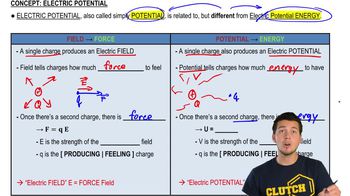
Electric Potential

Electric potential, V, is the work done per unit charge in bringing a positive test charge from infinity to a point in space. It is a scalar quantity and is measured in volts. In this problem, the potential at a point is the sum of potentials due to the inner and outer spheres, considering the reference point at infinity where V is zero.
Video consigliato:
Percorso guidato
07:33
Electric Potential

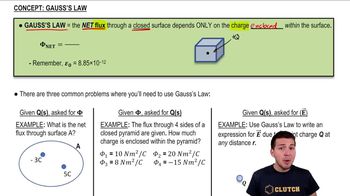
Gauss's Law

Gauss's Law relates the electric field E to the charge distribution. It states that the electric flux through a closed surface is proportional to the enclosed charge. For spherical symmetry, it simplifies the calculation of electric fields, allowing us to determine E(r) based on the charge within a sphere of radius r, crucial for parts (c) and (d) of the problem.
Video consigliato:

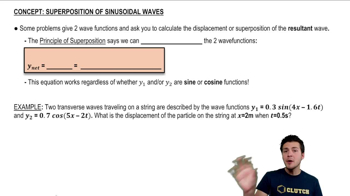
Superposition Principle

The superposition principle states that the net potential or electric field at a point is the vector sum of potentials or fields due to individual charges. This principle is essential for calculating the potential V(r) and electric field E(r) in the regions between and outside the spheres, as it allows us to consider the effects of each sphere separately and then combine them.
Video consigliato:
Percorso guidato
03:32
Superposition of Sinusoidal Wave Functions
Pratica correlata
Domanda del libro di testo

A metal sphere with radius ra r_a is supported on an insulating stand at the center of a hollow, metal, spherical shell with radius rbr_b. There is charge +q+q on the inner sphere and charge −q-q on the outer spherical shell. Use Er=[1/(4πϵ0)](q/r2)E_r = [1/(4πϵ_0 )](q/r^2) and the result from part (a) to find the electric field at a point outside the larger sphere at a distance rr from the center, where r>rbr > r_b. Note: Part (a) asked to calculate the potential V(r)V(r) for (i) r<rar < r_a; (ii) ra<r<rbr_a < r < r_b; (iii) r>rbr > r_b. (Hint: The net potential is the sum of the potentials due to the individual spheres.) Take VV to be zero when rr is infinite..

3353
views
Domanda del libro di testo

A metal sphere with radius ra r_a is supported on an insulating stand at the center of a hollow, metal, spherical shell with radius rbr_b. There is charge +q+q on the inner sphere and charge −q-q on the outer spherical shell. Show that the potential of the inner sphere with respect to the outer is Vab=q/(4πϵ0)(1/ra−1/rb)V_ab=q/(4πϵ_0 ) (1/r_a -1/r_b).

1897
views
1
rank
Domanda del libro di testo

A very large plastic sheet carries a uniform charge density of −6.00-6.00 nC/m2 on one face. As you move away from the sheet along a line perpendicular to it, does the potential increase or decrease? How do you know, without doing any calculations? Does your answer depend on where you choose the reference point for potential?

2645
views
Domanda del libro di testo

A metal sphere with radius ra r_a is supported on an insulating stand at the center of a hollow, metal, spherical shell with radius rbr_b. There is charge +q+q on the inner sphere and charge −q-q on the outer spherical shell. Use Er=−∂V/∂r=(−∂/∂r)(1/(4πϵ0)q/r)=[1/(4πϵ0)](q/r2)E_r=-∂V/∂r=(-∂/∂r) (1/(4πϵ_0 ) q/r)=[1/(4πϵ_0 )](q/r^2) and the result from part (a) to show that the electric field at any point between the spheres has magnitude E(r)=[Vab/(1/ra−1/rb)](1/r2)E(r)=[V_ab/(1/r_a -1/r_b )](1/r^2). Note: Part (a) asked to calculate the potential V(r)V(r) for (i) r<rar < r_a; (ii) ra<r<rbr_a < r < r_b; (iii) r>rbr > r_b. (Hint: The net potential is the sum of the potentials due to the individual spheres.) Take VV to be zero when rr is infinite..

1671
views