Ch 25: Current, Resistance, and EMF
Young & Freedman Calc - University Physics 15th Edition
Young & Freedman Calc15th EditionUniversity PhysicsISBN: 9780135159552Non è quello che usi tu?Cambia libro di testo
Capitolo 25, Problema 34a

When a resistor with resistance RR is connected to a 1.501.50-V flashlight battery, the resistor consumes 0.06250.0625 W of electrical power. (Throughout, assume that each battery has negligible internal resistance.) What power does the resistor consume if it is connected to a 12.612.6-V car battery? Assume that RR remains constant when the power consumption changes.

Guida verificata passo dopo passo
1
Start by recalling the formula for electrical power consumed by a resistor: P = V^2 / R, where P is the power, V is the voltage, and R is the resistance.
Given the initial conditions with the flashlight battery: P = 0.0625 W and V = 1.50 V, use the formula to solve for the resistance R. Rearrange the formula to R = V^2 / P.
Substitute the known values into the rearranged formula: R = (1.50^2) / 0.0625.
Now, use the resistance R calculated from the flashlight battery scenario to find the power consumed when connected to the car battery with a voltage of 12.6 V. Use the formula P = V^2 / R again.
Substitute the car battery voltage and the previously calculated resistance into the formula: P = (12.6^2) / R, where R is the resistance found in step 3.

Risposta video verificata per un problema simile:

Questa soluzione video è stata consigliata dai nostri tutor come utile per risolvere questo problema.

Concetti chiave

Ecco i concetti essenziali che devi comprendere per rispondere correttamente alla domanda.

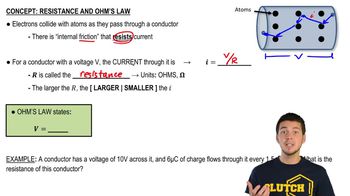
Ohm's Law

Ohm's Law states that the current through a conductor between two points is directly proportional to the voltage across the two points, and inversely proportional to the resistance. It is expressed as V = IR, where V is voltage, I is current, and R is resistance. This law is fundamental in calculating the current and understanding how voltage and resistance affect power consumption.
Video consigliato:
Percorso guidato
03:07
Resistance and Ohm's Law

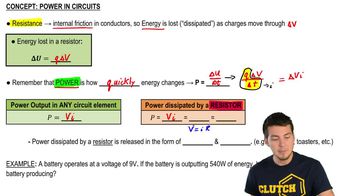
Power in Electrical Circuits

Electrical power is the rate at which electrical energy is transferred by an electric circuit. The power consumed by a resistor can be calculated using the formula P = VI, where P is power, V is voltage, and I is current. Alternatively, it can be expressed as P = V^2/R when the resistance is constant, which is useful for determining power consumption with different voltage sources.
Video consigliato:
Percorso guidato
06:18
Power in Circuits

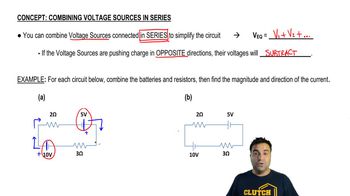
Voltage Source Impact

The voltage source impacts the power consumed by a resistor. When the voltage increases, assuming resistance remains constant, the power consumed by the resistor increases quadratically according to the formula P = V^2/R. Understanding how different voltage sources affect power consumption is crucial for predicting changes in electrical circuits.
Video consigliato:
Percorso guidato
04:01
Combining Voltage Sources in Series