
Four long, parallel power lines each carry 100 A currents. A cross-sectional diagram of these lines is a square, 20.0 cm on each side. For each of the three cases shown in Fig. E28.25, calculate the magnetic field at the center of the square.
Ch 28: Sources of Magnetic Field
Young & Freedman Calc15th EditionUniversity PhysicsISBN: 9780135159552Non è quello che usi tu?Cambia libro di testo
Capitolo 28, Problema 20
Currents in dc transmission lines can be 100 A or higher. Some people are concerned that the electromagnetic fields from such lines near their homes could pose health dangers. For a line that has current 150 A and a height of 8.0 m above the ground, what magnetic field does the line produce at ground level? Express your answer in teslas and as a percentage of the earth's magnetic field, which is 0.50 G. Is this value cause for worry?
Guida verificata passo dopo passo1
To find the magnetic field produced by a long, straight current-carrying wire at a point, we use the formula for the magnetic field (B) at a distance (r) from the wire: \( B = \frac{\mu_0 I}{2\pi r} \), where \( \mu_0 \) is the permeability of free space (\( 4\pi \times 10^{-7} \) T·m/A), \( I \) is the current, and \( r \) is the distance from the wire.
Substitute the given values into the formula: \( I = 150 \) A and \( r = 8.0 \) m. This will allow you to calculate the magnetic field at ground level.
Convert the Earth's magnetic field from gauss to teslas for comparison. Recall that 1 G = \( 10^{-4} \) T, so 0.50 G = \( 0.50 \times 10^{-4} \) T.
Calculate the percentage of the magnetic field produced by the transmission line relative to the Earth's magnetic field using the formula: \( \text{Percentage} = \left( \frac{B_{\text{line}}}{B_{\text{earth}}} \right) \times 100 \% \).
Discuss whether the calculated magnetic field value is a cause for concern by comparing it to typical environmental magnetic field levels and health guidelines.

Risposta video verificata per un problema simile:
Questa soluzione video è stata consigliata dai nostri tutor come utile per risolvere questo problema.
Durata del video:
4mConcetti chiave
Ecco i concetti essenziali che devi comprendere per rispondere correttamente alla domanda.
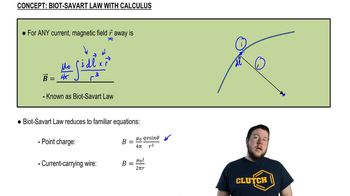
Biot-Savart Law
The Biot-Savart Law describes the magnetic field generated by a steady current. It states that the magnetic field at a point in space is proportional to the current and inversely proportional to the distance from the current. This law is essential for calculating the magnetic field produced by the transmission line at ground level.
Video consigliato:
Percorso guidato
Biot-Savart Law with Calculus
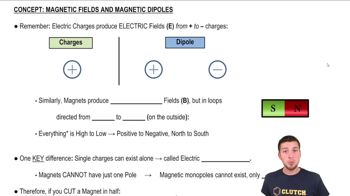
Magnetic Field Units
Magnetic fields are measured in teslas (T), where 1 T = 10,000 gauss (G). Understanding these units is crucial for converting the calculated magnetic field into a percentage of the Earth's magnetic field, which is typically around 0.50 G. This conversion helps assess the relative strength of the field produced by the transmission line.
Video consigliato:
Percorso guidato
Magnetic Fields and Magnetic Dipoles
Health Effects of Electromagnetic Fields
Electromagnetic fields (EMFs) are often scrutinized for potential health risks. While high levels of EMFs can be harmful, the fields produced by typical transmission lines are generally considered safe. Evaluating the calculated magnetic field against known safety standards helps determine if the field poses any health concerns.
Video consigliato:
Percorso guidato
The Doppler Effect
Pratica correlata
Domanda del libro di testo
2272
views
4
rank
Domanda del libro di testo
Two long, parallel wires are separated by a distance of 0.400 m (Fig. E28.29). The currents I1 and I2 have the directions shown. Each current is doubled, so that I1 becomes 10.0 A and I2 becomes 4.00 A. Now what is the magnitude of the force that each wire exerts on a 1.20 m length of the other?
1449
views
Domanda del libro di testo
Two long, parallel wires are separated by a distance of 0.400 m (Fig. E28.29). The currents I1 and I2 have the directions shown. Calculate the magnitude of the force exerted by each wire on a 1.20-m length of the other. Is the force attractive or repulsive?
1775
views
