Ch 30: Inductance
Young & Freedman Calc - University Physics 15th Edition
Young & Freedman Calc15th EditionUniversity PhysicsISBN: 9780135159552Non è quello che usi tu?Cambia libro di testo
Capitolo 30, Problema 39b

An L-R-C series circuit has L = 0.450 H, C = 2.50 × 10⁻⁵ F, and resistance R. What value must R have to give a 5.0% decrease in angular frequency compared to the value calculated in part (a)?

Guida verificata passo dopo passo
1
First, recall the formula for the angular frequency \( \omega_0 \) of an L-R-C series circuit without resistance: \( \omega_0 = \frac{1}{\sqrt{LC}} \). Substitute the given values for L and C to find \( \omega_0 \).
Next, understand that the presence of resistance R in the circuit modifies the angular frequency to \( \omega = \sqrt{\omega_0^2 - \left(\frac{R}{2L}\right)^2} \). This is the formula for the damped angular frequency.
To achieve a 5.0% decrease in angular frequency, set \( \omega = 0.95 \omega_0 \). Substitute \( \omega_0 \) from step 1 into this equation.
Rearrange the equation \( \omega = \sqrt{\omega_0^2 - \left(\frac{R}{2L}\right)^2} = 0.95 \omega_0 \) to solve for R. This involves isolating \( \left(\frac{R}{2L}\right)^2 \) and then taking the square root.
Finally, substitute the known values for L and \( \omega_0 \) into the rearranged equation to find the value of R that results in the desired decrease in angular frequency.

Risposta video verificata per un problema simile:

Questa soluzione video è stata consigliata dai nostri tutor come utile per risolvere questo problema.
Durata del video:
4m

Concetti chiave

Ecco i concetti essenziali che devi comprendere per rispondere correttamente alla domanda.

Angular Frequency in L-R-C Circuits

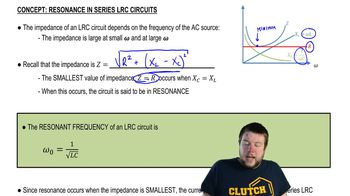
Angular frequency in an L-R-C circuit is determined by the formula ω = 1/√(LC), where L is inductance and C is capacitance. This frequency represents the rate of oscillation of the circuit's current and voltage. In the context of the question, understanding how resistance affects this frequency is crucial for determining the required decrease.
Video consigliato:

Damping in RLC Circuits

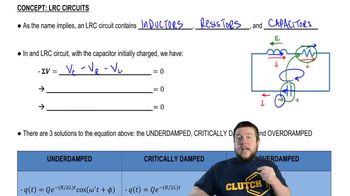
Damping refers to the reduction in amplitude of oscillations in a circuit due to resistance. In an L-R-C circuit, resistance causes energy loss, affecting the angular frequency. The damping factor, which includes resistance, modifies the natural frequency, leading to a decrease in angular frequency as resistance increases.
Video consigliato:

Quality Factor and Resonance

The quality factor (Q) of an L-R-C circuit is a measure of its resonance sharpness, defined as Q = ωL/R. It indicates how underdamped the circuit is, affecting the angular frequency. A decrease in Q due to increased resistance results in a lower angular frequency, which is essential for calculating the required resistance for a specific frequency change.
Video consigliato:
Percorso guidato
05:23
Resonance in Series LRC Circuits