
Ch 34: Geometric Optics
Young & Freedman Calc - University Physics 15th Edition
Young & Freedman Calc15th EditionUniversity PhysicsISBN: 9780135159552Non è quello che usi tu?Cambia libro di testo
Capitolo 33, Problema 55

BIO Ordinary Glasses. Ordinary glasses are worn in front of the eye and usually 2.0 cm in front of the eyeball. Suppose that the person in Exercise 34.52 prefers ordinary glasses to contact lenses. What focal length lenses are needed to correct his vision, and what is their power in diopters?

Guida verificata passo dopo passo
1
Understand the problem: The goal is to determine the focal length of the glasses and their power in diopters. The glasses are positioned 2.0 cm in front of the eye, and the correction is for the person's vision. The focal length is related to the lens's ability to focus light, and the power in diopters is given by the formula \( P = \frac{1}{f} \), where \( f \) is the focal length in meters.
Identify the key parameters: From the problem, the glasses are 2.0 cm (or 0.02 m) in front of the eye. Use the information from Exercise 34.52 (not provided here) to determine the near point or far point of the person's vision, as this will help calculate the required focal length.
Apply the lens formula: The lens formula is \( \frac{1}{f} = \frac{1}{v} - \frac{1}{u} \), where \( f \) is the focal length, \( v \) is the image distance (distance from the lens to the corrected near or far point), and \( u \) is the object distance (distance from the lens to the uncorrected near or far point). Adjust \( v \) to account for the 2.0 cm distance of the glasses from the eye.
Solve for the focal length \( f \): Rearrange the lens formula to isolate \( f \). Substitute the values for \( v \) and \( u \) based on the person's vision correction needs. Ensure all distances are in meters for consistency.
Calculate the power in diopters: Once the focal length \( f \) is determined, calculate the power \( P \) using the formula \( P = \frac{1}{f} \). Express the result in diopters (D), which is the standard unit for lens power.

Risposta video verificata per un problema simile:

Questa soluzione video è stata consigliata dai nostri tutor come utile per risolvere questo problema.
Durata del video:
4m

Concetti chiave

Ecco i concetti essenziali che devi comprendere per rispondere correttamente alla domanda.

Focal Length

The focal length of a lens is the distance from the lens to the point where parallel rays of light converge or appear to diverge. It is a critical parameter in lens design, determining how strongly the lens converges or diverges light. For corrective lenses, the focal length must be adjusted to compensate for the individual's vision deficiencies, allowing them to see clearly.
Video consigliato:
Percorso guidato
10:54
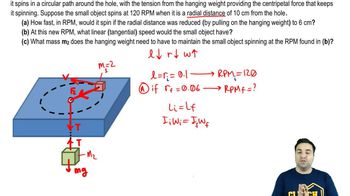
Spinning on a string of variable length

Lens Power

Lens power, measured in diopters, is the reciprocal of the focal length in meters. A positive power indicates a converging lens (convex), while a negative power indicates a diverging lens (concave). The power of corrective lenses is essential for determining how much correction is needed for a person's vision, with higher absolute values indicating stronger lenses.
Video consigliato:
Percorso guidato
05:38
Lens Maker Equation

Optical Correction

Optical correction involves using lenses to adjust the focal point of light entering the eye, ensuring that images are focused on the retina. This is crucial for individuals with refractive errors, such as myopia or hyperopia. The distance of the glasses from the eye and the individual's specific vision needs must be considered when calculating the required focal length and power of the lenses.
Video consigliato:
Percorso guidato
06:25
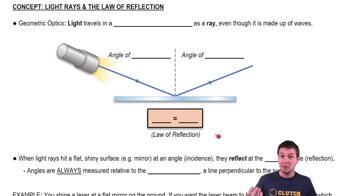
Law of Reflection
Pratica correlata
Domanda del libro di testo

Contact lenses are placed right on the eyeball, so the distance from the eye to an object (or image) is the same as the distance from the lens to that object (or image). A certain person can see distant objects well, but his near point is 45.0 cm from his eyes instead of the usual 25.0 cm. Is this person nearsighted or farsighted?

1750
views
Domanda del libro di testo

A thin lens with a focal length of 6.00 cm is used as a simple magnifier. What angular magnification is obtainable with the lens if the object is at the focal point?

2016
views
Domanda del libro di testo

BIO A person can see clearly up close but cannot focus on objects beyond 75.0 cm. She opts for contact lenses to correct her vision. Is she nearsighted or farsighted?

1954
views
Domanda del libro di testo

Where is the near point of an eye for which a contact lens with a power of +2.75 diopters is prescribed?

1833
views
Domanda del libro di testo

Zoom Lens. Consider the simple model of the zoom lens shown in Fig. 34.43a. The converging lens has focal length f1 = 12 cm, and the diverging lens has focal length f2 = -12 cm. The lenses are separated by 4 cm as shown in Fig. 34.43a. (a) For a distant object, where is the of the converging lens? (c) Where is the final image? Compare your answer to Fig. 34.43a.

1684
views
Domanda del libro di testo

BIO A person can see clearly up close but cannot focus on objects beyond 75.0 cm. She opts for contact lenses to correct her vision. What focal length contact lens is needed, and what is its power in diopters?

2043
views