
Ch 37: Special Relativity
Young & Freedman Calc - University Physics 15th Edition
Young & Freedman Calc15th EditionUniversity PhysicsISBN: 9780135159552Non è quello che usi tu?Cambia libro di testo
Capitolo 36, Problema 7

An alien spacecraft is flying overhead at a great distance as you stand in your backyard. You see its searchlight blink on for 0.1500.150 s. The first officer on the spacecraft measures that the searchlight is on for 12.012.0 ms.
(a) Which of these two measured times is the proper time?
(b) What is the speed of the spacecraft relative to the earth, expressed as a fraction of the speed of light cc?

Guida verificata passo dopo passo
1
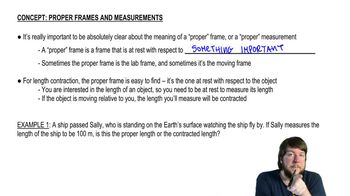
Identify the concept of proper time: Proper time is the time interval measured by an observer who is at rest relative to the event being timed. In this problem, the proper time is the time measured by the observer who is at rest relative to the searchlight.
Determine which observer measures the proper time: Since the first officer on the spacecraft is at rest relative to the searchlight, the time measured by the officer (12.0 ms) is the proper time.
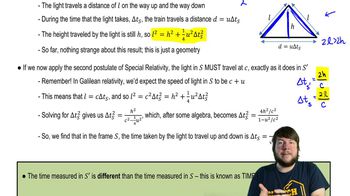
Use the time dilation formula to relate the two time measurements: The time dilation formula is given by \( t = \frac{t_0}{\sqrt{1 - \frac{v^2}{c^2}}} \), where \( t \) is the time measured by the observer in motion (0.150 s), \( t_0 \) is the proper time (12.0 ms), \( v \) is the velocity of the spacecraft, and \( c \) is the speed of light.
Rearrange the time dilation formula to solve for the velocity \( v \): \( v = c \sqrt{1 - \left(\frac{t_0}{t}\right)^2} \). Substitute the known values into this equation, ensuring that the units are consistent (convert 12.0 ms to seconds).
Calculate the speed of the spacecraft as a fraction of the speed of light \( c \): After substituting the values, simplify the expression to find \( \frac{v}{c} \), which represents the speed of the spacecraft relative to the speed of light.

Risposta video verificata per un problema simile:

Questa soluzione video è stata consigliata dai nostri tutor come utile per risolvere questo problema.
Durata del video:
5m

Concetti chiave

Ecco i concetti essenziali che devi comprendere per rispondere correttamente alla domanda.

Proper Time

Proper time is the time interval measured by an observer who is at rest relative to the event being timed. In this scenario, the proper time is the time measured by the first officer on the spacecraft, as they are at rest relative to the searchlight blinking on and off.
Video consigliato:
Percorso guidato
07:49
Proper Frames and Measurements

Time Dilation

Time dilation is a phenomenon predicted by Einstein's theory of relativity, where time is observed to pass at different rates for observers in different inertial frames. It occurs when an object is moving at a significant fraction of the speed of light, causing the time interval measured by a stationary observer to be longer than the proper time.
Video consigliato:

Speed of Light

The speed of light, denoted as c, is approximately 299,792,458 meters per second and is the maximum speed at which all energy, matter, and information in the universe can travel. In this problem, the spacecraft's speed relative to Earth is expressed as a fraction of c, highlighting relativistic effects such as time dilation.
Video consigliato:
Percorso guidato
06:03
The Doppler Effect (Light)
Pratica correlata
Domanda del libro di testo

As you pilot your space utility vehicle at a constant speed toward the moon, a race pilot flies past you in her spaceracer at a constant speed of 0.800c 0.800c relative to you. At the instant the spaceracer passes you, both of you start timers at zero.

(a) At the instant when you measure that the spaceracer has traveled 1.20×1081.20\(\times\)10^8 m past you, what does the race pilot read on her timer?

(b) When the race pilot reads the value calculated in part (a) on her timer, what does she measure to be your distance from her?

(c) At the instant when the race pilot reads the value calculated in part (a) on her timer, what do you read on yours?

1438
views
Domanda del libro di testo

A rocket ship flies past the earth at 91.0% of the speed of light. Inside, an astronaut who is undergoing a physical examination is having his height measured while he is lying down parallel to the direction in which the ship is moving. (a) If his height is measured to be 2.00 m by his doctor inside the ship, what height would a person watching this from the earth measure? (b) If the earth-based person had measured 2.00 m, what would the doctor in the spaceship have measured for the astronaut’s height? Is this a reasonable height?

1010
views
Domanda del libro di testo

Why Are We Bombarded by Muons? Muons are unstable subatomic particles that decay to electrons with a mean lifetime of 2.2 μs. They are produced when cosmic rays bombard the upper atmosphere about 10 km above the earth's surface, and they travel very close to the speed of light. The problem we want to address is why we see any of them at the earth's surface. (a) What is the greatest distance a muon could travel during its 2.2 μs lifetime? (b) According to your answer in part (a), it would seem that muons could never make it to the ground. But the 2.2 μs lifetime is measured in the frame of the muon, and muons are moving very fast. At a speed of 0.999c, what is the mean lifetime of a muon as measured by an observer at rest on the earth? How far would the muon travel in this time? Does this result explain why we find muons in cosmic rays? (c) From the point of view of the muon, it still lives for only 2.2 μs, so how does it make it to the ground? What is the thickness of the 10 km of atmosphere through which the muon must travel, as measured by the muon? Is it now clear how the muon is able to reach the ground?

1902
views
Domanda del libro di testo

The positive muon (µ+), an unstable particle, lives on average 2.20 × 10⁻⁶ s (measured in its own frame of reference) before decaying. If such a particle is moving, with respect to the laboratory, with a speed of 0.900c, what average lifetime is measured in the laboratory?

1572
views
Domanda del libro di testo

The positive muon (µ+), an unstable particle, lives on average 2.20 × 10⁻⁶ s (measured in its own frame of reference) before decaying. What average distance, measured in the laboratory, does the particle move before decaying?

1391
views
Domanda del libro di testo

A pursuit spacecraft from the planet Tatooine is attempting to catch up with a Trade Federation cruiser. As measured by an observer on Tatooine, the cruiser is traveling away from the planet with a speed of 0.600c. The pursuit ship is traveling at a speed of 0.800c relative to Tatooine, in the same direction as the cruiser. (a) For the pursuit ship to catch the cruiser, should the velocity of the cruiser relative to the pursuit ship be directed toward or away from the pursuit ship? (b) What is the speed of the cruiser relative to the pursuit ship?

1147
views