
Ch 39: Particles Behaving as Waves
Young & Freedman Calc - University Physics 15th Edition
Young & Freedman Calc15th EditionUniversity PhysicsISBN: 9780135159552Non è quello che usi tu?Cambia libro di testo
Capitolo 38, Problema 25b

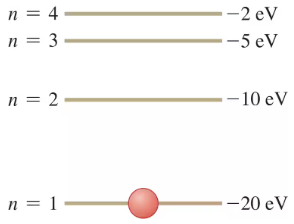
The energy-level scheme for the hypothetical one-electron element Searsium is shown in Fig. E39.25E39.25. The potential energy is taken to be zero for an electron at an infinite distance from the nucleus. An 1818-eV photon is absorbed by a Searsium atom in its ground level. As the atom returns to its ground level, what possible energies can the emitted photons have? Assume that there can be transitions between all pairs of levels.

Guida verificata passo dopo passo
1
Step 1: Analyze the energy-level diagram provided. The energy levels for Searsium are given as follows: Fundamental state (n=1) at -18.0 eV, First excited state (n=2) at -4.50 eV, Second excited state (n=3) at -2.00 eV, and Third excited state (n=4) at -1.13 eV.
Step 2: Determine the initial excitation caused by the absorption of the 18-eV photon. Since the ground state energy is -18.0 eV, absorbing an 18-eV photon will move the electron to the zero potential energy level, which corresponds to an infinite distance from the nucleus.
Step 3: As the atom returns to its ground state, the electron can transition between any pair of energy levels. The possible transitions are: (n=4 to n=3), (n=4 to n=2), (n=4 to n=1), (n=3 to n=2), (n=3 to n=1), and (n=2 to n=1).
Step 4: Calculate the energy of the emitted photons for each transition using the formula ΔE = E_final - E_initial. For example, for the transition from n=4 to n=3, ΔE = (-2.00 eV) - (-1.13 eV). Repeat this calculation for all transitions.
Step 5: List all possible photon energies resulting from these transitions. These energies correspond to the differences between the energy levels as calculated in Step 4.

Risposta video verificata per un problema simile:

Questa soluzione video è stata consigliata dai nostri tutor come utile per risolvere questo problema.
Durata del video:
1m

Concetti chiave

Ecco i concetti essenziali che devi comprendere per rispondere correttamente alla domanda.

Energy Levels

Energy levels in an atom represent the specific energies that electrons can have when bound to the nucleus. Each level corresponds to a quantized state, with lower energy levels being closer to the nucleus. Electrons can transition between these levels by absorbing or emitting photons, with the energy of the photon equal to the difference in energy between the two levels.
Video consigliato:
Percorso guidato
04:10
Intro to Energy & Types of Energy

Photon Absorption and Emission

Photon absorption occurs when an electron in an atom absorbs a photon and moves to a higher energy level. Conversely, photon emission happens when an electron drops from a higher energy level to a lower one, releasing energy in the form of a photon. The energy of the emitted or absorbed photon is directly related to the energy difference between the initial and final states of the electron.
Video consigliato:

Transition Between Energy Levels

Transitions between energy levels in an atom can occur in various ways, allowing electrons to move between any two levels. The possible energies of emitted photons depend on the specific transitions that occur as the atom returns to its ground state. In the case of Searsium, the transitions can involve any pair of energy levels, leading to a range of possible photon energies upon emission.
Video consigliato:
Percorso guidato
03:43
Relationships Between Force, Field, Energy, Potential
Pratica correlata
Domanda del libro di testo

In a set of experiments on a hypothetical one-electron atom, you measure the wavelengths of the photons emitted from transitions ending in the ground level (n=1n = 1), as shown in the energy-level diagram in Fig. E39.2739.27. You also observe that it takes 17.5017.50 eV to ionize this atom. What is the energy of the atom in each of the levels (n=1n = 1, n=2n = 2, etc.) shown in the figure?

1878
views
Domanda del libro di testo

A hydrogen atom is in a state with energy −1.51-1.51 eV. In the Bohr model, what is the angular momentum of the electron in the atom, with respect to an axis at the nucleus?

1695
views
Domanda del libro di testo

A triply ionized beryllium ion, Be3+ (a beryllium atom with three electrons removed), behaves very much like a hydrogen atom except that the nuclear charge is four times as great. What is the ground-level energy of Be3+? How does this compare to the ground-level energy of the hydrogen atom?

1842
views
Domanda del libro di testo

Use Balmer's formula to calculate (a) the wavelength, (b) the frequency, and (c) the photon energy for the Hg line of the Balmer series for hydrogen.

2120
views
Domanda del libro di testo

A triply ionized beryllium ion, Be3+ (a beryllium atom with three electrons removed), behaves very much like a hydrogen atom except that the nuclear charge is four times as great. For the hydrogen atom, the wavelength of the photon emitted in the n=2n = 2 to n=1n = 1 transition is 122122 nm (see Example 39.639.6). What is the wavelength of the photon emitted when a Be3+ ion undergoes this transition?

2441
views
Domanda del libro di testo

Find the longest and shortest wavelengths in the Lyman and Paschen series for hydrogen. In what region of the electromagnetic spectrum does each series lie?

2150
views