Ch 41: Quantum Mechanics II: Atomic Structure
Young & Freedman Calc - University Physics 15th Edition
Young & Freedman Calc15th EditionUniversity PhysicsISBN: 9780135159552Non è quello che usi tu?Cambia libro di testo
Capitolo 40, Problema 9c

Consider an electron in the NN shell. What is the largest orbital angular momentum this electron could have in any chosen direction? Express your answers in terms of ℏ\(\hslash\) and in SI units.

Guida verificata passo dopo passo
1
Identify the principal quantum number (n) for the N shell. The N shell corresponds to n = 4.
Recall that the orbital angular momentum quantum number (l) can take integer values from 0 to (n - 1). For n = 4, the possible values of l are 0, 1, 2, and 3. The largest value of l is 3.
The magnitude of the orbital angular momentum (L) is given by the formula: \( L = \sqrt{l(l+1)} \hbar \), where \( \hbar \) is the reduced Planck's constant (\( \hbar = 1.0545718 \times 10^{-34} \, \text{J·s} \)). Substitute \( l = 3 \) into this formula.
The largest component of the orbital angular momentum in any chosen direction (usually the z-direction) is given by \( L_z = m_l \hbar \), where \( m_l \) is the magnetic quantum number. For a given \( l \), \( m_l \) can range from \( -l \) to \( +l \) in integer steps. The largest value of \( m_l \) is \( l \), so \( L_z = l \hbar \). Substitute \( l = 3 \) into this formula.
Express the result for \( L_z \) in terms of \( \hbar \) (U) and in SI units (J·s). The final expression for the largest orbital angular momentum in any chosen direction is \( L_z = 3 \hbar \).

Risposta video verificata per un problema simile:

Questa soluzione video è stata consigliata dai nostri tutor come utile per risolvere questo problema.
Durata del video:
2m

Concetti chiave

Ecco i concetti essenziali che devi comprendere per rispondere correttamente alla domanda.

Orbital Angular Momentum

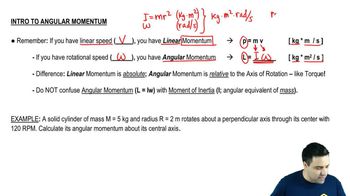
Orbital angular momentum is a measure of the rotational motion of an electron around the nucleus of an atom. It is quantized and can be expressed using the formula L = √(l(l+1))ħ, where l is the azimuthal quantum number and ħ is the reduced Planck's constant. The maximum value of l for an electron in the N shell (n=4) is 3, corresponding to the f subshell, which allows for the largest angular momentum.
Video consigliato:
Percorso guidato
06:18
Intro to Angular Momentum

Quantum Numbers

Quantum numbers are sets of numerical values that describe the unique quantum state of an electron in an atom. The principal quantum number (n) indicates the energy level, while the azimuthal quantum number (l) determines the shape of the orbital. For the N shell, n=4, and l can take values from 0 to n-1, allowing for different orbital types (s, p, d, f) and their associated angular momenta.
Video consigliato:
Percorso guidato
07:19
Moles & Avogadro's Number

SI Units and Energy

In physics, SI units are the standard units of measurement used to express physical quantities. For angular momentum, the SI unit is joule-seconds (J·s). When expressing angular momentum in terms of energy (U), it is important to understand the relationship between energy and angular momentum, particularly in quantum mechanics, where energy levels are quantized and related to the motion of particles.
Video consigliato:
Percorso guidato
03:18
Introduction to Units & the SI System