Skip to main content
Precalculus
Il mio corso
Impara
Preparazione agli esami
AI Tutor
Guide di studio
Flashcard
Esplora
Prova l'app
Il mio corso
Impara
Preparazione agli esami
AI Tutor
Guide di studio
Flashcard
Esplora
Prova l'app
Indietro
Angles in Standard Position definitions
2 Gli studenti hanno trovato questo utile
Puoi toccare per girare la carta.
Angle
Puoi toccare per girare la carta.
👆
Angle
Gap or space formed between two line segments, often measured in degrees from a common starting point.
Avanzamenti del tracciato
I pulsanti di controllo sono stati cambiati in modalità "navigazione".
1/15
Flashcard correlate
Pratica correlata
Video consigliati
Angles in Standard Position quiz
Angles in Standard Position
15 Termini
Angles in Standard Position
7. Measuring Angles
7 Problemi
Argomento
Coterminal Angles
7. Measuring Angles
3 Problemi
Argomento
7. Measuring Angles
4 Argomenti
8 Problemi
Capitolo
5:50
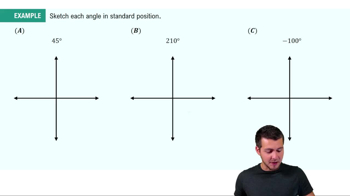
Drawing Angles in Standard Position
3788
views
163
rank
3:59
Example 1
1765
views
83
rank
Termini in questo insieme (15)
Nascondere definizioni
Angle
Gap or space formed between two line segments, often measured in degrees from a common starting point.
Degree
Unit for measuring angles, with a full circle containing 360 of these equal divisions.
Standard Position
Configuration where the initial side of an angle lies along the positive x-axis on a coordinate plane.
Initial Side
Fixed ray of an angle, always placed along the positive x-axis when drawing in standard position.
Terminal Side
Ray that represents the end position of an angle after rotation from the initial side.
Positive Angle
Angle measured by rotating counterclockwise from the initial side on the coordinate plane.
Negative Angle
Angle measured by rotating clockwise from the initial side on the coordinate plane.
Acute Angle
Angle whose measure is less than 90 degrees, forming a sharp or narrow gap.
Obtuse Angle
Angle whose measure is greater than 90 degrees but less than 180 degrees, forming a wide gap.
Right Angle
Angle measuring exactly 90 degrees, often associated with perpendicular lines.
Protractor
Instrument used to estimate or measure the size of an angle in degrees.
Quadrant
One of four regions into which the x and y axes divide the coordinate plane, each spanning 90 degrees.
X-Axis
Horizontal axis in the coordinate plane, serving as the reference for the initial side of angles.
Counterclockwise Direction
Movement opposite to the direction of a clock's hands, used for drawing positive angles.
Clockwise Direction
Movement in the same direction as a clock's hands, used for drawing negative angles.
 IndietroIndietro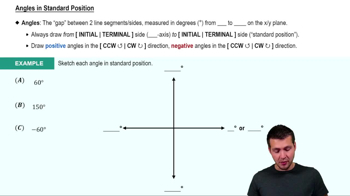
 5:50
5:50