Skip to main content
Precalculus
Il mio corso
Impara
Preparazione agli esami
AI Tutor
Guide di studio
Flashcard
Esplora
Prova l'app
Il mio corso
Impara
Preparazione agli esami
AI Tutor
Guide di studio
Flashcard
Esplora
Prova l'app
Indietro
Combinatorics definitions
Puoi toccare per girare la carta.
Fundamental Counting Principle
Puoi toccare per girare la carta.
👆
Fundamental Counting Principle
A rule stating that the total number of outcomes is found by multiplying the number of choices for each independent event.
Avanzamenti del tracciato
I pulsanti di controllo sono stati cambiati in modalità "navigazione".
1/15
Flashcard correlate
Pratica correlata
Video consigliati
Combinatorics quiz
Combinatorics
15 Termini
Combinatorics
21. Combinatorics and Probability
5 Problemi
Argomento
Probability
21. Combinatorics and Probability
4 Problemi
Argomento
21. Combinatorics and Probability
3 Argomenti
5 Problemi
Capitolo
VideoThumbView.guidedCourse
06:37
Permutations of Non-Distinct Objects
318
views
3
rank
VideoThumbView.guidedCourse
07:11
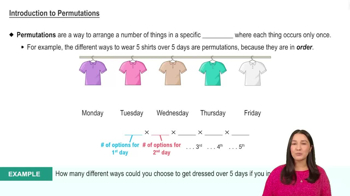
Introduction to Permutations
385
views
3
rank
VideoThumbView.guidedCourse
03:18
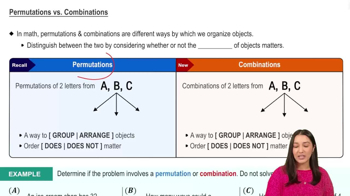
Permutations vs. Combinations
332
views
4
rank
Termini in questo insieme (15)
Nascondere definizioni
Fundamental Counting Principle
A rule stating that the total number of outcomes is found by multiplying the number of choices for each independent event.
Permutation
An arrangement of distinct objects where the order is important, calculated using factorials.
Combination
A selection of objects where the order is irrelevant, using a formula with an extra factorial in the denominator.
Factorial
The product of all positive integers up to a given number, denoted by an exclamation mark.
Outcome
A possible result from a choice or event, such as a specific outfit or roll of a die.
Distinct Object
An item that is unique from others in a set, affecting how arrangements are counted.
Non-distinct Object
An item that is identical to others in a set, requiring adjustment in counting arrangements.
Numerator
The top part of a fraction in counting formulas, often representing the total number of objects factorial.
Denominator
The bottom part of a fraction in counting formulas, often containing factorials to adjust for order or identical items.
n
A variable representing the total number of objects or options in counting problems.
r
A variable representing the number of objects chosen from the total in permutations or combinations.
Permutation Notation
A symbolic way to represent the number of ordered arrangements, often written as P(n, r) or nPr.
Combination Notation
A symbolic way to represent the number of unordered selections, often written as C(n, r) or nCr.
Order
A property indicating whether the sequence of selected objects affects the outcome in arrangements.
Arrangement
A specific sequence or grouping of objects, relevant in both permutations and combinations.
 IndietroIndietro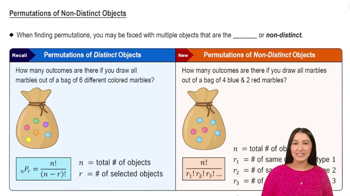
 06:37
06:37