Skip to main content
Precalculus
Il mio corso
Impara
Preparazione agli esami
AI Tutor
Guide di studio
Flashcard
Esplora
Prova l'app
Il mio corso
Impara
Preparazione agli esami
AI Tutor
Guide di studio
Flashcard
Esplora
Prova l'app
Indietro
Convert Equations Between Polar and Rectangular Forms quiz
Puoi toccare per girare la carta.
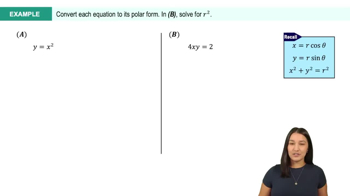
What substitutions do you use for x and y when converting a rectangular equation to polar form?
Puoi toccare per girare la carta.
👆
What substitutions do you use for x and y when converting a rectangular equation to polar form?
Replace x with r*cos(theta) and y with r*sin(theta).
Avanzamenti del tracciato
I pulsanti di controllo sono stati cambiati in modalità "navigazione".
1/15
Flashcard correlate
Pratica correlata
Video consigliati
Convert Equations Between Polar and Rectangular Forms definitions
Convert Equations Between Polar and Rectangular Forms
15 Termini
Convert Equations Between Polar and Rectangular Forms
15. Polar Equations
1 problema
Argomento
Graphing Other Common Polar Equations
15. Polar Equations
3 Problemi
Argomento
15. Polar Equations
3 Argomenti
5 Problemi
Capitolo
VideoThumbView.guidedCourse
6:50
Convert Equations from Polar to Rectangular
469
views
7
rank
VideoThumbView.guidedCourse
3:28
Convert Equations from Rectangular to Polar Example 1
511
views
12
rank
VideoThumbView.guidedCourse
3:03
Convert Equations from Polar to Rectangular Example 2
420
views
5
rank
Termini in questo insieme (15)
Nascondere definizioni
What substitutions do you use for x and y when converting a rectangular equation to polar form?
Replace x with r*cos(theta) and y with r*sin(theta).
How do you convert the equation y = 5 into polar form?
Replace y with r*sin(theta), solve for r, and get r = 5*csc(theta).
What is the polar form of the equation y = x + 1?
It is r = 1 / (sin(theta) - cos(theta)).
How do you convert x^2 + y^2 = 25 into polar form?
Replace x^2 + y^2 with r^2 to get r^2 = 25, then r = 5.
What does the equation r = 5 represent in rectangular form?
It represents a circle with radius 5 centered at the origin.
When converting from polar to rectangular form, what should you try to get in your equation?
Try to get terms like r*cos(theta), r*sin(theta), or r^2.
How do you convert r = 4 into rectangular form?
Square both sides to get r^2 = 16, then substitute x^2 + y^2 for r^2 to get x^2 + y^2 = 16.
What is the rectangular form of r = sec(theta)?
Rewrite sec(theta) as 1/cos(theta), multiply both sides by cos(theta) to get r*cos(theta) = 1, then substitute x for r*cos(theta) to get x = 1.
How do you convert r = 6*sin(theta) into rectangular form?
Multiply both sides by r to get r^2 = 6r*sin(theta), then substitute x^2 + y^2 for r^2 and y for r*sin(theta) to get x^2 + y^2 = 6y.
What algebraic technique is used to rewrite x^2 + y^2 = 6y into a standard form?
Complete the square on the y terms to get x^2 + (y - 3)^2 = 9.
What shape does the equation x^2 + (y - 3)^2 = 9 represent?
It represents a circle of radius 3 centered at (0, 3).
What is the rectangular form of r*cos(theta) = 1?
It is x = 1.
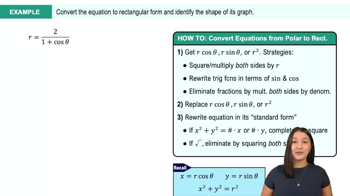
What should you do if your polar equation contains a fraction with a trigonometric denominator?
Multiply both sides by the denominator to eliminate the fraction.
What is the general strategy for converting polar equations to rectangular form?
Manipulate the equation to get r*cos(theta), r*sin(theta), or r^2, then substitute x, y, or x^2 + y^2, respectively.
Why is it helpful to identify the shape of the graph when converting equations?
Recognizing the shape helps confirm the equation is in a standard or recognizable form.
 IndietroIndietro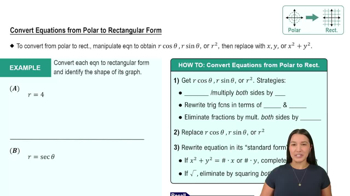
 6:50
6:50