Skip to main content
Precalculus
Il mio corso
Impara
Preparazione agli esami
AI Tutor
Guide di studio
Flashcard
Esplora
Prova l'app
Il mio corso
Impara
Preparazione agli esami
AI Tutor
Guide di studio
Flashcard
Esplora
Prova l'app
Indietro
Cross Product definitions
Puoi toccare per girare la carta.
Cross Product
Puoi toccare per girare la carta.
👆
Cross Product
An operation on two vectors that produces a third vector perpendicular to both original vectors.
Avanzamenti del tracciato
I pulsanti di controllo sono stati cambiati in modalità "navigazione".
1/13
Flashcard correlate
Pratica correlata
Video consigliati
Cross Product quiz
Cross Product
15 Termini
Cross Product
14. Vectors
5 Problemi
Argomento
Dot Product
14. Vectors
6 Problemi
Argomento
14. Vectors
6 Argomenti
11 Problemi
Capitolo
5:21
Computing the Cross Product
405
views
1
rank
Termini in questo insieme (13)
Nascondere definizioni
Cross Product
An operation on two vectors that produces a third vector perpendicular to both original vectors.
Vector
A mathematical quantity with both magnitude and direction, often represented by components along axes.
Scalar
A single numerical value representing magnitude without direction, such as the result of a dot product.
Perpendicular Vector
A vector that forms a 90-degree angle with two given vectors in three-dimensional space.
Component
A value representing the projection of a vector along a specific axis, such as x, y, or z.
Matrix
A rectangular array of numbers or symbols arranged in rows and columns, used to organize vector components.
Unit Vector
A vector with a magnitude of one, indicating direction along an axis, commonly denoted as i, j, or k.
i
The unit vector representing the x-axis direction in three-dimensional space.
j
The unit vector representing the y-axis direction in three-dimensional space.
k
The unit vector representing the z-axis direction in three-dimensional space.
Cross Down and Up Strategy
A method for calculating cross product components by multiplying diagonally across a matrix.
Component Form
A way of expressing a vector as an ordered list of its x, y, and z values, such as (1, -4, -2).
Unlike Components
Pairs of different vector components, such as x and y, whose products are used in cross product calculations.
 IndietroIndietro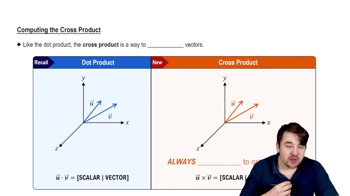
 5:21
5:21