Skip to main content
Precalculus
Il mio corso
Impara
Preparazione agli esami
AI Tutor
Guide di studio
Flashcard
Esplora
Prova l'app
Il mio corso
Impara
Preparazione agli esami
AI Tutor
Guide di studio
Flashcard
Esplora
Prova l'app
Indietro
Function Operations quiz
Puoi toccare per girare la carta.
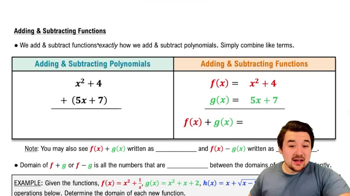
How do you add two functions, such as f(x) = x^2 + 4 and g(x) = 5x + 7?
Puoi toccare per girare la carta.
👆
How do you add two functions, such as f(x) = x^2 + 4 and g(x) = 5x + 7?
You add the corresponding terms to get x^2 + 5x + 11.
Avanzamenti del tracciato
I pulsanti di controllo sono stati cambiati in modalità "navigazione".
1/15
Flashcard correlate
Pratica correlata
Video consigliati
Function Operations definitions
Function Operations
15 Termini
Function Operations
3. Functions & Graphs
2 Problemi
Argomento
Function Composition
3. Functions & Graphs
7 Problemi
Argomento
3. Functions & Graphs
5 Argomenti
9 Problemi
Capitolo
7:24
Multiplying & Dividing Functions
1367
views
47
rank
2
comments
4:46
Adding & Subtracting Functions Example 1
1396
views
46
rank
1
comments
5:56
Adding & Subtracting Functions
2002
views
41
rank
1
comments
Termini in questo insieme (15)
Nascondere definizioni
How do you add two functions, such as f(x) = x^2 + 4 and g(x) = 5x + 7?
You add the corresponding terms to get x^2 + 5x + 11.
What is the domain of the sum or difference of two functions?
It is the intersection of the domains of the individual functions, considering any restrictions like division by zero.
What restriction must you consider when a function has a denominator of x?
x cannot be equal to 0 because division by zero is undefined.
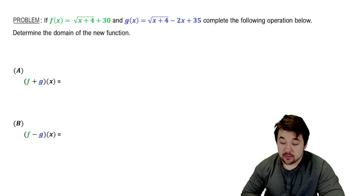
How do you subtract h(x) = x + sqrt(x-8) from g(x) = x^2 + x + 2?
You distribute the negative sign and combine like terms to get x^2 + 2 - sqrt(x-8).
What is the domain of h(x) = x + sqrt(x-8)?
x must be greater than or equal to 8 because the expression under the square root cannot be negative.
When multiplying f(x) = sqrt(x) and g(x) = 3x - 6, what is the resulting function?
The result is 3x*sqrt(x) - 6*sqrt(x).
What is the domain of f(x) = sqrt(x)?
The domain is all real numbers x such that x ≥ 0.
What additional restriction must you consider when dividing functions?
The denominator cannot be zero, so any x that makes the denominator zero must be excluded from the domain.
If f(x) = sqrt(x) and g(x) = 3x - 6, what is the domain of f(x)/g(x)?
The domain is x ≥ 0 and x ≠ 2, since 3x - 6 = 0 when x = 2.
How do you multiply f(x) = x^2 - 4 and g(x) = x + 2?
Use the distributive property (FOIL) to get x^3 + 2x^2 - 4x - 8.
What is the domain of the product of two polynomials?
The domain is all real numbers, since polynomials are defined everywhere.
How do you divide f(x) = x^2 - 4 by g(x) = x + 2 and simplify?
Factor the numerator to (x + 2)(x - 2), cancel x + 2, and get x - 2, but x ≠ -2.
Why must you find domain restrictions before simplifying a division of functions?
Because simplification can remove factors that cause restrictions, but the original domain restrictions still apply.
What does the notation (f + g)(x) mean?
It means f(x) + g(x), the sum of the two functions evaluated at x.
What does the notation (f/g)(x) mean?
It means f(x) divided by g(x), with the domain restricted so that g(x) ≠ 0.
 IndietroIndietro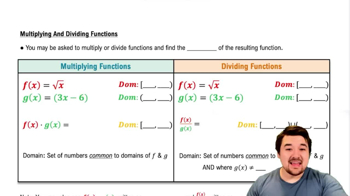
 7:24
7:24