Skip to main content
Precalculus
Il mio corso
Impara
Preparazione agli esami
AI Tutor
Guide di studio
Flashcard
Esplora
Prova l'app
Il mio corso
Impara
Preparazione agli esami
AI Tutor
Guide di studio
Flashcard
Esplora
Prova l'app
Indietro
Introduction to Limits definitions
Puoi toccare per girare la carta.
Limit
Puoi toccare per girare la carta.
👆
Limit
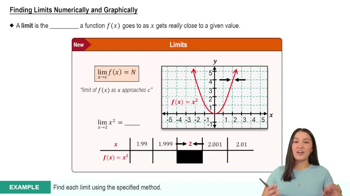
The y-value a function approaches as x gets arbitrarily close to a specific value from either side.
Avanzamenti del tracciato
I pulsanti di controllo sono stati cambiati in modalità "navigazione".
1/15
Flashcard correlate
Pratica correlata
Video consigliati
Introduction to Limits quiz
Introduction to Limits
15 Termini
Introduction to Limits
22. Limits & Continuity
5 Problemi
Argomento
Finding Limits Algebraically
22. Limits & Continuity
5 Problemi
Argomento
22. Limits & Continuity
3 Argomenti
9 Problemi
Capitolo
VideoThumbView.guidedCourse
02:34
Finding Limits Numerically and Graphically Example 1
460
views
5
rank
VideoThumbView.guidedCourse
03:07
Cases Where Limits Do Not Exist
384
views
3
rank
VideoThumbView.guidedCourse
06:47
Finding Limits Numerically and Graphically
711
views
8
rank
Termini in questo insieme (15)
Nascondere definizioni
Limit
The y-value a function approaches as x gets arbitrarily close to a specific value from either side.
One-sided Limit
The value a function approaches as x nears a specific point from only one direction, either left or right.
Left-sided Limit
The value a function approaches as x gets close to a specific point from values less than that point.
Right-sided Limit
The value a function approaches as x gets close to a specific point from values greater than that point.
Limit Notation
A symbolic way to express the value a function approaches as x nears a specific point, often using 'lim' and arrows.
Piecewise Function
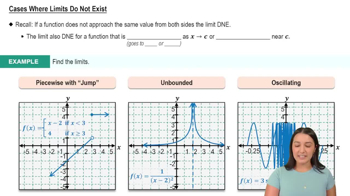
A function defined by different expressions over different intervals, often causing jumps or breaks in the graph.
Jump Discontinuity
A sudden change in a function's value at a point, causing the left and right limits to differ.
Unbounded Behavior
A situation where a function increases or decreases without bound as x approaches a specific value.
Oscillation
A function's repeated up-and-down movement near a point, preventing it from settling on a single value.
Asymptote
A line that a function's graph approaches but never touches, often causing unbounded behavior.
Table of Values
A numerical method for estimating limits by evaluating a function at points increasingly close to a target value.
Graphical Method
A visual approach to finding limits by observing the behavior of a function's graph near a specific x-value.
DNE
An abbreviation indicating that a limit does not exist at a particular point due to differing behaviors or unboundedness.
Function Value
The actual output of a function at a specific input, which may differ from the limit at that point.
Approaching Value
A value that x gets arbitrarily close to, but does not necessarily reach, when analyzing a function's limit.
 IndietroIndietro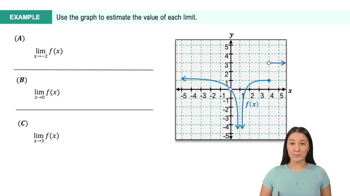
 02:34
02:34