Skip to main content
Precalculus
Il mio corso
Impara
Preparazione agli esami
AI Tutor
Guide di studio
Flashcard
Esplora
Prova l'app
Il mio corso
Impara
Preparazione agli esami
AI Tutor
Guide di studio
Flashcard
Esplora
Prova l'app
Indietro
Linear Equations quiz
Puoi toccare per girare la carta.
What is a linear equation?
Puoi toccare per girare la carta.
👆
What is a linear equation?
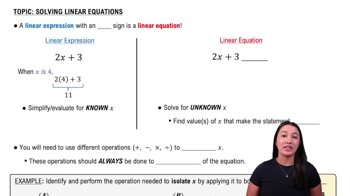
A linear equation is formed by setting a linear expression equal to a value, creating an equation that can be solved for the variable.
Avanzamenti del tracciato
I pulsanti di controllo sono stati cambiati in modalità "navigazione".
1/15
Flashcard correlate
Pratica correlata
Video consigliati
Linear Equations definitions
Linear Equations
15 Termini
Linear Equations
1. Equations and Inequalities
7 Problemi
Argomento
Rational Equations
1. Equations and Inequalities
7 Problemi
Argomento
1. Equations and Inequalities - Part 1 of 2
7 Argomenti
13 Problemi
Capitolo
1. Equations and Inequalities - Part 2 of 2
5 Argomenti
12 Problemi
Capitolo
VideoThumbView.guidedCourse
04:02
Solving Linear Equations with Fractions
2582
views
109
rank
1
comments
VideoThumbView.guidedCourse
07:48
Introduction to Solving Linear Equations
4945
views
185
rank
1
comments
VideoThumbView.guidedCourse
06:00
Categorizing Linear Equations
2240
views
76
rank
Termini in questo insieme (15)
Nascondere definizioni
What is a linear equation?
A linear equation is formed by setting a linear expression equal to a value, creating an equation that can be solved for the variable.
How do you isolate the variable in a linear equation?
You isolate the variable by performing operations such as addition, subtraction, multiplication, or division on both sides of the equation.
What must you always do to both sides of a linear equation when solving?
You must perform the same operation to both sides of the equation to maintain equality.
What is the opposite operation of addition when solving equations?
The opposite operation of addition is subtraction.
What is the opposite operation of multiplication when solving equations?
The opposite operation of multiplication is division.
What is the first step when solving a linear equation with fractions?
The first step is to multiply every term by the least common denominator (LCD) to eliminate the fractions.
Why do we use the least common denominator (LCD) when solving equations with fractions?
We use the LCD to clear all fractions, making the equation easier to solve.
What is a conditional equation?
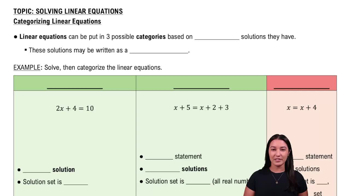
A conditional equation is a linear equation that has exactly one solution.
What is an identity equation?
An identity equation is a linear equation that is true for all real numbers, meaning it has infinite solutions.
What is an inconsistent equation?
An inconsistent equation is a linear equation that has no solution because it leads to a false statement.
How is the solution set of a linear equation with one solution written?
It is written in set notation as the solution value inside curly brackets, for example, {3}.
How is the solution set written for an equation with infinite solutions?
It is written as all real numbers, often denoted by the symbol ℝ.
How is the solution set written for an equation with no solutions?
It is written as the empty set, represented by curly brackets with a slash through a zero: {∅}.
What is the final step after solving a linear equation?
The final step is to check your solution by substituting it back into the original equation to verify it makes the equation true.
What do you call the value that makes a linear equation true?
It is called the solution, root, or answer of the equation.
 IndietroIndietro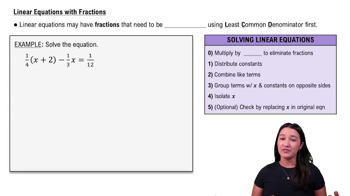
 04:02
04:02