Skip to main content
Precalculus
Il mio corso
Impara
Preparazione agli esami
AI Tutor
Guide di studio
Flashcard
Esplora
Prova l'app
Il mio corso
Impara
Preparazione agli esami
AI Tutor
Guide di studio
Flashcard
Esplora
Prova l'app
Indietro
Probability definitions
Puoi toccare per girare la carta.
Probability
Puoi toccare per girare la carta.
👆
Probability
A numerical measure expressing the likelihood of an event, ranging from 0 (impossible) to 1 (certain).
Avanzamenti del tracciato
I pulsanti di controllo sono stati cambiati in modalità "navigazione".
1/15
Flashcard correlate
Pratica correlata
Video consigliati
Probability quiz
Probability
15 Termini
Probability
21. Combinatorics and Probability
4 Problemi
Argomento
Combinatorics
21. Combinatorics and Probability
5 Problemi
Argomento
21. Combinatorics and Probability
3 Argomenti
5 Problemi
Capitolo
VideoThumbView.guidedCourse
02:57
Probability of Non-Mutually Exclusive Events Example
357
views
3
rank
VideoThumbView.guidedCourse
04:23
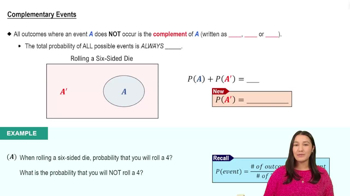
Complementary Events
293
views
6
rank
VideoThumbView.guidedCourse
03:59
Introduction to Probability Example
367
views
8
rank
Termini in questo insieme (15)
Nascondere definizioni
Probability
A numerical measure expressing the likelihood of an event, ranging from 0 (impossible) to 1 (certain).
Event
A specific outcome or set of outcomes from a random process, such as rolling a die or drawing a card.
Theoretical Probability
A ratio based on possible outcomes, calculated before any experiment is performed.
Empirical Probability
A ratio based on actual results from experiments or collected data, reflecting observed frequencies.
Sample Space
A set containing all possible outcomes of a random experiment, often shown in curly brackets.
Complement
All outcomes in the sample space that are not part of a specified event.
Mutually Exclusive Events
Events that cannot occur at the same time; their occurrence is completely separate.
Non-Mutually Exclusive Events
Events that can occur simultaneously, sharing some overlapping outcomes.
Independent Events
Events where the outcome of one does not affect the outcome of the other.
Dependent Events
Events where the outcome of one influences the outcome of the other.
Addition Rule
A method for finding the probability of at least one of multiple events, adjusted for overlap if needed.
Multiplication Rule
A method for finding the probability of multiple independent events all occurring, by multiplying their probabilities.
Set Notation
A mathematical way to represent collections of outcomes, often using symbols like U (union) and ∩ (intersection).
Union
The set of outcomes that belong to at least one of two events, represented by the symbol U.
Intersection
The set of outcomes shared by two events, represented by the symbol ∩.
 IndietroIndietro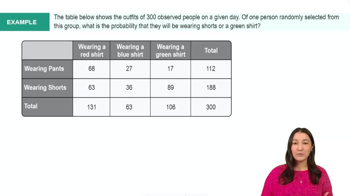
 02:57
02:57