Skip to main content
Precalculus
Il mio corso
Impara
Preparazione agli esami
AI Tutor
Guide di studio
Flashcard
Esplora
Prova l'app
Il mio corso
Impara
Preparazione agli esami
AI Tutor
Guide di studio
Flashcard
Esplora
Prova l'app
Indietro
Solving Trigonometric Equations Using Identities quiz
Puoi toccare per girare la carta.
What is the first step when solving a trigonometric equation with multiple trig functions?
Puoi toccare per girare la carta.
👆
What is the first step when solving a trigonometric equation with multiple trig functions?
Use trigonometric identities to rewrite the equation in terms of just one trig function.
Avanzamenti del tracciato
I pulsanti di controllo sono stati cambiati in modalità "navigazione".
1/15
Flashcard correlate
Pratica correlata
Video consigliati
Solving Trigonometric Equations Using Identities definitions
Solving Trigonometric Equations Using Identities
15 Termini
Solving Trigonometric Equations Using Identities
12. Trigonometric Identities
3 Problemi
Argomento
Double Angle Identities
12. Trigonometric Identities
4 Problemi
Argomento
12. Trigonometric Identities
4 Argomenti
8 Problemi
Capitolo
VideoThumbView.guidedCourse
4:42
Solve Trig Equations Using Identity Substitutions
1283
views
31
rank
Termini in questo insieme (15)
Nascondere definizioni
What is the first step when solving a trigonometric equation with multiple trig functions?
Use trigonometric identities to rewrite the equation in terms of just one trig function.
Which identity can be used to rewrite sec^2(θ) - 1?
The Pythagorean identity, which gives sec^2(θ) - 1 = tan^2(θ).
How do you simplify (sec^2(θ) - 1) / tan(θ)?
Rewrite the numerator as tan^2(θ), then divide by tan(θ) to get tan(θ).
After simplifying to tan(θ) = 1, how do you find all solutions for θ?
Find the angles where tan(θ) = 1 on the unit circle and add πn to account for all solutions.
What should you do if the arguments of trig functions in a fraction are not the same?
Look for other identities, such as double angle or even-odd identities, to simplify the equation.
Which identity is used to rewrite sin(2θ)?
The double angle identity: sin(2θ) = 2sin(θ)cos(θ).
How do you simplify cos(-θ) using an identity?
Use the even-odd identity: cos(-θ) = cos(θ) because cosine is an even function.
What happens when you have the same trig function in the numerator and denominator?
They cancel each other out, simplifying the equation.
After simplifying to 2sin(θ) = 1, what is the next step?
Divide both sides by 2 to isolate sin(θ), resulting in sin(θ) = 1/2.
Which angles on the unit circle satisfy sin(θ) = 1/2?
θ = π/6 and θ = 5π/6.
How do you write the general solution for sin(θ) = 1/2?
Add 2πn to each solution: θ = π/6 + 2πn and θ = 5π/6 + 2πn.
Why is it important to add 2πn to your solutions?
To account for all possible solutions since trigonometric functions are periodic.
What is the main strategy emphasized for solving complex trig equations?
Use trigonometric identities to reduce the equation to a simpler form with one trig function.
When should you consider using the Pythagorean identities?
Whenever you see squared trig functions in the equation.
What is the benefit of rewriting a trig equation in terms of one function?
It allows you to solve the equation using known unit circle values and standard techniques.
 IndietroIndietro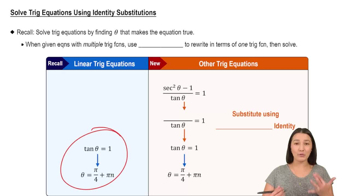
 4:42
4:42