Skip to main content
Precalculus
Il mio corso
Impara
Preparazione agli esami
AI Tutor
Guide di studio
Flashcard
Esplora
Prova l'app
Il mio corso
Impara
Preparazione agli esami
AI Tutor
Guide di studio
Flashcard
Esplora
Prova l'app
Indietro
Vectors in Component Form quiz
Puoi toccare per girare la carta.
What is a position vector?
Puoi toccare per girare la carta.
👆
What is a position vector?
A position vector is a vector whose initial point is at the origin of the graph.
Avanzamenti del tracciato
I pulsanti di controllo sono stati cambiati in modalità "navigazione".
1/15
Flashcard correlate
Pratica correlata
Video consigliati
Vectors in Component Form definitions
Vectors in Component Form
15 Termini
Vectors in Component Form
14. Vectors
3 Problemi
Argomento
Direction of a Vector
14. Vectors
3 Problemi
Argomento
14. Vectors
6 Argomenti
11 Problemi
Capitolo
02:26
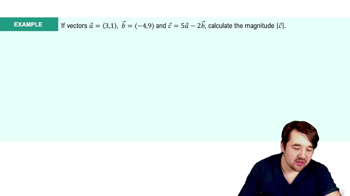
Finding Magnitude of a Vector Example 1
458
views
12
rank
03:11
Algebraic Operations on Vectors Example 1
443
views
14
rank
01:36
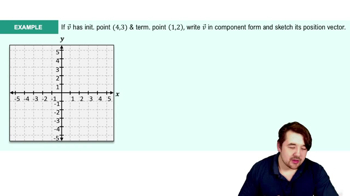
Position Vectors & Component Form Example 1
490
views
9
rank
Termini in questo insieme (15)
Nascondere definizioni
What is a position vector?
A position vector is a vector whose initial point is at the origin of the graph.
How do you write a vector in component form?
A vector in component form is written as (x, y), where x and y are the lengths in the x and y directions.
How do you find the component form of a vector given its initial and terminal points?
Subtract the initial point from the terminal point for both x and y: (x2 - x1, y2 - y1).
What does the x component of a vector represent?
The x component represents how far the vector moves in the x direction.
What does the y component of a vector represent?
The y component represents how far the vector moves in the y direction.
How do you calculate the magnitude of a vector in component form?
Use the formula: magnitude = sqrt(x^2 + y^2), where x and y are the vector's components.
Which theorem is used to find the magnitude of a vector?
The Pythagorean theorem is used to find the magnitude of a vector.
If a vector has components (4, 3), what is its magnitude?
Its magnitude is 5, since sqrt(4^2 + 3^2) = sqrt(16 + 9) = sqrt(25) = 5.
How do you add two vectors in component form?
Add their corresponding x components and y components: (x1 + x2, y1 + y2).
How do you subtract one vector from another in component form?
Subtract their corresponding components: (x1 - x2, y1 - y2).
What is the result of adding vectors (2, 3) and (3, -1)?
The result is (5, 2), since 2+3=5 and 3+(-1)=2.
How do you multiply a vector by a scalar?
Multiply each component of the vector by the scalar: k(x, y) = (kx, ky).
What is 3 times the vector (2, 4)?
It is (6, 12), since 3*2=6 and 3*4=12.
If v = (8, 5) and u = (2, 4), what is v - 3u?
First, 3u = (6, 12); then v - 3u = (8-6, 5-12) = (2, -7).
Why is mastering vector operations in component form important?
It is essential for further studies in mathematics and physics, as these operations are foundational for more advanced topics.
 IndietroIndietro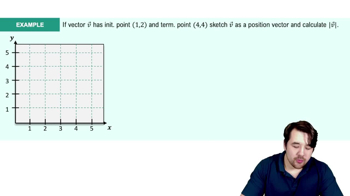
 02:26
02:26