Skip to main content
Precalculus
Il mio corso
Impara
Preparazione agli esami
AI Tutor
Guide di studio
Flashcard
Esplora
Prova l'app
Il mio corso
Impara
Preparazione agli esami
AI Tutor
Guide di studio
Flashcard
Esplora
Prova l'app
Indietro
Writing Parametric Equations quiz
Puoi toccare per girare la carta.
What is the first step in writing parametric equations from a rectangular equation?
Puoi toccare per girare la carta.
👆
What is the first step in writing parametric equations from a rectangular equation?
The first step is to choose an expression for the parameter t, often involving x or y.
Avanzamenti del tracciato
I pulsanti di controllo sono stati cambiati in modalità "navigazione".
1/15
Flashcard correlate
Pratica correlata
Video consigliati
Writing Parametric Equations definitions
Writing Parametric Equations
15 Termini
Writing Parametric Equations
16. Parametric Equations
3 Problemi
Argomento
Eliminate the Parameter
16. Parametric Equations
3 Problemi
Argomento
16. Parametric Equations
3 Argomenti
2 Problemi
Capitolo
08:02
Parameterizing Equations
374
views
8
rank
06:03
Equations of Circles & Ellipses
318
views
6
rank
04:26
Parameterizing Equations Example 1
289
views
5
rank
Termini in questo insieme (15)
Nascondere definizioni
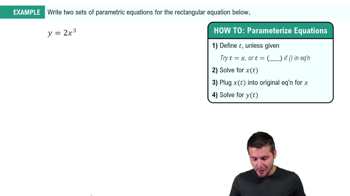
What is the first step in writing parametric equations from a rectangular equation?
The first step is to choose an expression for the parameter t, often involving x or y.
Why is it common to set t equal to x when parameterizing an equation?
Setting t equal to x is simple and avoids domain restrictions, making it a reliable choice for most problems.
After defining t, what is the next step in finding parametric equations?
Solve for x in terms of t to get x(t), then substitute this into the original equation to find y(t).
Why should you avoid choosing t as an even power of x, like x^2, when parameterizing?
Choosing t as an even power of x can restrict the domain and may lead to imaginary numbers if t is negative.
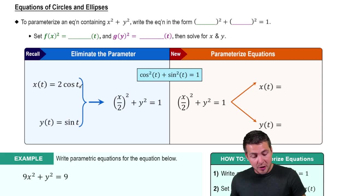
How do you parameterize equations involving x^2 + y^2?
Use the Pythagorean identity by setting x and y in terms of cosine and sine functions of t.
What should you do if the equation is not in the form f(x)^2 + g(y)^2 = 1?
Rewrite the equation, often by dividing both sides by a constant, to get it into the form f(x)^2 + g(y)^2 = 1.
How do you find x(t) for an equation like x^2/4 + y^2 = 1?
Set x/2 = cos(t), so x(t) = 2cos(t).
How do you find y(t) for an equation like x^2/4 + y^2 = 1?
Set y = sin(t), so y(t) = sin(t).
What is a good way to check if your parametric equations are correct?
Eliminate the parameter t from your parametric equations to see if you return to the original rectangular equation.
If t = x + 1, how do you express x in terms of t?
Solve for x to get x(t) = t - 1.
Given y = 2x + 5 and t = x + 1, what is y(t)?
Substitute x(t) into y to get y(t) = 2(t - 1) + 5 = 2t + 3.
For y = (x + 2)^2 - 3, what is a good choice for t?
Set t equal to the expression inside the parentheses, so t = x + 2.
Given t = x + 2, how do you write x(t) and y(t) for y = (x + 2)^2 - 3?
x(t) = t - 2 and y(t) = t^2 - 3.
How do you parameterize 9x^2 + y^2 = 9?
Rewrite as x^2 + (y^2)/9 = 1, then set x = cos(t) and y = 3sin(t).
Why is it important to avoid domain restrictions when choosing t?
Domain restrictions can limit the possible values of t and may result in undefined or imaginary values for x or y.
 IndietroIndietro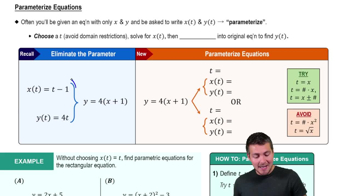
 08:02
08:02