Skip to main content
Precalculus
Il mio corso
Impara
Preparazione agli esami
AI Tutor
Guide di studio
Flashcard
Esplora
Prova l'app
Il mio corso
Impara
Preparazione agli esami
AI Tutor
Guide di studio
Flashcard
Esplora
Prova l'app
Indietro
Precalculus: Chapter 2 - Graphs
Puoi toccare per girare la carta.
What is the definition of a function in terms of graphs?
Puoi toccare per girare la carta.
👆
What is the definition of a function in terms of graphs?
A function is a relation where each input (x-value) has exactly one output (y-value) on the graph.
Avanzamenti del tracciato
I pulsanti di controllo sono stati cambiati in modalità "navigazione".
1/20
Video consigliati
02:16
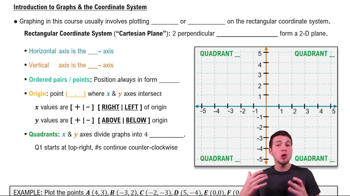
Graphs and Coordinates - Example
3366
views
298
rank
05:10
Graphs & the Rectangular Coordinate System
7128
views
256
rank
1
comments
Termini in questo insieme (20)
Nascondere definizioni
What is the definition of a function in terms of graphs?
A function is a relation where each input (x-value) has exactly one output (y-value) on the graph.
What does the vertical line test determine?
The vertical line test determines if a graph represents a function by checking if any vertical line intersects the graph more than once.
How do you find the x-intercept of a graph?
The x-intercept is found where the graph crosses the x-axis, so set y = 0 and solve for x.
How do you find the y-intercept of a graph?
The y-intercept is where the graph crosses the y-axis, so set x = 0 and solve for y.
What is the domain of a function?
The domain is the set of all possible input values (x-values) for which the function is defined.
What is the range of a function?
The range is the set of all possible output values (y-values) that the function can produce.
How is a function's graph affected by a vertical shift?
A vertical shift moves the graph up or down by adding or subtracting a constant to the function's output.
How is a function's graph affected by a horizontal shift?
A horizontal shift moves the graph left or right by adding or subtracting a constant inside the function's input.
What does it mean for a function to be increasing on an interval?
A function is increasing on an interval if the y-values rise as the x-values move from left to right.
What does it mean for a function to be decreasing on an interval?
A function is decreasing on an interval if the y-values fall as the x-values move from left to right.
What is an even function and how is it identified on a graph?
An even function satisfies f(-x) = f(x) and its graph is symmetric about the y-axis.
What is an odd function and how is it identified on a graph?
An odd function satisfies f(-x) = -f(x) and its graph is symmetric about the origin.
How do you reflect a graph across the x-axis?
Multiply the function by -1, changing f(x) to -f(x), which flips the graph over the x-axis.
How do you reflect a graph across the y-axis?
Replace x with -x in the function, changing f(x) to f(-x), which flips the graph over the y-axis.
What is the effect of vertical stretching on a graph?
Multiplying the function by a factor greater than 1 stretches the graph away from the x-axis vertically.
What is the effect of vertical compression on a graph?
Multiplying the function by a factor between 0 and 1 compresses the graph toward the x-axis vertically.
How do you determine if a function is one-to-one from its graph?
A function is one-to-one if every horizontal line intersects the graph at most once (horizontal line test).
What is the significance of the slope in a linear graph?
The slope represents the rate of change or steepness of the line, calculated as rise over run.
How do you write the equation of a line given its slope and y-intercept?
Use the slope-intercept form: \(y=mx+b\), where m is slope and b is y-intercept.
What is the standard form of a linear equation?
The standard form is \(Ax+By=C\), where A, B, and C are integers and A ≥ 0.
 IndietroIndietro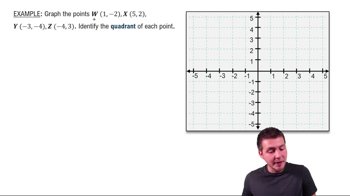
 02:16
02:16